After months of careful preparation, one Florida mother welcomed her first child through an unmedicated hospital birth that unfolded far more quickly than she ever expected. Supported by her husband, an experienced doula, and a medical team committed to honoring her birth preferences, she delivered a healthy baby boy at St. Vincent’s Riverside in what she describes as one of the most empowering days of her life.
Jen’s labor began quietly late one evening with what she initially assumed was a digestive issue. Around 10 p.m., she repeatedly felt the urge to use the bathroom, but nothing seemed unusual. When she tried to fall asleep an hour later using guided sleep meditations, the same sensation kept waking her. After more than an hour, she realized the discomfort was arriving in a regular pattern.
At 2 a.m., she began timing the waves and quickly recognized they were contractions. She woke her husband, Tom, and contacted their doula, Dallas, who had spent months helping the couple prepare through childbirth classes, prenatal visits, and countless conversations about labor.
Dallas arrived at their home around 3:15 a.m., where Jen worked through early labor using breathing techniques, a warm shower, and a Forward-Leaning Inversion exercise designed to encourage optimal fetal positioning. By 4 a.m., the contractions had strengthened enough that everyone agreed it was time to leave for the hospital.
The drive to St. Vincent’s Riverside was uncomfortable but manageable, and the family arrived shortly before 5 a.m.. The labor and delivery unit was quiet, allowing Jen, Tom, and Dallas to settle into triage without feeling rushed.
Then, exactly at 7:00 a.m., labor took a dramatic step forward.
While changing clothes in the triage bathroom, Jen’s water suddenly broke with a powerful gush.
“It felt exactly like a water balloon popping,” she later recalled.
Even then, she struggled to believe labor was progressing so quickly. In fact, she took a moment to text her coworkers that she would unexpectedly miss what had been scheduled as her final workday before maternity leave.
Once admitted to her labor room, Jen quickly found a rhythm.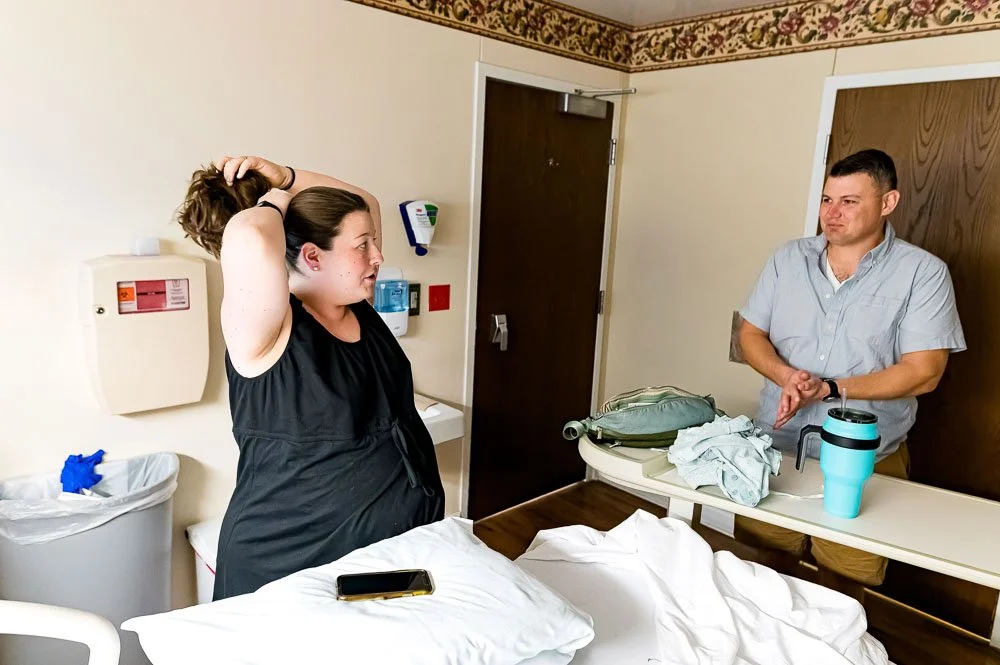
Because she had chosen intermittent fetal monitoring, she was able to spend long periods moving freely instead of remaining continuously attached to monitors. She alternated between standing, swaying, showering, deep squats, and resting while Tom provided strong hip squeezes, massage, and steady encouragement through every contraction.
The couple relied heavily on the comfort techniques they had practiced throughout pregnancy.
Heating pads, cold compresses, sacral pressure, a TENS unit, breathing exercises, and carefully timed position changes all became valuable tools as labor intensified.
Jen later said one of the greatest benefits of preparing beforehand was that she never had to think about what to try next.
Instead, she simply focused on breathing while Tom and Dallas quietly anticipated her needs—helping her stay hydrated, encouraging position changes, supporting her in the shower, and reminding her of the comfort measures they had already practiced together.
As labor progressed to around 7 centimeters, Jen began experiencing an overwhelming urge to push. Knowing that pushing too early could cause cervical swelling, her support team helped her find a side-lying position with a partially inflated support cushion placed between her legs. The position immediately reduced the urge, allowing her body to continue dilating naturally.
One personal decision also helped keep her mentally grounded throughout labor.
She intentionally refused to watch the clock.
Leaving her watch at home, Jen chose to experience labor one contraction at a time rather than measuring its progress by hours.
Eventually, the urge to push returned.
A cervical examination revealed she had reached 9.5 centimeters. A long shower followed by upright labor using a squat bar helped complete the final stage of dilation, and before long she was ready to begin pushing with Dr. Miller.
Determined to let her body guide the process, Jen tried multiple pushing positions, including using the squat bar, hands-and-knees, side-lying, and even a playful game of tug-of-war with one of the nurses to generate additional pushing power.
Despite the growing intensity, she never lost her sense of humor.
At one point during pushing, she unexpectedly passed gas directly toward her physician.
Rather than feeling embarrassed, she laughed afterward, joking that months of pregnancy-related constipation had finally begun resolving.
As her baby’s head crowned, she experienced the familiar “ring of fire” sensation before encountering the most difficult part of delivery—the shoulders. She later described it as feeling like she was trying to push out a bowling ball, admitting the intensity briefly made her hesitate before gentle reminders to breathe carried her through the final moments.
Just before the last push, Dr. Miller invited her to look down.
For the first time, she saw the top of her baby’s head.
Only moments later, at 6:38 p.m., their son entered the world.
Earlier in the evening, one of the nurses had confidently predicted the baby would arrive before 6:40 p.m.
She was correct.
The delivery became even more emotional when Tom was given the honor of announcing the baby’s sex himself.
“It’s a boy.”
Looking up, Jen saw tears streaming down her husband’s face as they welcomed their son, Theodore, into the world.
The moment felt strangely familiar.
During a growth ultrasound several weeks earlier, one of the images had looked remarkably like Tom as a baby. When Theodore arrived, the resemblance was unmistakable.
Placed immediately onto his mother’s chest, Theodore calmly explored his new surroundings while Jen studied every tiny feature she had spent months imagining.
Later, Dr. Miller carefully explained the placenta to the new parents, giving Tom an informative “placenta tour” before allowing the family uninterrupted time together.
Soon afterward, Theodore instinctively searched for the breast. Although learning to breastfeed required patience from both mother and baby, Jen found reassurance in watching her body naturally produce colostrum, marking another milestone in their first hours together.
The following morning brought another unforgettable memory.
Theodore’s proud older brother, David, arrived to meet him for the first time.
Watching David carefully cradle his newborn sibling while Tom leaned protectively nearby became one of Jen’s favorite moments of the entire experience.
Reflecting afterward, Jen says the birth unfolded even better than she had hoped.
Her doctor and nursing team respected every aspect of her birth plan, her husband provided unwavering support, and the months of preparation gave her the confidence to achieve the unmedicated birth she had envisioned.
For Jen and Tom, Theodore’s arrival represented far more than the birth of their son. It was the reward for months of learning, preparation, teamwork, and trust—a reminder that while no labor unfolds exactly as expected, compassionate support and careful planning can help transform even the most challenging moments into memories that last a lifetime.