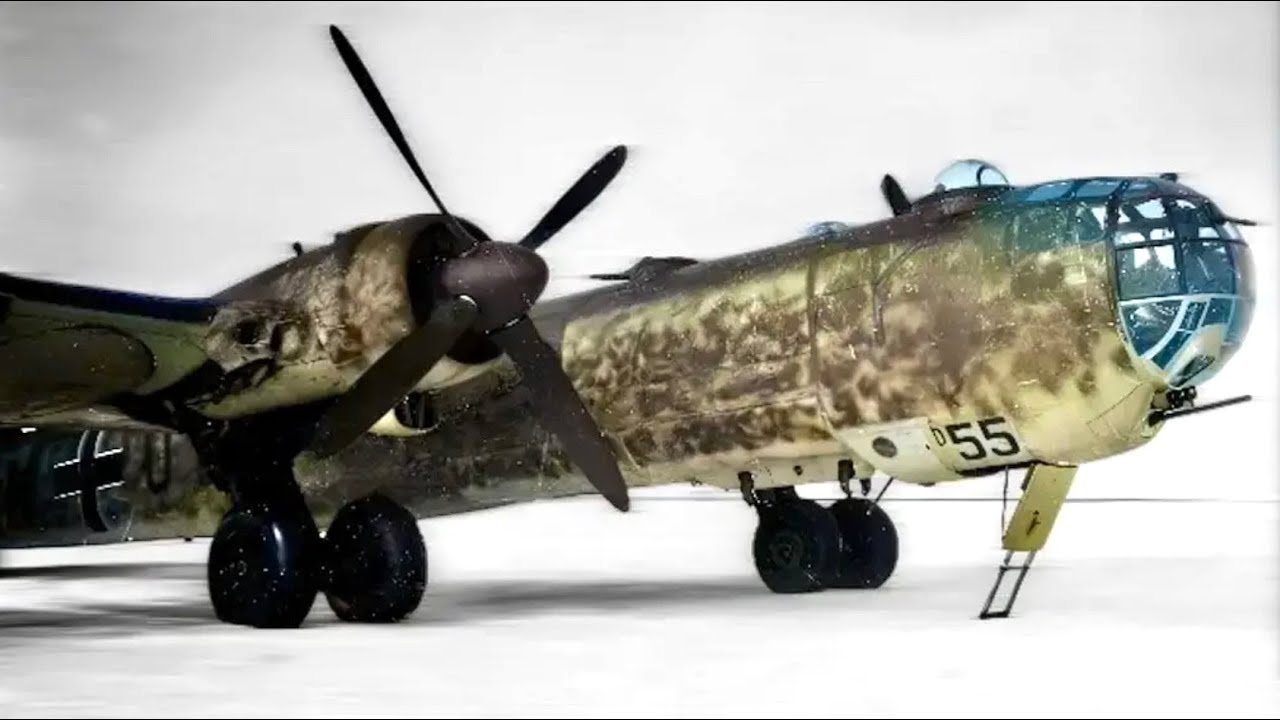
In a startling revelation, newly uncovered evidence exposes a daring and secret Luftwaffe plan to bomb Manhattan during World War II, utilizing the formidable Heinkel 177 bomber and an audacious refueling strategy via Greenland. This unprecedented scheme highlights Nazi Germany’s desperate push to directly strike the American homeland.
The Luftwaffe’s ambition to attack New York City has long been considered a fantasy due to Europe’s vast distance from the United States. However, research reveals a chilling plan involving the heavy Heinkel 177 bomber—Germany’s only true long-range heavy bomber—to make a one-way bombing mission across the Atlantic.
Originally designed for missions over England, the Heinkel 177 suffered from serious reliability issues, including dangerous engine fires. Despite its flaws, the modified A7 variant of the Heinkel 177 showed enough promise to be linked with this highly classified raid, capable of carrying increased fuel and a heavy bomb load.
The operation was to begin in northern Norway, possibly from Trondheim Air Base, with the bombers flying over the North Atlantic, along a grueling 3,590-mile course directly to Manhattan. The aircraft could carry enough fuel to make this journey, but not enough to return, making the mission a one-way suicide attack.
To overcome the range limitation, the Luftwaffe planned a daring mid-mission refuel stop in Greenland. German forces had already established covert weather stations across Greenland, a key strategic area during the war. The capability to land large aircraft on ice was proven in a secret 1944 operation, solidifying Greenland’s potential as a refueling base.
Greenland’s vast, rugged, and icy terrain had once been thought impenetrable, but German teams installed hidden weather outposts, crucial for transatlantic military and meteorological operations. One such station near Cap Sussi was even evacuated by a large German transport plane that landed on sea ice, proving feasibility for heavy aircraft landings.
The plan involved stockpiling fuel on Greenland’s sea ice runway to triple the Heinkel’s operational range. Fighters would refuel mid-flight, then push onward to drop bombs over New York City. After releasing their payloads, crews were expected to bail out near the coast, hoping U-boats would rescue them—though this rescue phase was fraught with deadly risk.
The U-boat rendezvous was the riskiest aspect. Allied patrols dominated the eastern seaboard, making any surface activity by German submarines perilous. Countless U-boats had already been sunk or compromised in these waters, casting doubt on the mission’s survival odds for its crews and submariners alike.
Despite the clear peril, the mission was reportedly treated as a last-ditch symbolic strike, designed to shock the United States with a direct Luftwaffe attack on its most iconic city. However, German high command eventually scrapped the plan, deeming it too costly in human lives and resources for minimal tactical gain.
Adding complexity to the story, post-war investigations dispelled rumors that these bombers carried atomic weapons. Germany’s atomic program never produced a bomb, and the modified Heinkel 177s were designed exclusively for conventional payloads, albeit with extended range and increased bomb capacity.
This revelation, brought forth by a 2005 confession from an ex-Luftwaffe pilot involved in training, finally sheds light on one of the war’s most audacious and overlooked German operations. Aviation historians confirm that the technical and logistical groundwork for such a mission was tragically plausible.
The strategic game of cat and mouse over Greenland’s ice—known as the “Weather War”—was critical not only for transatlantic meteorology but also as a military staging ground. The Allies relentlessly sought and destroyed German bases, yet some remote stations remained hidden deep in the Arctic wilderness.
This Arctic staging was pivotal. Without Greenland’s covert airstrip and fuel caches, the Heinkel 177’s transatlantic reach to Manhattan was impossible. The Germans displayed remarkable ingenuity, converting natural ice fields into makeshift runways and leveraging long-range aircraft to extend their warfront across continents.
While the Germans had various speculative plans to attack the US, ranging from ballistic missiles launched from submarines to specialized “mother” subs mining enemy harbors, the Heinkel 177 Greenland raid remained their most credible direct aerial threat against American soil.
Fortunately, none of these plans materialized before the war’s end. The collapse of Nazi Germany prevented the Luftwaffe from executing this operation—and spared New York City from a devastating symbolic airstrike that, while limited in damage, would have been a massive psychological blow.
This newly unveiled history demands a reassessment of WWII’s transatlantic air war. It emphasizes that even in their final desperate hours, Nazi strategists sought to project power across oceans, blending bold engineering feats and covert Arctic operations to reach an enemy thought untouchable.
The implications of this revelation stretch beyond military history. It speaks to the relentless human drive for technological innovation under wartime pressure—and the perilous balance between strategic ambition and operational reality, often risking human lives on missions born of desperation.
As the evidence becomes public, debate erupts among historians and aviation experts alike. Was this mission a foolhardy fantasy doomed from inception? Or a near-executed strike that could have redefined aerial warfare in the Atlantic theater? The intense scrutiny will continue for years.
Despite the mission’s risks and eventual abandonment, this chapter of WWII history stands as a chilling reminder that no city—not even the mighty Manhattan—was beyond the reach of war’s shadow, if only barely. The Luftwaffe’s Greenland refueling raid plan remains a stark testament to Nazi Germany’s desperate edge.
Today, artifacts like the captured modified Heinkel 177 at Czechoslovakian airbases fuel ongoing research into these secret operations, offering grim insights into the final desperate months of the Luftwaffe’s strategic planning and the extraordinary lengths taken to hit the American homeland.
This breath-taking story unfolds amid the cold stretches of Arctic ice, the roar of gargantuan bombers over the Atlantic, and the stealthy shadow of U-boats lurking beneath. It symbolizes a wartime gamble on speed, range, risk, and surprise that could have rewritten history’s course.
In the face of overwhelming Allied naval dominance and the technological constraints of the era, the Germans’ Greenland refueling gambit remains one of the most extraordinary aerial plots of World War II—marking a dark vision of a direct Luftwaffe air raid on Manhattan that nearly became reality.
As this revelation spreads, the world gains a clearer picture of the hidden battles waged over icy Arctic expanses, and the astonishing lengths to which wartime innovation pushed aircraft, crew, and commanders to strike a blow so many miles from home.
The Luftwaffe’s bold plan to bomb Manhattan via a Greenland refueling stop impresses upon us the complexity and desperation embedded in Nazi Germany’s final war strategies—plans forged in icy isolation yet aimed at the beating heart of America’s largest city.
With countless lives and potential devastation hanging in the balance, the unexecuted mission remains a powerful symbol of WWII’s most desperate and daring efforts, reflecting a dark chapter of aviation history that until now has been shrouded in secrecy.