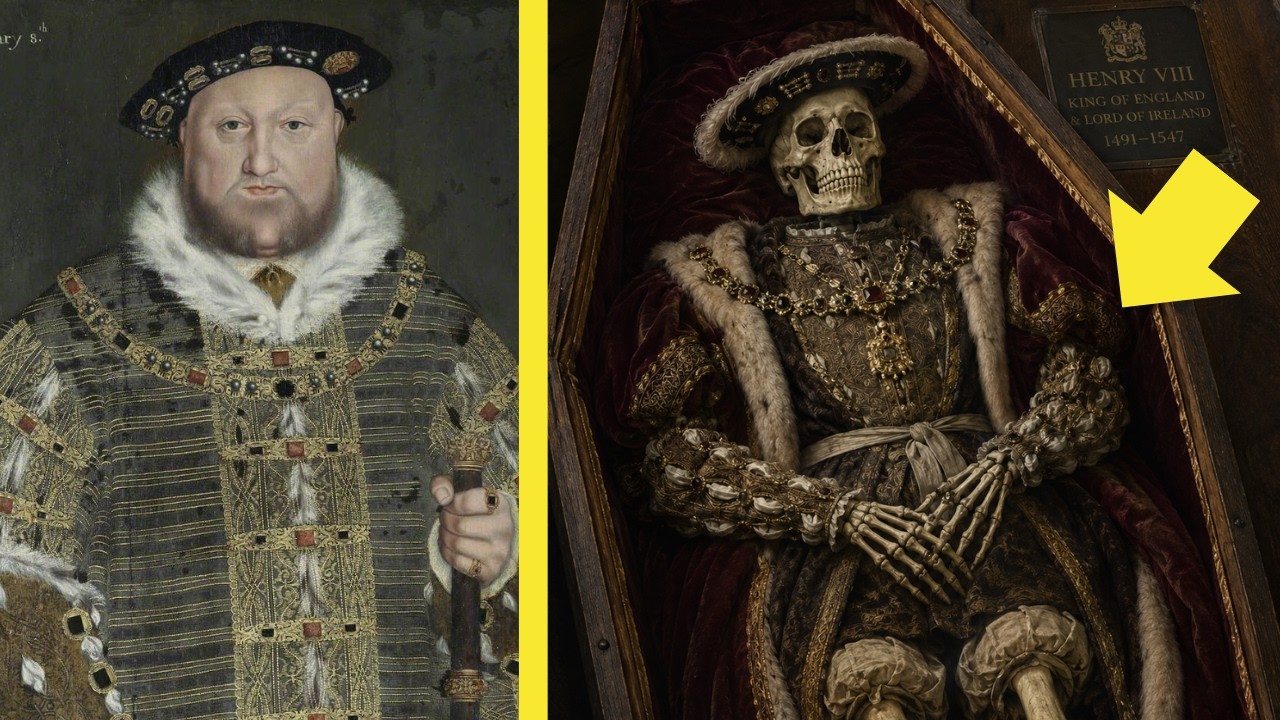
King Henry VIII, the formidable Tudor monarch known for reshaping England, was shockingly left to rest in an unfinished, modest vault beneath St. George’s Chapel, rather than the grandiose tomb he painstakingly planned. Financial strain, political turmoil, and untimely death halted his legacy’s physical monument, leaving one of history’s greatest kings buried in simplicity.
King Henry VIII’s reign transformed England—from breaking with the Roman Catholic Church to marrying six times and igniting religious reform and political upheaval. Despite his thirst for glory and extravagant displays, the final resting place he envisioned remains a haunting testament to shattered ambitions. His planned tomb, a vast masterpiece of Renaissance art, was never completed.
The king commissioned a monumental tomb at Windsor Castle, intended to surpass the grandeur of his parents’ resting place in Westminster Abbey. Elaborate bronze statues, ornate columns, and intricate religious carvings were designed to immortalize Henry’s reign. Marble and bronze were acquired, craftsmen laboring intensively—yet the tomb was not finished when Henry died in 1547.
As Henry’s health worsened, England was embroiled in costly wars against France and Scotland, draining the royal treasury. The financial crisis slowed construction to a crawl. Henry passed away at 55, leaving his extravagant monument incomplete. With no time to delay, he was interred beneath a plain stone slab in a vault beneath St. George’s Chapel—meant only as a temporary measure.
Following Henry VIII’s death, political instability gripped England. His nine-year-old son, Edward VI, ascended amid factions struggling for control. The government shifted priorities away from royal extravagance, redirecting funds to pressing religious reforms and maintaining governance. The incomplete tomb project was abandoned, destined to remain unfinished for decades.
The reign of Edward VI was brief; following his death, a succession crisis ensued, bringing Queen Mary I and then Queen Elizabeth I to power. Neither showed interest in finishing Henry’s tomb, burdened by their own political and religious challenges. Elizabeth’s legitimacy depended on her father’s controversial marriages, further complicating the issue.
As years passed, the grand monument faded from political and public memory. The lavish bronze commissioned for Henry’s tomb was repurposed, ironically forming part of King Charles I’s monument after the monarchy’s restoration. By the 17th century, Henry’s vision had become a relic of a bygone era, overshadowed by new historical priorities.
The phrase “left to rot” often arises when describing Henry’s burial, but it misleads. Henry VIII lies in one of England’s most prestigious royal chapels, a place of high honor. Nonetheless, his coffin remains in a modest vault beneath the chapel floor, never resting under the grand monument he deserved or designed.
A grisly and famous tale amplifies the 𝒹𝓇𝒶𝓂𝒶: during the funeral procession, Henry’s coffin reportedly burst due to decomposition gases. Liquids 𝓵𝓮𝓪𝓴𝓮𝓭, and stray dogs were said to have lapped them up. Though details are debated, the story reinforced the grim perception of the king’s fate, fulfilling a chilling posthumous prediction.
The vault was accidentally uncovered centuries later, in 1813, confirming the coffin’s damage and deterioration. Despite this, the vault remains unopened to modern archaeological teams. Henry’s burial site is now marked only by a simple black stone in the chapel floor, stark against the surrounding majestic monuments—a silent reminder of unfinished grandeur.
Henry’s legacy, however, remains immortal. History, literature, film, and scholarship continue to revisit his tumultuous reign, ensuring the king is far from forgotten. But the absence of a fitting physical memorial highlights a dramatic irony: the monarch who destroyed numerous religious shrines failed to secure his own monumental remembrance.
Today, visitors walk unknowingly over Henry’s humble gravesite. The intricate tomb he craved—a symbol of power, wealth, and legacy—was never realized due to practical constraints and a rapidly changing England. His resting place stands as a powerful symbol of mortality, political flux, and the limits of earthly grandeur.
In death, Henry VIII’s story became a stark lesson: no matter a king’s power and ambition, control over legacy and memorial is fragile. His simple vault beneath Windsor’s chapel floor contrasts sharply with the opulence and ferocity that marked his life, leaving a lasting, poignant historical paradox nearly five centuries on.
This dramatic episode reveals the intricate interplay of economics, politics, health, and history shaping royal memory. Henry VIII, who shaped England’s future forever, lies concealed beneath modest stone rather than towering art. His unfinished tomb remains a silent monument to the unpredictability of history and the human condition.