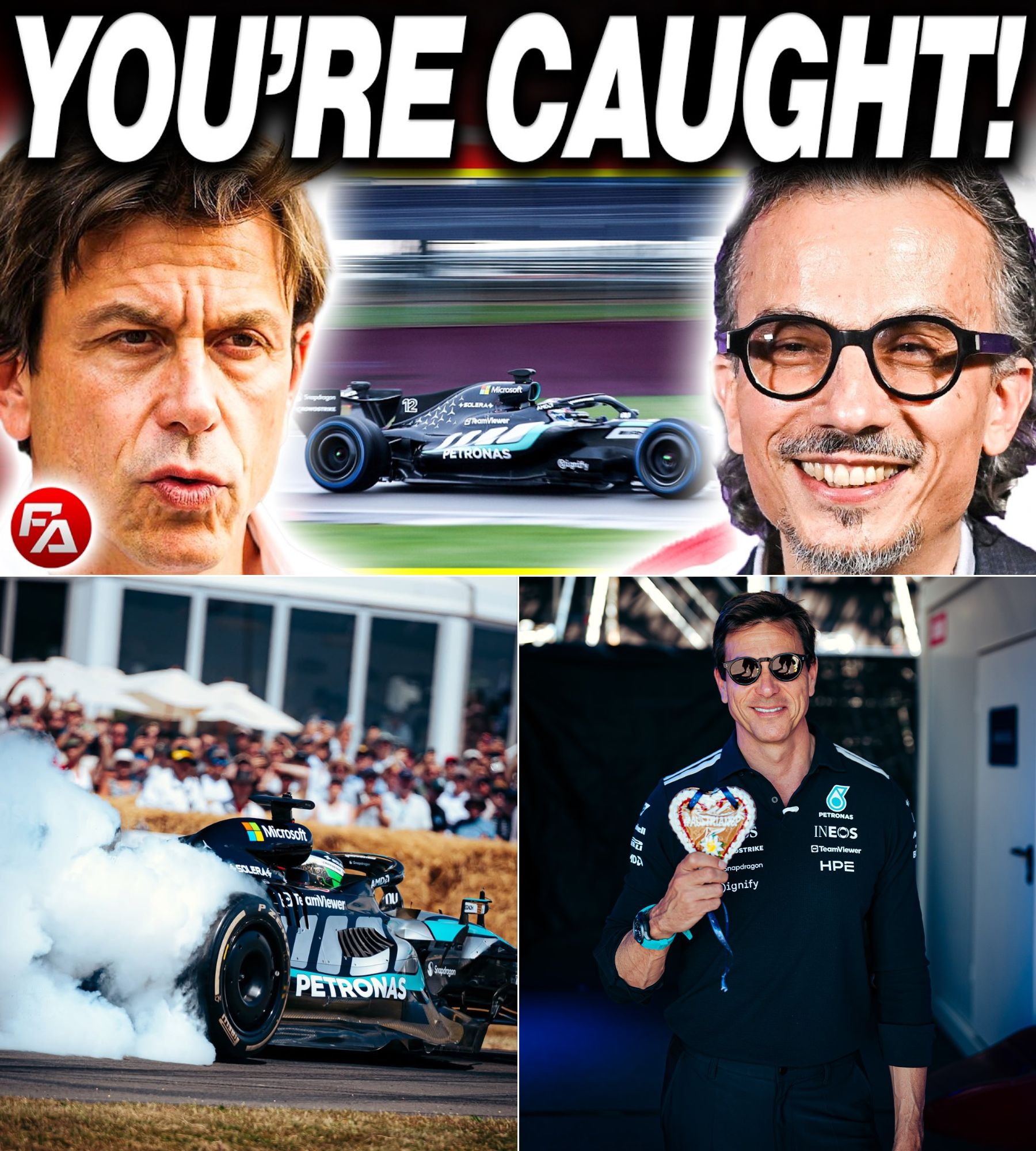
Formula 1 has always been a game of inches, but a recent revelation has sent shockwaves through the paddock. Teams have been caught trying to replicate a clever strategy employed by Mercedes, and it’s not what anyone expected. This time, it’s not about an innovative wing design or a radical floor change; it’s a subtle engine trick that has everyone talking.
 During the qualifying rounds at the British Grand Prix, drivers George Russell and Kimi Antonelli made a move that puzzled many. As they sped toward the finish line, both suddenly lifted off the throttle, seemingly sacrificing precious seconds. When Antonelli missed the sprint pole by a mere 0.011 seconds to Ferrari’s Lewis Hamilton, it appeared that lift had cost him the top position. But the reality was far more intriguing.
Mercedes had discovered a method to slow down in order to actually go faster. After analyzing the telemetry from the session, rival teams realized that Mercedes had ingeniously unlocked additional performance while adhering to the rules. The FIA confirmed the legality of this technique, prompting a wave of curiosity among the other teams in the paddock. If Mercedes could gain speed this way, surely everyone else would want to follow suit.
However, there’s a significant catch. While the idea sounds straightforward, executing this trick is far more complex than it seems. A single mistake could lead to disqualification from qualifying altogether. To grasp why this is such a pivotal moment, we need to delve into the intricacies of Formula 1’s energy regulations for this season.
Under the current rules, drivers cannot simply unleash their battery power at will. They must adhere to a ramp-down rate, meaning that as the battery depletes, power must gradually decrease. At circuits like Silverstone, this means drivers can only lose 50 kW of power every second as they approach the finish line. This regulation is in place to prevent sudden slowdowns that could endanger other drivers.

Typically, a driver would use the full 350 kW of power exiting the final corner, only to see that power taper off as they near the finish line. But Mercedes found a workaround. By momentarily lifting off the throttle, their drivers could maintain maximum power for longer before the system initiated its gradual reduction. The result? A minuscule but crucial gain of around 0.5 seconds—an eternity in the high-stakes world of Formula 1.
This isn’t the first time Mercedes has pushed the boundaries of the rules. Earlier in the season, they, along with Red Bull, had found a legal loophole to bypass the ramp-down rule by shutting down the MGU-K under specific emergency conditions at the end of qualifying laps. However, after some teams drove unusually slowly during practice in Japan, the FIA stepped in to clarify that such shutdowns could only occur in genuine emergencies.
Yet, rather than surrendering, Mercedes engineers continued to innovate. They uncovered another legal avenue: if the driver completely lifted off the throttle, different rules applied. While the concept might seem simple on paper, executing it on the track requires remarkable precision. What appeared to be a routine lift became one of the most significant technical revelations of the season, leaving rival teams questioning how they had overlooked it.

Now that the secret is out, the competition is heating up. With races like the Hungaroring on the horizon, where every millisecond counts, teams are racing to replicate this system. However, understanding the trick is one thing; mastering it is an entirely different challenge. Mercedes has proven that speed can be found within the regulations, but executing it flawlessly lap after lap is where the real test lies.
The stakes are high. A miscalculated lift could turn a stellar qualifying lap into a nightmare, with teams facing the possibility of starting from the back of the grid. This high-risk strategy is not something drivers can simply pick up in one practice session. It demands extensive preparation, impeccable timing, and unwavering trust between the driver and their engineers.
In preparation for the British Grand Prix, Russell and Antonelli spent countless hours in the simulator, honing this technique until it became second nature. The key was to lift off the throttle before the battery reached zero percent—if the battery drained completely while the driver was still pushing full throttle, the MGU-K would shut down abruptly, leading to a breach of technical regulations.

As teams across the paddock scramble to decode Mercedes’ strategy, the pressure mounts. Engineers are reportedly analyzing the same telemetry data, devising their own systems, and considering various methods to signal their drivers when to lift. Whether through audible cues or visual alerts, the race is on to see who can adapt this high-risk tactic first.
In this new era of Formula 1, success hinges not just on speed but on a deep understanding of the rule book and the courage to push boundaries without crossing them. Mercedes has illustrated this perfectly, showcasing that sometimes the most significant breakthroughs lie hidden within the fine print of regulations.
As teams vie to master this innovative approach, one question looms large: who will rise to the challenge and perfect this daring strategy, and who will falter under the pressure? The 𝒹𝓇𝒶𝓂𝒶 is just beginning.