“Place your dog tags on the table, Van, and then get out of my hangar. ”
Colonel Harris didn’t look up. His voice was flat, dry—the bureaucratic cold you only found in the air-conditioned offices of Ramstein Air Base. His fingers tapped the keyboard indifferently, the screen washing his face in pale blue light.
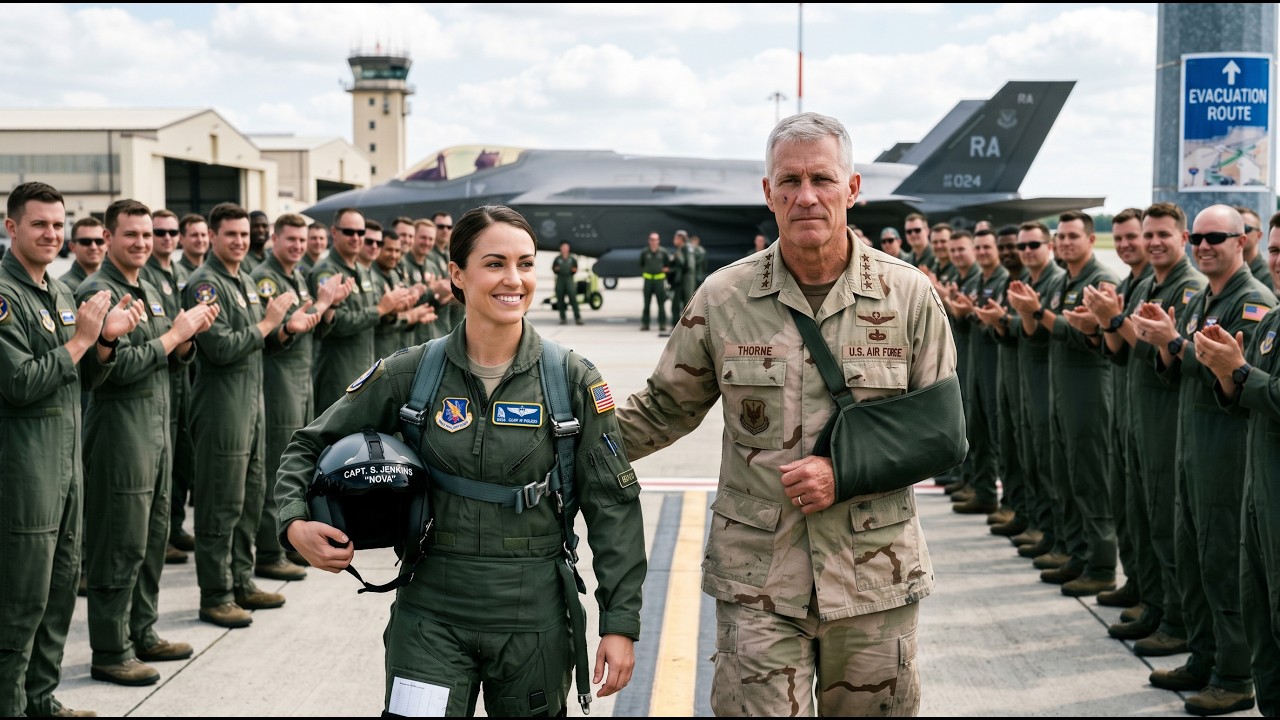
Captain Avery Van didn’t move. Her right hand gripped her flight helmet. The visor was scratched—marked by the canyon gravel she’d skimmed over while pulling Delta Force operators out of a kill box. She’d saved their lives by threading her F-35 through an uncharted gorge, bypassing the air defense network.
She’d also disobeyed a direct order. “Do you have a hearing problem, Captain? ” Harris finally looked up. His eyes were narrow, his features sour.
“You’re grounded indefinitely. The Pentagon wants flawless discipline. No cowboys playing hero. Your airframe is reassigned.
You’re moving to logistics. Paperwork. ”
A murmur passed through the room. Behind Harris stood Major Miller and a few other officers.
None of them met Avery’s eyes. Some stared at the floor. Others barely hid their smiles. To them, a woman in the cockpit of the world’s most advanced fighter was only a political concession.
Now the experiment was over. Avery didn’t look at the men. She fixed Harris, unclasped the chain from her neck, and placed the metal tags on the polished desk without a sound. “The files will be kept properly, sir,” she said quietly.
No tremor. No tears. Nothing but absolute, almost eerie calm. Three weeks later.
Hangar 7 was a giant tomb of concrete and steel. The smell of burnt kerosene and hot hydraulic oil hung heavy. Avery sat at a small metal table in the corner, lit by a bare bulb. Hundreds of maintenance logs stacked in front of her.
Outside, Miller’s engines roared as he took off for the daily routine patrol over Sector 1. A safe flight. A coward’s flight. “You shouldn’t be down here,” said Chief Mechanic Richter.
The old German’s face was lined from decades of working on fighters. He was the only one on base who didn’t treat her like a leper. He knew her file from her test-pilot days at Jagel, before she was transferred to Ramstein. “The papers need checking, Richter,” Avery replied without looking up.
“You’re not a typist, girl,” he growled, tucking a cigarette behind his ear. “You’re the best thing this damn Air Force has put in a cockpit in years. Those out there—they fly by the book. When the engine catches fire, they die by the book.
You don’t. ”
Avery paused. Her fingers traced the serial number on a paper—her old airframe. The engine data showed minute deviations in the high-pressure compressor, details no computer flagged as faults, but which she had felt in the control stick.
Suddenly the dull rumble of engines outside died. Not fading—abruptly cut off. Seconds later the main siren tore the hangar’s silence into shreds. Not the wave tone of a drill.
The continuous high-pitched tone of highest alert. Red strobes cut through the darkness. “Ground-to-air contact in Sector 4,” the mechanical voice blared. “All squadron leaders to battle stations immediately.
”
Richter looked at the ceiling. “That’s no routine crap. ”
Avery was already standing. She didn’t wait for permission.
As the maintenance crew ran onto the tarmac, she moved quickly toward the command bunker. Chaos in the corridor. Officers ran with folders. Screens flickered red.
When she reached the door to the briefing room, Major Miller blocked her way. His face was sweaty, flight suit half-open. “What do you want, Van? ” he barked.
“This is a combat briefing for active pilots. Go back to your forms. You’re in the way. ”
Avery looked at him.
She didn’t raise her voice. “Who got shot down out there? ”
Miller’s eyes widened. But before he could answer, the heavy steel door swung open.
Colonel Harris stepped out—face drained of color, lips blue, eyes fixed in shock. In his hand he held a crumpled satellite print. He didn’t look at Miller. His gaze searched the corridor until it landed on Avery.
“Van,” he said, voice hoarse. “Come in now. ”
She walked past Miller. Her step was precise.
Inside, everyone stared at the central hologram. Deep in a valley in the rugged eastern sector, a wreck symbol glowed. “Twenty minutes ago,” Harris began, his voice breaking, “the reconnaissance aircraft of General Joseph Van—commander of NATO air forces and deputy defense secretary—was shot down by a mobile S-400 battery. He survived.
He’s trapped. Enemy ground forces are advancing. ”
Avery stared at the hologram. General Joseph Van—her father.
No one in this room knew the connection. She’d sealed her maiden name in the records to avoid any hint of nepotism. Harris looked around at the top pilots. “The computer simulation says any rescue by air is impossible.
The radar coverage is absolute. Anyone who flies in dies in the first three minutes. ” He swallowed hard, then turned slowly to Avery. He placed the file he’d closed three weeks ago on the table.
“Van, you said that day that the computer doesn’t understand the airflow in the mountains. ” Harris looked at her, and for the first time there was no contempt in that man’s eyes—only raw, pathetic fear. “Tell me that wasn’t a lie. ”
The briefing room was so quiet you could hear the fans humming under the hologram table.
None of the pilots dared to breathe. All eyes on Avery. She stepped to the table. She didn’t look at Harris.
She didn’t look at Miller, who stood arms crossed in the second row, face tight. Her focus was entirely on the three-dimensional contours of Sector 4. The red rings of enemy radar overlapped like dragon scales—a deadly wall of electronics and steel. “The S-400 uses a 92N6E radar,” Avery said.
Her voice was cutting, emotionless. “If you take the standard approach route over the north ridge, the system will detect an F-35 at exactly 42 kilometers because of the larger radar cross-section from above. That’s the distance Miller and his people would die at. ”
“And how do you figure this, Van?
” Miller shot back, his voice trembling with wounded pride. “Are you going to smile the missiles away? The ridge offers no cover for a jet at Mach 1. The computer calculated every vector.
There’s no ingress angle. ”
Avery looked at him—a brief, almost pitying glance. “The computer calculates with static meteorological data, Major. ” She tapped the screen and zoomed in on a thin, almost invisible gap in the eastern mountain range.
“The Devil’s Eye. The canyon is 14 meters wide at its narrowest. An F-35 has a wingspan of just under 11 meters. The computer blocks this corridor in autopilot because the downwind from the Alps—the Föhn—blasts through there at over 60 knots.
”
“That’s not a flight corridor—that’s a meat grinder,” Miller shouted, turning to Harris. “Sir, she’s insane. At that speed you lose lift from the turbulence. The aircraft will be smashed against the rock wall before the radar even turns on.
”
Avery ignored him. She fixed Harris, who had pressed his hands onto the table edge so hard his knuckles were white. “The airflow is cyclical,” she explained calmly. “Every four minutes, the air wave breaks against the rock wall and creates a vacuum in the valley for exactly 45 seconds.
If you manually throttle the engine, bank the jet on its side, use terrain masking, you stay under the radar horizon. The radar sees only mountain, not the aircraft—a blind spot. But you have to fly without fly-by-wire, completely mechanical. ”
“No one flies an F-35 without computer assistance in low-level canyon flight,” whispered one of the older captains.
“That’s physical suicide. ”
Harris stared at the map. Time was running out. On the live feed, enemy armored transports were approaching the burning wreck.
The generals had barricaded themselves in a ruin, but their ammunition wouldn’t last thirty more minutes. “Three weeks ago you called me a threat to the statistics, Colonel,” Avery’s voice broke the silence. She stood directly in front of Harris. “Now you have a choice.
Either you leave two of NATO’s highest commanders to the enemy to keep your stat clean, or you give me back my airplane. ”
Harris swallowed. He knew that if this mission failed, his career was finished. Court-martial.
But if he did nothing and the generals died, he was finished too. He saw the determination in Avery’s eyes—a coldness that made him shiver. “Colonel, you can’t allow this,” Miller protested, stepping forward. “She’s suspended.
”
“Silence Miller! ” Harris shouted, his voice cracking. He took a deep breath, reached into his pocket, and pulled out a titanium key card—the clearance for the sealed weapons system in Hangar 7. He slid it across the table.
“You fly, Van,” Harris said, voice tight. “But I’m telling you—if you put that plane into the mountain, I’ll make sure your name goes down as sabotage. You fly at your own risk. ”
Avery took the card.
No thanks. No salute. She turned and walked out. When she reached the hangar 7 airlock, Chief Richter was already at the fueling console.
The gray tarp had been ripped off the F-35. Three mechanics were removing engine covers. Richter watched her pull on the G-suit. In his eyes there was no doubt—only the deep, serious respect of a man who remembered war from the old days.
He handed her a flight helmet. It wasn’t the standard one Harris had confiscated. It was her old helmet—the one with the faded insignia of the experimental squadron from Jagel. On the side, painted in white: “Ghost of the Ridge.
”
Avery ran her fingers over the lettering. She put the helmet on, closed the visor. As she climbed the ladder, Richter stepped to the side of the aircraft. He knocked twice against the radar-absorbent skin, looked up, and spoke through his headset.
“Show those desk-jockeys why they called you the Ghost of the Ridge, Avery. ”
Behind her in the hangar, Miller and the other pilots stood frozen. They’d heard Richter’s words. “Ghost of the Ridge” was a legend in the air force—the anonymous test pilot who had survived the extreme low-level flight through the Norwegian fjords.
Avery started the engines. The dull, monstrous roar of the F-35 came to life. The canopy lowered with a whine. She didn’t look back.
She rolled onto the runway, into the gray sky over Germany, straight into the hell of Sector 4. The cockpit was tight, cold, smelling of pure oxygen. At 800 km/h, the outside world became a blur of gray rock and thick clouds. Avery kept a firm but relaxed grip on the stick.
Green data flickered on the heads-up display. She had crossed the enemy airspace boundary two minutes ago. “Ghost Seven, Overwatch. ” Harris’s voice came through the radio, trembling.
“Enemy radar just changed frequency. They’re looking for you. The search beams are brushing the mountain peak right above your position. Climb, Van, you’re too low.
”
“Negative, Overwatch,” Avery replied calmly. She breathed evenly against the mask. “If I climb, the S-400 radar will lock me in three milliseconds. I’m staying low.
”
“You’re flying below the treeline, dammit! ” Harris shouted. “Sensors report ground proximity. The autopilot is about to initiate a climb.
”
“Not if I turn it off. ”
With a quick left-hand motion, Avery flipped three switches on the side panel. The primary flight control system let out a shrill warning beep. On the main screen, a message flashed red: Manual Override—Fly-By-Wire Restricted.
In that instant, the aircraft lost its artificial stability. Without computer assistance, the F-35 was aerodynamically unstable as a flying brick. Every tiny air movement transmitted directly to Avery’s hand. The jet began shaking violently as it hit the first gusts of the Föhn wind.
Ahead, the massive black wall of the Devil’s Eye loomed. The canyon looked like a wound in the earth. “Avery, don’t,” whispered a voice on a private channel—Jessica. “The wind is turning in the valley.
You have no control surface margin. ”
Avery didn’t answer. She focused on the timer in the display. Three.
Two. One. The vacuum. The air wave broke against the rock wall.
She yanked the stick left. The F-35 banked with brutal force—almost 90 degrees, wings vertical to the ground as the aircraft shot into the narrow canyon at near-supersonic speed. The G-force hit Avery like a sledgehammer. Nine times Earth’s gravity.
Her body suddenly weighed nearly 800 kilograms. Blood was forced from her brain into her legs. Her vision narrowed in seconds, colors fading to dull gray—the dreaded gray-out. If she lost consciousness now, it was over.
Press, breathe, press. She tensed every muscle in her legs and abdomen, forcing blood back into her head through pure will. Her eyes fixed forward. The gray rock walls on both sides were so close that the airflow from her engines tore small stones off the cliffs.
Her left wing passed a protruding rock nose with less than three meters clearance. A single millimeter deviation on the stick and the aircraft would explode. “Warning! Obstacle!
Warning! ” the emergency system screamed. Avery ignored the cockpit alarms. Her eyes scanned the displays.
Suddenly a yellow dot flickered on the tactical screen—a mobile radar truck had picked up a brief, unclear signal. A Doppler echo. They knew something was there. “Surface-to-air missile launched,” Harris’s voice cut through the radio.
“They didn’t lock you, but they’re firing blind into the canyon. SA-15 Tor. Coming straight at you. ”
Avery saw the white smoke trail of the missile dropping over the cliff into the canyon.
The missile was heat-seeking. In this narrow gorge there was no room to evade. She couldn’t drop countermeasures—the flares would bounce off the walls and only guide the missile faster to her. She had exactly four seconds.
Instead of pulling up, she pushed the nose down. Even lower into the shadow of the canyon, straight toward a dry riverbed. She twisted the aircraft into a brutal, unnatural turn—the Doppler notch. She positioned the jet exactly perpendicular to the enemy radar beam.
To the enemy’s radar system, the F-35 became one with the mountain’s movement. She disappeared from their screens. The missile lost lock. It shot inches over the canopy, close enough that Avery heard the solid-fuel motor hiss, and detonated three hundred meters behind against a rock wall.
The shockwave hit the jet’s tail. The aircraft was thrown forward uncontrollably, nose dropping toward a massive rock wall at the end of the canyon. In Ramstein, everyone held their breath. On the main screen, Ghost Seven’s signal had vanished.
Miller let his arms fall. A triumphant, vicious smile crept onto his face. “That’s it,” Miller muttered loud enough for the whole room. “She’s scrap.
”
In the command center, total silence. The red icon of Ghost Seven was frozen. No telemetry, no radio. “Van, report!
” Harris shouted into his mic. “Avery, answer! ”
Miller stepped back, adjusting his flight suit. “Predictable, sir.
Physics doesn’t yield to arrogance. She just flew the Air Force’s most expensive plane into a wall. ”
Suddenly the screen flickered. A green dot shot out from the end of the canyon—out of nowhere.
The signal returned—faster, lower, more aggressive than before. “Overwatch, this is Ghost Seven. ” Avery’s voice crackled through the speakers. She was breathing heavily, but her voice was ice cold.
“I’m in the target area. Beginning cleanup. ”
Miller froze mid-motion. His mouth hung open.
Harris collapsed into his chair, staring at the speed indicator in disbelief. Avery had slammed the nose up in the last fraction of a second, lit the afterburners, and burst vertically out of the Devil’s Eye. She hadn’t come from the front where the air defense expected her—she came from behind, right out of the enemy positions’ blind spot. On her display, the target glowed: the main radar of the S-400 battery, positioned on a plateau, flanked by two mobile launchers.
The enemy crews had their searchlights and missile tubes pointed rigidly north. They didn’t notice the F-35 until the thunder of its engine shattered the windows of their control containers. Avery didn’t wait for the computer’s lock tone. She aimed manually.
Her fingers lay on the red trigger. “Two JDMs away,” she said quietly. The precision-guided bombs dropped from the internal bay. They didn’t fall—they shot down like arrows.
Seconds later, the enemy main radar turned into a giant fireball of burning magnesium and fuel. The shockwave ripped surrounding antenna masts like matchsticks. “Direct hit,” the operator in Ramstein called out. Scattered cheers broke out, but Harris silenced them with a gesture.
“Van, the radar is down,” he shouted, “but enemy infantry has surrounded the generals’ ruin. Delta Force rescue helicopters need a clear landing zone. You have less than two minutes before enemy reinforcements arrive. ”
Avery banked the aircraft into a tight turn and dove again.
Through her helmet visor, linked to the jet’s external cameras, she saw the ruin on the hill. Three enemy armored transports had formed a wedge formation in front of the entrance. Heavy machine guns hammered continuously against the walls where her father and the minister were trapped. She switched to the rotary cannon—25mm uranium ammunition.
“Ghost Seven going in for attack,” she reported. She flew so low that the dust thrown up by her passage obscured her view. She corrected course by feel alone. The first tank appeared in the reticle.
Fire. The dull, sawing roar of the cannon tore the air. A chain of shells struck the unarmored top of the first vehicle. The tank exploded instantly, turret blown away.
Avery pulled the stick slightly right, corrected the drift, and fired a second burst. The second and third tanks were literally torn to pieces by the heavy shells. Surviving enemy soldiers fled in panic into the surrounding woods. “Landing zone is clear,” Avery said coolly.
“Delta One, you are free for extraction. ”
Two heavy MH-60 Blackhawk helicopters swept over the treetops and settled in the dust on the plateau. Elite soldiers stormed out, secured the ruin, and extracted the two injured generals. “Overwatch, Delta One,” came the ground commander’s voice.
“We have the packages. Both generals alive. We’re lifting off. Thanks for the air support, Ghost Seven.
That was damn good work. ”
Avery exhaled. She felt the adrenaline slowly fade. She pulled the aircraft up to 20,000 feet to head home.
Then a red light flared on her screen—close. A shrill, continuous warning tone blasted through her headset. Enemy radar lock from behind. “Van, break!
” the operator screamed. “Two enemy SU-35s broke through the cloud cover. They’re right behind you and you have no missiles left. ”
Avery looked at the weapons display.
JDMs gone. Cannon had exactly 15 rounds left. She was defenseless. The two enemy interceptors were closing at double the speed of sound.
The cockpit filled with the panicked, rhythmic scream of the radar warning system. Lock. Lock. Lock.
Two SU-35 Flanker Es attached to her tail. At this altitude without air-to-air missiles, the F-35 was a target. In Ramstein, pure horror. Miller stared at the screen, a cruel tremor in his voice.
“She can’t shake them. The SU-35 is three times more maneuverable in a turning fight. She’s dead. ”
Harris gripped the handset so hard the plastic cracked.
“Van, engage afterburner. Flee west. ”
“Too late for that, Overwatch. ” Avery’s voice was eerily calm, almost a whisper.
“The enemy missiles are faster than my afterburner. ”
Behind her, two white dots separated from the SU-35s’ wings. R-77 medium-range radar-guided missiles—relentless, deadly. Avery didn’t look back.
She looked down. The burning wrecks of the S-400 site she’d destroyed minutes earlier were spewing thick black smoke. The smoke was heavily ionized, saturated with burning electronics and fuel—a curtain of heat and metal particles. “Richter,” she said on a direct channel to the hangar.
“Remember the maneuver in the fjords? ”
On the other end, the old German held his breath. His eyes widened. “Avery, that will rip the wings off.
”
“Not today. ”
Avery pushed the F-35’s nose straight down. She dove vertically, freefalling into the burning smoke cloud of the enemy position. The two enemy missiles followed like bloodhounds.
In the last fraction of a second, just before hitting the ground, Avery yanked the stick back with both hands and stomped the left rudder pedal. She used the extreme instability of the aircraft without computer assistance. The F-35 executed a brutal, physically near-impossible move—the Cobra maneuver. The nose shot straight up while the aircraft, its flat underside creating enormous drag, decelerated from 1,000 to 200 km/h in less than a second.
The two enemy missiles, locked on a constant trajectory, shot past the stationary F-35 by inches. They lost lock in the thick ionized smoke and slammed directly into the wreckage of their own position. But that was only half the equation. The lead SU-35, chasing at supersonic speed, had no time to react.
The enemy pilot saw the wall of metal appearing in front of him far too late. With a deafening crack, the SU-35 flashed past Avery, hit the turbulence from her engine exhaust, and crashed uncontrollably into the opposite slope of the mountain. A massive explosion lit the valley. The second enemy pilot, shocked by his wingman’s destruction, yanked his aircraft into a panicked climb and turned away.
He didn’t dare attack again. Avery leveled the F-35, stabilized the flight. Her fuel was in the red. Her muscles trembled with exhaustion.
“Overwatch,” she reported, voice flat but steady. “Airspace is clear. I’m coming home. ”
Two hours later.
Ramstein Air Base. The evening sky was deep blue when Ghost Seven’s wheels touched down with a loud screech. The aircraft rolled slowly toward Hangar 7’s apron. The entire squadron stood there—hundreds of soldiers, mechanics, and officers lined up.
No one spoke. Absolute silence. As the canopy whined open, Colonel Harris was first to the ladder. Behind him stood the two rescued generals.
One of them, General Joseph Van, had his arm in a sling, but his gaze on Avery was full of pride. Avery took off her helmet. Her hair was plastered with sweat, her face pale, but her eyes were unbroken. She climbed down and stood before Harris.
Harris looked at her. The man who had called her a threat three weeks ago was trembling. Slowly he raised his hand in a salute. Perfect.
“Captain Van,” Harris said, his voice carrying across the tarmac. “I… I misjudged your abilities. What you did today will go down in the history of this base. ”
Avery looked past him.
Her eyes found Major Miller, standing in the background. Miller couldn’t meet her gaze. He stared at the ground, his face red with shame, while the other pilots slowly moved away from him. He was the one who had said she was dead.
Now he was the man who would never speak another word about her. Avery turned back to Harris. She reached into her pocket and pulled out the titanium key card. She didn’t hand it to him.
She let it fall to the ground—right where he had demanded her dog tags three weeks ago. “Keep the card, Colonel,” Avery said quietly, but with a sharpness that hit every man on the apron. “I don’t need a desk’s clearance to fly. I fly because I know how to survive.
”
She walked past him. No one stopped her. The crowd parted before her like the sea. General Van watched his daughter go, a thin smile on his lips, as he said to Harris, “Make sure her flight book is back at the top tomorrow, Harris.
And pray we never need anyone like her again. ”
Avery walked on into the darkness of the hangar. She knew the bureaucrats would write new reports tomorrow. She knew the rules would remain.
But she also knew something else. In the sky, there were no paragraphs. Up there, only skill counted—and the spirit of those who dared to rewrite the limits.