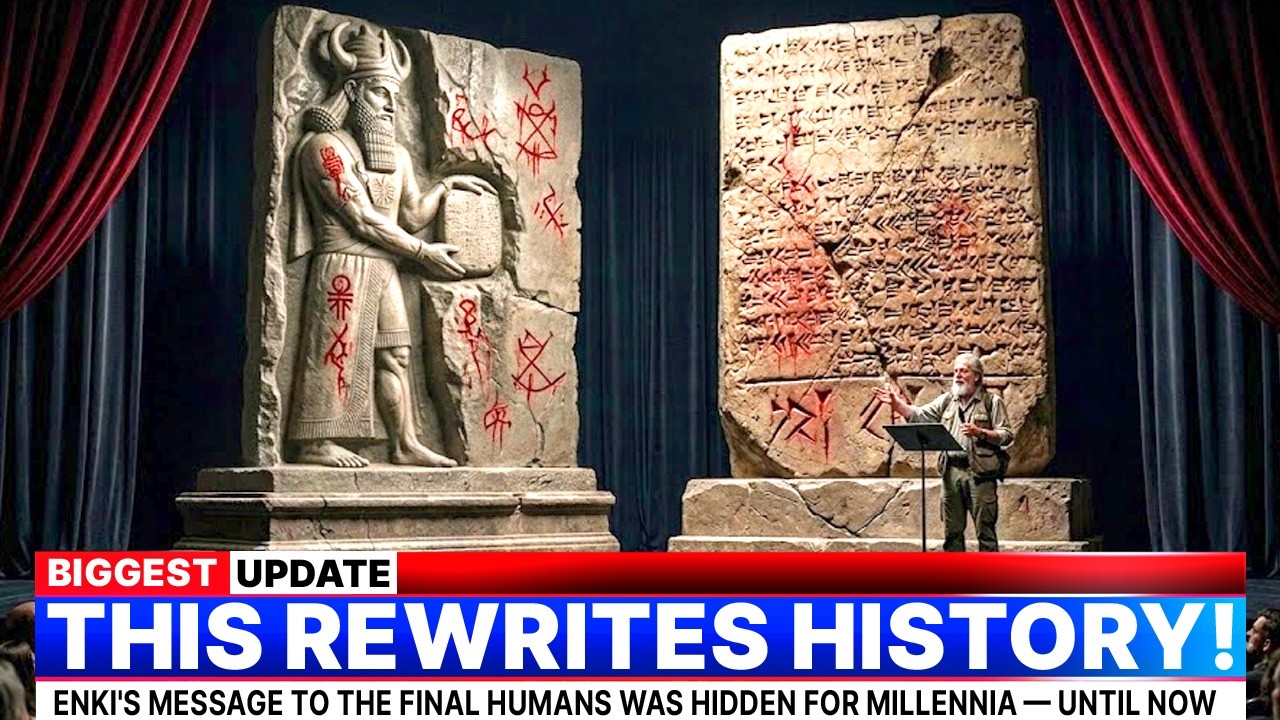
An extraordinary ancient message hidden for millennia has been uncovered, revealing the final warning from the Sumerian god Enki to humanity before a cataclysmic flood erased civilization. This rediscovered legacy, encoded on 4,000-year-old clay tablets, uncovers lost wisdom and a divine loophole that saved mankind from extinction.
The story begins with Utnapishtim, the flood survivor whose tale mirrors the biblical Noah but is rooted in the far older Sumerian epic. Enki, god of wisdom and cunning, covertly warned him of the impending annihilation decreed by the divine council of gods known as the Anunnaki. Their plan was to erase humans because their noise had become unbearable.
Humanity’s origin, as described in ancient texts, was far from benevolent. Enki engineered mankind from clay infused with the blood and spirit of a slain god, creating a laborer designed to bear drudgery in place of divine workers who had rebelled. Yet, this creation multiplied beyond control, provoking Enlil, the god of authority, to decree their destruction.
Enlil’s wrath unfolded through incremental disasters—plagues, droughts, famine—each attempt to reduce humanity’s numbers without success. When all else failed, the gods agreed on a final solution: a worldwide flood to obliterate mankind completely. An unbreakable oath was sworn, ensuring no god would warn humans of the catastrophe.
Defying the sacred vow, Enki devised a brilliant loophole. Unable to directly alert humans, he spoke through the “reed wall” of Utnapishtim’s house, uttering secret instructions for building a massive boat designed to survive the flood. The man overheard, acted on the hidden message, and constructed a vessel that saved life’s seeds and his family.
This ancient narrative survived buried under millennia of soil, language extinction, and the fall of mighty empires. Written in cuneiform on fragile clay tablets, Enki’s message lay inaccessible and unreadable for nearly two thousand years. Its resurrection began in the 19th century with the excavation of the Assyrian palace library at Nineveh.
The pivotal breakthrough came from George Smith, a self-taught scholar who deciphered a shattered tablet telling of the flood, the ark, and the release of birds signaling land. His discovery predates the biblical account by over a millennium, radically reshaping humanity’s understanding of its own origins and divine interference.
These tablets revealed not only the flood story but also Enki’s complex personality as a god who consistently sided with humanity, sharing knowledge and warnings in defiance of a controlling council. He gifted civilization with the “me,” codes of law, crafts, music, and truths both noble and harsh—the complete blueprint of society.
Enki’s legacy, examined through myths of wisdom-bringers like Adapa, shows a persistent theme: knowledge and survival come not from divine rescue, but from humans hearing truth, making choices, and acting with agency. He never promised salvation but offered clarity and the unvarnished knowledge vital for freedom.
This profound message challenges modern seekers to discern truth from false prophets. Enki’s warnings demand honesty, accessibility, and verifiable reality—rejecting secret bloodlines, doomsday profiteering, and vague prophecies. The real “chosen” are simply those who listen through the wall and choose to build their own ark against coming storms.
The question now posed to humanity is urgent: in today’s world, what is your boat? What preparations will you make if you understand the final season is upon us? This ancient wisdom calls for action—not passive belief—resonating with the timeless human struggle to awaken, to survive, and to thrive beyond catastrophe.
As the silence of lost languages is broken, Enki’s voice returns with a singular, timeless exhortation: see the world clearly and resist the noise of distraction and deception. This rediscovered message is not myth but a survival manual encoded in clay, urging an ancient vigilance with undeniable modern relevance.
The legacy of the reed wall warning, the flood, and the divine survival strategy stretches beyond myth into the core of human identity. It reveals the origin of civilization’s foundations and raises a stark reminder: sometimes, survival depends on hearing what others refuse to disclose and daring to act before it’s too late.
Now fully readable and more urgent than ever, Enki’s message challenges contemporary humanity to confront its fate with wisdom inherited from those silent clay tablets. Buried truth has resurfaced, shaking ancient dust from forgotten warnings that have outlasted empires, languages, and time itself.
This revelation transforms ancient myth into an active call for awareness, responsibility, and preparedness. It exposes the power struggles hidden within divine mythologies and replaces them with a mandate for insight and choice. Enki’s final message refuses to be silenced again.
The emergence of this profound narrative into public knowledge disrupts accepted histories and urges a deep reevaluation of what ancient texts truly teach about human survival, divine justice, and the wrath—and mercy—of gods who walk among us in legend.
Historians, archaeologists, theologians, and truth seekers now have at their fingertips an unparalleled glimpse into the dawn of civilization and its catastrophic resets. Enki’s message is a rare window into the oldest recorded human crisis, one echoing through millennia to warn today’s world.
With this message, the old gods’ voices converge into one unmistakable truth: awareness and action are humanity’s tools to navigate existential threats. Enki, the master of wisdom, points to a future shaped not by fate, but by those brave enough to “build the boat” and heed the warning whispered through time.
The story of Enki remains unfinished, a living dialogue between past and present, inviting each generation to reclaim lost knowledge and resist the inevitability of destruction through foresight and courage. This newly unlocked ancient wisdom marks a pivotal moment in the shared human saga.
As the dust settles on millennia of silence, this reemergence compels global reflection on history and destiny. The final message from Enki is no mere myth but a foundational text urging that the survival of humanity rests on the clarity of vision and readiness to face what comes next.
The rediscovered Enki message resounds across time, confronting modern humanity with its deepest fears and highest hopes. It reveals the ancient blueprint for survival carved in clay—and asks the crucial question: when the flood returns, will you be ready, and what will your ark be?
This is more than history; it’s a revelation reborn, a divine warning etched in stone and clay that defies erasure. The voice of Enki demands to be heard in our tumultuous age, urging all who listen to awaken, prepare, and choose life in the face of inevitable transformation.