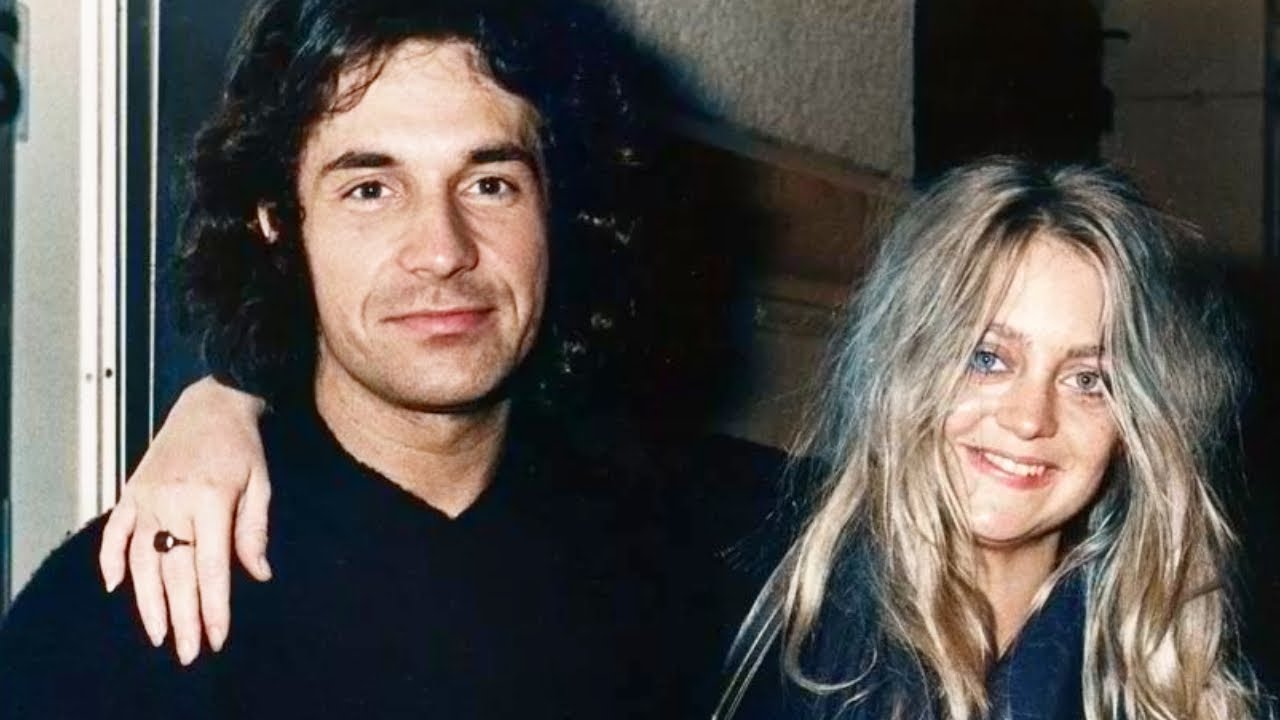
The decision that unraveled one of Hollywood’s most talked-about marriages came down to a single, startling request: an open marriage. According to musician Bill Hudson, Goldie Hawn’s suggestion that they explore non-monogamy was the moment their union began to crumble. Hudson, who married Hawn in 1976, has now revealed in interviews that her proposal for an open relationship was not a mutual exploration, but a unilateral demand that left him feeling betrayed and inadequate.
Hawn, then at the peak of her stardom following her Oscar win for “Cactus Flower,” had already experienced one marriage ending under the weight of her fame. Her first husband, Gus Trikonis, struggled as her career skyrocketed. But with Hudson, the dynamic shifted even more dramatically.
 Hudson recalls that right after their wedding ceremony, Hawn whispered a chilling question: “Are you sure we did the right thing?” That doubt, he says, never faded.
The musician, who was part of the Hudson Brothers pop group, described his initial joy at marrying America’s sweetheart. But the fairy tale quickly soured. Hudson alleges that Hawn suggested an open marriage, which he reluctantly tried to accept.
However, he soon realized that the arrangement was one-sided. “She was the only one enjoying that freedom,” Hudson has said, accusing Hawn of infidelity and a shallow commitment to their vows.
Hudson has painted a picture of a marriage where Hawn’s need for liberation—both romantic and professional—clashed with his desire for a traditional family. He claimed that Hawn’s own father once warned him, saying she needed a different man for each of her moods. “I was consumed with love,” Hudson recalled, “but she had a series of devastating character flaws.”
The cracks in their foundation became canyons.
The couple had two children—Oliver and Kate Hudson—who would later become stars in their own right. But Hudson’s role as a father was increasingly sidelined. After their divorce in 1982, Hawn found lasting love with Kurt Russell, and the blended family became Hollywood’s gold standard.
Hudson, meanwhile, became a ghost, absent from family photos and red carpets. Decades later, his children publicly called him out, with Oliver posting “Happy abandonment day” on Father’s Day 2015.
 Hudson’s version of the split offers a stark counterpoint to Hawn’s own narrative. She has rarely spoken in detail about their marriage but has implied that her success was too heavy a cross for her husbands to bear. In one interview, she reportedly said that the men she loved could not cope with having a wife who was more successful than they were.
The open marriage request, however, takes the blame in a more specific direction.
Sources close to Hawn have not confirmed or denied the open marriage claim, but her later public statements about fidelity align with a more unconventional view of relationships. In 2005, she appeared on “The View” and defended men who cheat, calling it “biologically correct.” She said she never asked longtime partner Kurt Russell about infidelity because “it keeps me happy.”
That free-spirited philosophy, while working for her now, was devastating to Hudson.
Hudson’s memoirs and interviews paint a man deeply wounded by the dissolution of his family. He has accused Hawn of willfully alienating him from their children, alleging she poisoned them against him. The public feud simmered for years, with Hudson firing back at his children’s social media posts.
In 2018, Oliver revealed that he and Bill had begun speaking again, a glimmer of reconciliation after decades of estrangement.
 The question remains: Was Hawn’s suggestion of an open marriage the true reason for the divorce, or was it the final straw in a relationship already strained by fame’s glare? Hudson’s accounts suggest it was the catalyst. “She wanted to be free,” he has said.
“I wanted a wife and a family. Those two things could not coexist.” For Hawn, love was never meant to be owned, only felt.
For Hudson, that truth felt more like loss than liberation.
Goldie Hawn’s career continued to soar after the divorce. She produced and starred in hits like “The First Wives Club,” directed television films, and remained a beloved figure. Her relationship with Kurt Russell, now spanning over four decades, is a testament to a different kind of partnership—one that never required a marriage certificate.
Hawn has said, “Marriage was never the goal. Marriage didn’t work for either one of us.”
Bill Hudson, meanwhile, has lived in the shadow of that failed union. He remarried actress Cindy Williams and had two more children, but that marriage also ended in divorce. He later fathered another daughter with a girlfriend.
 His memoir, “Two Versions: The Other Side of Fame and Family,” was his attempt to reclaim his narrative. Critics called it defensive, but for Hudson, it was a way to speak when no one had been listening.
The Hudson-Hawn divorce remains a cautionary tale about the perils of mismatched expectations in Hollywood. When one partner’s star is rising and the other’s is flickering, even the most sincere love can buckle. Hudson’s revelation that an open marriage was the breaking point adds a new layer to a story that has fascinated fans for decades.
It underscores the tension between traditional commitment and the allure of personal freedom.
As of today, Goldie Hawn continues to defy convention. At 79, she made headlines at the 2025 Academy Awards when she admitted on live television she couldn’t see the teleprompter due to cataracts. Her vulnerability, as always, was wrapped in humor.
But her ex-husband’s account reminds us that behind every Hollywood smile, there are often painful, unspoken truths. The open marriage request was, for Bill Hudson, the moment the dream died.