2 September 2026
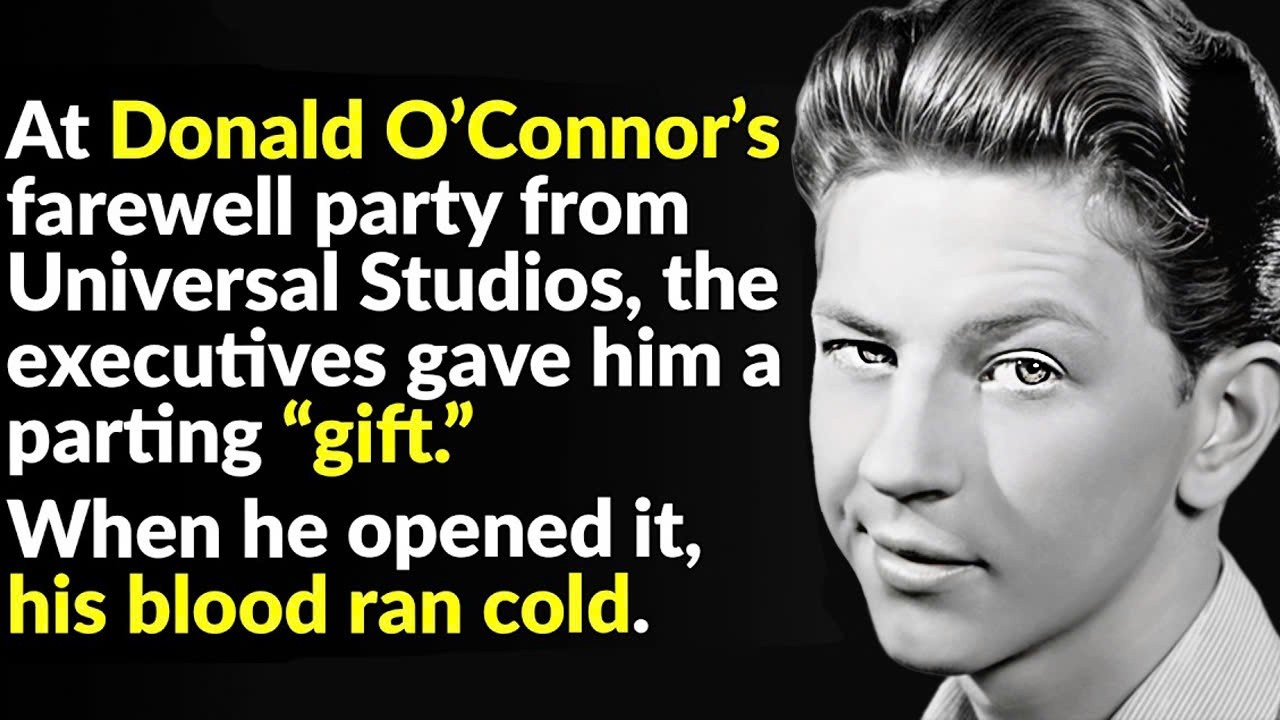
The bright, acrobatic joy of Donald O’Connor’s “Make ‘Em Laugh” number in Singin’ in the Rain remains one of cinema’s most electrifying moments, a testament to physical comedy that seems to defy gravity and exhaustion. Yet the man who hurled himself against walls and flipped backward with a grin was masking a reality so brutal that it included a childhood marked by death, a Hollywood system that nearly broke him, and a private battle with alcoholism that left him temporarily paralyzed. The public saw a bouncing ball of energy; the private man was a survivor of a tragedy that began before he could even walk, a story that reveals the staggering cost of the smile that defined an era. The foundation of O’Connor’s life was laid in chaos and loss, a fact that seems almost incomprehensible given the polished perfection of his later work. His parents were itinerant vaudeville performers, a horse rider and an acrobat whose constant movement was so frenetic that neither could later recall the exact date or location of their son’s birth. This nomadic existence meant that the stage was not a career choice but a survival instinct, with Donald joining the family act at the astonishing age of just thirteen months. The glitter of the footlights, however, could not shield him from a series of devastating blows that would shape his psyche forever, beginning with a horrific accident that stole his sister’s life when he was only two years old. The tragedy of that moment was compounded by its immediate aftermath, creating a vortex of grief that the young boy could never fully escape. While crossing a street with his seven-year-old sister Arlene, Donald was struck by a car alongside her; he survived, but his sister succumbed to her injuries, a loss that shattered the family. The heartbreak was not isolated, as just a few weeks later, his father collapsed and died of a fatal heart attack while performing on stage, leaving the family without its patriarch. To add an almost unbearable layer of sorrow, three of Donald’s other siblings had already died in infancy, meaning that within a short, brutal window, the family had been decimated by death, leaving his mother in a state of profound and protective grief. That grief manifested in a suffocating overprotectiveness that would define Donald’s childhood and fuel his drive to perform. His mother, terrified of losing another child, refused to allow him to cross a street alone until he was thirteen years old, a constant reminder of the accident that had taken his sister. She also attempted to shield him from the most dangerous aspects of their vaudeville act, even as performing remained their only source of income, creating a paradox where he was both protected and pushed onto the stage. This environment forged a resilience in him, but it also instilled a deep-seated understanding that joy and tragedy were inextricably linked, a theme that would play out across his entire life and career. When Donald O’Connor arrived in Hollywood in the 1940s, signed by Universal Studios, he appeared to be an overnight sensation, a charming and energetic presence in a series of low-budget musicals. Audiences were captivated by his effortless charisma, but the reality behind the scenes was one of immense pressure and a desperate struggle for competence. Having taught himself to dance in the vaudeville style, which focused on movement from the waist down, he was suddenly faced with the upright, controlled technique demanded by Hollywood musicals. Studio executives expected him to master complex choreography almost instantly, forcing him to work twice as hard as his professionally trained peers just to keep his footing in a highly competitive environment. The pressure of this professional adaptation was immense, but it was soon overshadowed by the larger context of a world at war, which forced him into a life-altering decision. In 1944, at the age of eighteen, O’Connor was drafted into the US Army, and although he was assigned to the Special Services Entertainment Division rather than combat, the uncertainty of the future was overwhelming. Facing the possibility of being sent overseas, he made a rushed and impulsive decision, marrying a young woman named Gwen Carter in a quick ceremony in Tijuana. What seemed like a romantic gesture at the time would later be revealed as one of the most catastrophic errors of his personal life, setting the stage for a painful divorce and a bitter custody battle. While he was serving, Universal Studios, unwilling to lose a promising star, filmed a backlog of projects to release during his absence, a strategy that kept his name in the public eye. However, upon his return, the studio seemed unsure of how to reposition him, leading to an unusual and unexpected career pivot with the 1950 film Francis. In this surprise hit, O’Connor played a soldier who converses with a talking mule, a role that spawned a series of sequels and brought him commercial success, but which also sowed the seeds of a new kind of frustration. He would later joke that the mule received more fan mail than he did, but the experience was more than just an ego blow; it was during the filming of a sequel in 1953 that he contracted a rare infection, typically transmitted by animals, which he suspected came from his equine co-star. That illness had a direct and significant impact on his career trajectory, forcing him to miss out on a major opportunity that could have changed his legacy. Paramount Studios had wanted him to star alongside Bing Crosby in White Christmas, but O’Connor was too sick to take the role, a loss that must have been galling. Yet, fate had another plan in store, as it was around this time that Gene Kelly approached him with the offer to play Cosmo Brown in a new musical, Singin’ in the Rain. He accepted, and while the film would become a masterpiece, the experience of making it was a grueling ordeal that pushed him to his absolute physical and mental limits, a crucible that would leave him hospitalized. The filming of the iconic “Make ‘Em Laugh” number stands as a monument to his dedication and a stark illustration of the physical abuse he endured for his art. Gene Kelly, known for his demanding perfectionism, asked O’Connor to revive the dangerous vaudeville stunt of running up a wall and flipping backward, and to perform it twice for the scene’s finale. The entire sequence was shot in a single, brutal day on a hard concrete floor, involving constant dancing, leaping through props, and a series of punishing falls. By the end of the shoot, O’Connor’s body was completely shattered, and he collapsed into bed for three days, with some accounts reporting he spent nearly a week in the hospital recovering from the shock. The physical toll was devastating, but the psychological blow that followed was perhaps even crueler, as he was forced to relive the ordeal due to a technical error. When he returned to the studio, he was greeted with applause from the cast and crew, a moment of validation that was quickly shattered when Gene Kelly asked him if he could perform the number again. Kelly explained that a mistake with the camera’s aperture had ruined the footage, effectively fogging out the entire exhausting performance. With no room in the production schedule for delay, O’Connor was given just one day to recover before he had to perform the entire, punishing routine all over again, a feat of endurance that seems almost superhuman. Adding to the disappointment of that grueling experience was the quiet removal of another opportunity to shine alongside his co-stars. The famous “Singin’ in the Rain” number had originally been planned as a trio performance featuring Gene Kelly, Debbie Reynolds, and Donald O’Connor. However, at the last minute, Kelly decided the scene would be more powerful as a solo, a change that created one of the most iconic moments in film history but also denied O’Connor a place in it. While his career was reaching its peak with the release of the film, his personal life was disintegrating, and in 1954, he and Gwen Carter filed for divorce, a split that would have profound and damaging consequences. The divorce proceedings were acrimonious and devastating for O’Connor, revealing a side of his private life that was far from the cheerful image he projected on screen. Reports suggested that Carter’s jealousy over his success had turned their marriage toxic, with arguments sometimes escalating into violence. The legal battle ended with Carter being awarded full custody of their daughter, Donna, as well as the family home, leaving O’Connor crushed and alone.…