A 19-year-old sailor crouched in a 36-foot wooden rocket boat 300 yards off Omaha Beach on June 6, 1944, firing machine guns at German positions while the world’s largest amphibious invasion unfolded around him. That sailor was Lawrence “Yogi” Berra, years before he became a baseball icon. For nearly six decades, he kept the horrors of D-Day locked inside.
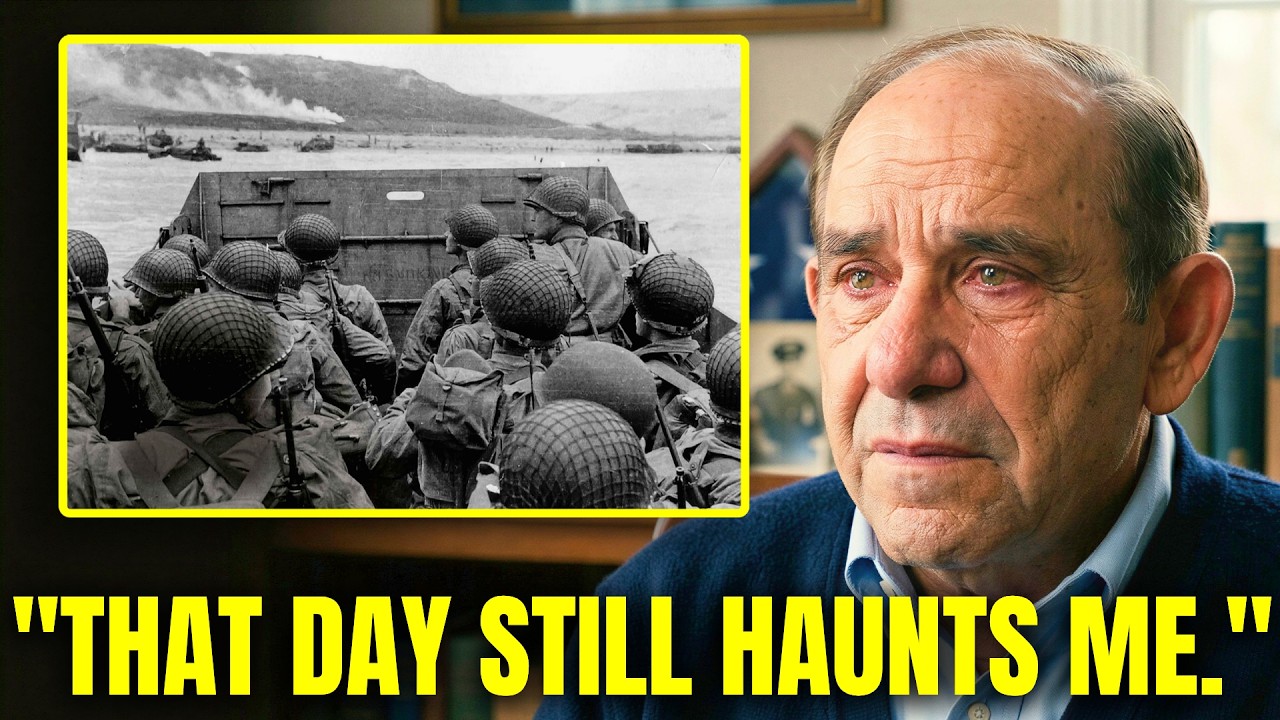
Yogi Berra, the beloved Hall of Fame catcher known for his tangled “Yogi-isms,” rarely spoke about what he witnessed during those first terrible days on that beach. He was simply Seaman Second Class Lawrence Berra, a teenager from the Italian neighborhood called The Hill in St. Louis.
The nickname that would make him famous came from a friend who thought the way he sat cross-legged reminded him of a snake charmer in a movie.
Long before anyone knew his name, Berra was growing up in a tightly packed, proudly Italian section of St. Louis.
A neighborhood of immigrant families who worked hard, went to church together, and spent evenings on front porches talking in a mix of English and Italian dialects. His childhood friend Joe Garagiola, who also became a major league player and beloved broadcaster, played pickup baseball with him in sand lots.
Baseball came naturally to Berra.
At 17, the New York Yankees signed him to a minor league contract in Norfolk, Virginia, near a large Navy shipyard. That detail would later feel like foreshadowing when war came. Though he stood only 5’8″—short for a catcher—he hit with remarkable power.
In one memorable minor league doubleheader, he drove in 23 runs, making scouts pay attention.
Then the war consumed the country. Like future Hall of Famers Ted Williams and Bob Feller, Berra set aside his baseball career to enlist in the United States Navy the moment he turned 18 in 1943.
For young men of his generation, it was simply the obvious and expected next step. Something you did because your country needed you and because everyone else your age was doing the same.
What happened after that enlistment is the part of Yogi Berra’s biography that most casual baseball fans never learn.
He didn’t end up in the infantry. Instead, he volunteered for a specialized Navy program that placed him on one of the tiniest, most 𝓮𝔁𝓹𝓸𝓼𝓮𝓭 vessels in the entire Allied invasion fleet. He served as a gunner’s mate on what the Navy called an LCS(S)—Landing Craft Support, Small—but sailors informally called the “landing craft Suicide Squad.”
Berra later recalled that the Navy asked for volunteers willing to serve on something called a rocket boat. He admitted he did not even know what a rocket boat was at the time. That single choice, made almost blindly by an unsuspecting teenager, placed him directly at the center of one of the most consequential days in modern military history.
Before reaching Normandy, Berra passed through a long chain of training bases. He trained at Bainbridge, Maryland, then at Little Creek, Virginia, learning the specific skills required for amphibious warfare—split-second timing, close coordination, and staying calm while operating tiny vessels dangerously close to enemy shorelines. By March 1944, he boarded LST-508 and traveled as part of a large convoy heading toward Glasgow, Scotland.
Once in Scotland, more weeks of intense amphibious assault training followed. Just before the invasion, Berra received his official assignment aboard the USS Bayfield, an attack transport serving as a command vessel for the Normandy landings. But he was never going to stay safely on the Bayfield.
 He was assigned to one of the rocket boats that would head straight toward the beach itself.
These rocket boats measured only 36 feet in length, built with a wooden hull reinforced with steel plating. But that protection was never designed to withstand heavy artillery fire.
The entire purpose of these small boats depended on getting dangerously close to the shoreline—far closer than larger warships—so their rockets could strike German machine gun nests with precision before Allied infantry waded ashore.
On the early morning of June 6, 1944, the largest seaborne invasion force in history moved across the English Channel. Somewhere within that armada, a 36-foot rocket boat carried a 19-year-old former baseball prospect from St.
Louis who only months earlier hadn’t known what a rocket boat was. His assignment required his boat to close to roughly 300 yards from Normandy’s shore—closer than three football fields.
Berra initially thought the spectacle of hundreds of planes roaring overhead looked like an enormous fireworks display.
Until an officer nearby sharply told him to keep his head down inside the boat if he wanted to keep it attached to his body. His crew operated in coordination with a lead boat that would fire a signal rocket toward the beach, marking the target for everyone else.
Berra’s boat took on enemy fire throughout the operation but was never directly struck.
He later received several official commendations for bravery. The boat survived the entire ordeal intact. Six young men crammed into a small wooden shell, absorbing the full chaos of the largest amphibious military assault in recorded history, came through that morning without suffering a single casualty aboard their own vessel.
But surviving the day without a scratch did not mean the mission was easy. Rocket boats operated at the very outer edge of the invasion, positioned closer to German guns than almost any other Allied vessel. During one intense barrage, Berra was grazed by a bullet from a German machine gun before quickly returning to his position at his twin .
50 caliber guns.
The strange contrasts of war showed themselves almost immediately after troops made it ashore. Berra recalled that only about 30 minutes after German gunners had been actively shooting at his crew, French civilians on shore were already coming out to welcome the arriving American sailors with gifts and songs.
He later summed up that bizarre emotional whiplash by calling it “a wacky war.”
Berra’s role did not end with the initial landing. He helped relay important messages back and forth between Omaha Beach and Utah Beach.
For a teenager who only months earlier had not known what a rocket boat was supposed to be, June 6, 1944, became one of the single most consequential days any future American professional athlete would ever experience in combat.
Here is where the story shifts from action to memory, and from memory to something heavier. Because the truth, according to Berra’s own later recollections, is that the actual morning of the invasion was never the part that haunted him most.
 On one of the rare occasions he discussed his D-Day experience in any real detail, he explained that the first day did not haunt him nearly as much as the second and third days that followed.
Why? Because of what slowly began rising to the surface of the water.
By the second and third days following the invasion, the bodies of soldiers killed during the fighting had begun floating up to the surface. Berra’s own son later explained that his father’s boat remained positioned just off the coast during those days, and part of their grim, largely unspoken duty became pulling those floating bodies out of the water.
Berra visibly grew emotional whenever this particular part of his experience came up in conversation, touching on it briefly before quickly pulling back and never fully explaining in detail what he had witnessed.
This detail matters enormously for understanding Yogi Berra the actual person rather than just the beloved baseball icon.
For sailors who remained positioned offshore during the days that followed the initial landing, the true weight of the war revealed itself in a much quieter and far more disturbing way—appearing slowly in the water, one body at a time, with no dramatic music or narration to soften the experience.
Berra’s combat experience did not end at Normandy.
Weeks later, during a separate landing near Marseilles in southern France in late August 1944, a German machine gun nest opened fire. Berra was shot in the left hand. He was formally nominated to receive a Purple Heart, but he never actually received it because he chose not to complete the required paperwork.
His reasoning had nothing to do with modesty about his bravery. It was to protect his mother, Paulina—he did not want her to receive a telegram informing her that her son had been wounded in combat overseas. A teenager freshly shot during active combat deliberately chose quiet silence over official recognition, purely out of concern for one worried mother sitting thousands of miles away back home in St.
Louis.
For nearly six decades after the war ended, Yogi Berra said almost nothing publicly about his experience on D-Day. He became over the course of his baseball career one of the single most quoted men in American history, remembered fondly for playful, tangled sayings like “It ain’t over till it’s over,” all while staying almost entirely silent about the one day that arguably shaped him more deeply than any single baseball game he ever played.
This pattern of silence was not unusual for men of his generation who had served overseas. Like the vast majority of what is often called the Greatest Generation, Berra rarely spoke of the horrors he had witnessed. Even those who knew him best later confirmed that much like most veterans of his era, he simply never talked very much about those specific wartime experiences.
One story captures this lifelong pattern especially well. Years later, Berra’s sons took their father to see the film “Saving Private Ryan” in a movie theater. Watching the brutally realistic depiction of the Normandy landing caused his old D-Day memories to come flooding back all at once—not primarily of the first day, but specifically of the second and third days when the bodies had begun surfacing in the water.
 It was not until Berra reached his 80s and later his 90s, as the overall ranks of surviving D-Day veterans continued to thin dramatically, that he finally began appearing publicly at anniversary ceremonies and offering brief, notably understated comments to reporters. At the official 70th anniversary ceremony in 2014, he told the Associated Press that D-Day had been both “amazing and awful” at the same time.
He simply said he had personally witnessed a great many horrors during his time there.
Just a handful of words. That is essentially all that Yogi Berra—a man who spent his entire adult life becoming famous for talking—was ever truly willing to say publicly about some of the very worst things he ever witnessed.
The rest of the world eventually caught up to what Yogi Berra had quietly carried inside himself for most of his adult life.
Recognition arrived slowly, much of it coming decades after the war ended and after he had already become far more famous for his baseball career and his uniquely tangled, endlessly quoted way of speaking than for anything related to his time in the Navy.
Berra eventually earned a Distinguished Unit Citation, two separate battle stars, and a European Theater of Operations ribbon in official recognition of his wartime service. In 2009, he received the Navy’s prestigious Lone Sailor Award.
In 2010, he was presented with the Audie Murphy Award specifically in recognition of his earlier Navy service. Later in his life, he was also awarded the Presidential Medal of Freedom.
The French government additionally honored him separately with a medal recognizing his role in the later invasion of southern France, the same operation during which he had been shot in the hand near Marseilles.
He never did end up receiving the Purple Heart he had been nominated for. His own decision made as a teenager to protect his worried mother from unnecessary distress ultimately cost him that formal recognition.
A later government records fire made it essentially impossible to go back and correct the paperwork afterward.
It stands as a small, almost strange historical footnote within an otherwise celebrated life—a fully documented war wound that remained permanently unrecognized because of one quiet act of consideration toward a worried mother made more than 70 years earlier by a frightened young man who simply did not want her to worry.
Berra passed away in 2015 at the age of 90, having lived one of the most publicly beloved and widely celebrated lives in all of American sports history. He earned 10 World Series championships, 18 All-Star selections, and three American League Most Valuable Player awards.
He earned a permanent place in the everyday language of American speech through his endlessly quoted, often accidentally philosophical Yogi-isms.
A New Jersey executive order issued in his honor specifically noted that in 1943 he had traded his minor league baseball uniform for a Navy uniform and bravely defended the country during the D-Day invasion at Normandy, providing crucial cover fire for the troops landing at Omaha Beach. But underneath all the folksy quotes, the championship rings, and the eventual Hall of Fame plaque, there remained a 19-year-old sailor who once spent three long days pulling lifeless bodies from the cold water off the coast of France.
He absorbed a bullet wound he chose never to officially report and quietly carried the emotional weight of everything he had witnessed almost entirely alone for the rest of his life. Yogi Berra spent decades teaching America that it ain’t over till it’s over. Yet for nearly 60 years, when it came to actually talking openly about what he had lived through and witnessed during D-Day, for him, in a very real sense, it simply never truly started.

