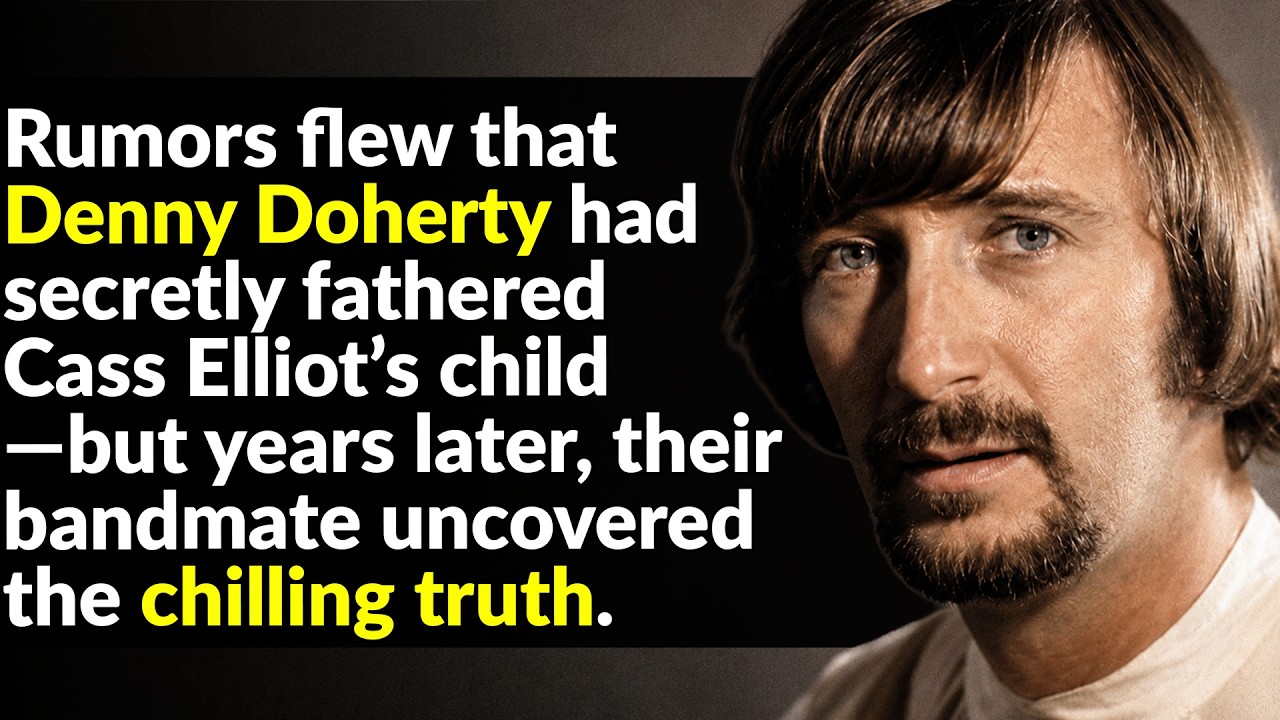
The tangled web of love, betrayal, and heartbreak that defined the iconic 1960s folk-rock group The Mamas & the Papas has been laid bare in a new investigation, revealing a secret that haunted the band for decades. At the center of the storm was Denny Doherty, the gentle-voiced singer from Halifax, Nova Scotia, whose life was irrevocably shaped by the chaos of his bandmates. For years, rumors swirled that Doherty had secretly fathered the child of his bandmate Cass Elliot, a scandal that threatened to unravel the group’s legacy.
But the truth, uncovered years later by their surviving bandmate Michelle Phillips, was far more complex—and far more tragic.
 Doherty was born in November 1940 in Halifax, the youngest child of the Doherty family. He was just 15 when he began performing with his first band, The Hipsters, setting him on a path to stardom. Two years later, the group dissolved, and Doherty formed the folk trio The Colonials.
This second band caught the attention of Columbia Records, leading to a name change to the Halifax 3. They recorded two LPs and even had a minor hit with “The Man Who Wouldn’t Sing Along with Mitch.” But Doherty had no idea how far his career would take him—or how deep the personal turmoil would run.
In 1963, the Halifax 3 met members of another band, the Big 3, through which Doherty began a friendship with Cass Elliot. Around the same time, he also met musicians John Phillips and his wife, Michelle. When the Halifax 3 decided to call it quits, Doherty and fellow band member Zal Yanovsky were left broke in Hollywood.
Cass Elliot convinced her manager to let them join her group, forming the Mugwumps, a rock and roll band that mostly played covers. After just one album, the Mugwumps broke up. Yanovsky went on to co-create The Lovin’ Spoonful, while Doherty joined John and Michelle Phillips in their band, The New Journeymen.
Soon, they added Cass Elliot, and The Mamas & the Papas were born.
John Phillips initially resisted Elliot’s inclusion, believing her voice was too low and that her weight would hurt the band’s image. Despite this rocky start, the group auditioned successfully for Lou Adler of Dunhill Records, signing a contract to record two albums per year for five years. But the tension over Elliot’s place in the band persisted.
In a vote that must have been excruciating for Doherty, he sided against his friend John, along with Adler and Michelle, to keep Elliot in the group. Before releasing their debut album, the band put out the single “California Dreamin’,” with Doherty on lead vocals. The song would go on to be crowned the number one song of 1966 by Billboard.
With hits like “California Dreamin’” and “Monday, Monday,” the band’s first album, “If You Can Believe Your Eyes and Ears,” was a massive success. But behind the scenes, Doherty began a secret affair with Michelle Phillips—not only his bandmate but also the wife of his friend John Phillips. The two carried on their relationship behind the backs of both John and Cass Elliot, who herself harbored a deep affection for Doherty.
The affair was discovered when John walked into Doherty’s bedroom to find Michelle in a nightgown, sitting on Doherty’s bed and feeding him candies. Shockingly, John forgave them and even co-wrote a song about the situation, “I Saw Her Again.”
 When Elliot learned of the affair, she was furious. She confronted Michelle, asking, “You could have any man you want. Why would you take mine?”
The drama deepened when Michelle also had an affair with Gene Clark of The Byrds. Unlike Doherty, Clark did not receive a pass. John fired Michelle from the band, though she returned within months after fan backlash.
The stress took its toll. During a tour of the East Coast, all four members performed while high, drunk, or tripping—sometimes all three at once. Doherty, still reeling from his affair, retreated to the Virgin Islands to drink heavily.
When he returned, he was in no condition to perform at the Monterey International Pop Festival, where the band gave one of its worst performances. The festival, featuring legends like Janis Joplin and Jimi Hendrix, saw The Mamas & the Papas come across as under-rehearsed, with Doherty’s drinking a major factor. The problems multiplied during a UK tour.
John Phillips insulted Elliot, and she walked away from the band. In February 1968, the group officially called it quits.
After the breakup, Michelle Phillips pursued acting, Cass Elliot rebranded as Mama Cass and released a successful solo album, and John Phillips released his own album in 1970. Doherty’s solo album, “What You Going to Do,” came out in 1971, with Michelle and Cass contributing vocals. Despite everything, Elliot still carried a torch for Doherty.
She proposed to him, but he declined, later admitting, “She weighed 300 lb and I wasn’t enough of a man to get past that.” Elliot consoled herself with the belief that Doherty wasn’t ready for marriage, but she soon learned the truth. On October 2, 1971, Doherty married Linda Woodward, one of the background singers on his album.
They later had a daughter.
 Elliot’s heart was broken, but her health was already fragile. On July 29, 1974, after a 24-hour partying spree in London, she died in her sleep from a heart attack. Doherty was devastated.
At her funeral, he was consoled by John and Michelle Phillips. Shortly after, John Phillips asked Doherty to join a musical he was writing with Andy Warhol called “Man on the Moon.” Doherty was cast as an evil doctor, but when Phillips was pulled from the cast, Doherty had to replace him.
The production was a disaster, playing for only two nights after critics ravaged the performance.
In 1978, Doherty divorced Linda and married a teacher named Janette. This marriage stuck. With a supportive wife, Doherty was ready for the next stage of his life.
In 1982, John Phillips contacted him about recreating The Mamas & the Papas, replacing Michelle with John’s daughter, Mackenzie, and Cass Elliot with Elaine “Spanky” McFarlane. The new group received great reviews but stopped performing when they realized they weren’t making money. They regrouped in 1985 for a world tour, but when Phillips and his daughter began using narcotics and alcohol, performances declined.
Audiences booed the band off stage. In 1987, Doherty walked away.
He then produced a play, “Dream a Little Dream,” the nearly true story of The Mamas & the Papas, which didn’t shy away from the scandals. He spent eight years voicing the Canadian children’s series “Theodore Tugboat.” His life was on a positive path until it came to a crashing halt.
His second wife, Janette, was diagnosed with ovarian cancer and died in 1998. In 1999, Doherty returned to Nova Scotia to perform in the CBC series “Pit Pony.” Around 2006, Michelle Phillips visited him before he underwent surgery for an abdominal aortic aneurysm.
 He survived but suffered kidney failure.
Doherty continued working, appearing as an FBI agent in the season 7 finale of “Trailer Park Boys.” He died on January 19, 2007, at his home in Mississauga, Canada. The cause of death was believed to be related to his kidney failure.
He was laid to rest at the Gates of Heaven Cemetery near his birthplace in Nova Scotia. Michelle Phillips attended both his burial and funeral. In 2010, Paul Ledoux released “Here I Am: Denny Doherty and The Mamas & the Papas,” a first-person documentary using parts of Doherty’s off-Broadway show and newly found recordings.
It featured an interview with Michelle Phillips, the last surviving member of the band.
Back in 1967, Cass Elliot had given birth to a healthy baby girl, Owen. She refused to reveal the father’s identity, fueling rumors that Doherty was the man. After a decade of investigation, it was Michelle Phillips who solved the mystery.
The father of Cass’s daughter was guitarist Chuck Day, who played with The Mamas & Papas on tracks like “California Dreamin’.” The truth, finally revealed, put to rest a scandal that had haunted the band for years. But for Doherty, the damage was done.
His life, marked by love, betrayal, and heartbreak, ended quietly, leaving behind a legacy of beautiful music and a story that continues to captivate.