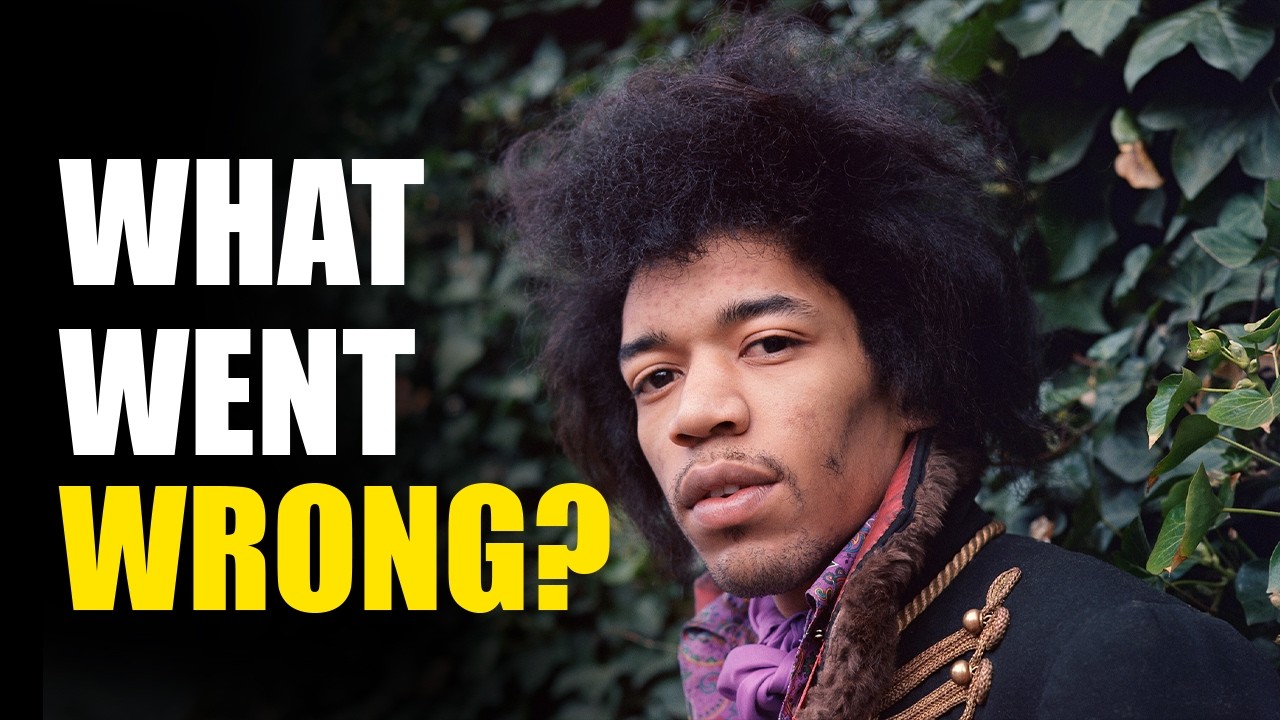
The world woke to the news on the morning of September 18, 1970, that James Marshall Hendrix, known to millions as Jimi Hendrix, had been found unresponsive at a friend’s apartment in London. He was pronounced dead at St. Mary Abbot’s Hospital at the age of 27.
The coroner later ruled an open verdict: death by asphyxiation from vomit under the influence of barbiturates. The circumstances remain disputed, but the loss is absolute.
 Hendrix’s final hours were spent at the Samarkand Hotel on Lansdowne Crescent, in the flat of his girlfriend Monika Dannemann. Earlier that evening, they had attended a party in Notting Hill. Returning in the early hours, Hendrix, plagued by chronic insomnia, took nine of Dannemann’s prescribed Vesparax sleeping tablets—18 times the recommended dose.
She found him unresponsive the next morning.
The ambulance rushed him to hospital, but it was too late. The guitar that had set fire to Monterey and bent the national anthem into a protest at Woodstock was silenced. The news sent shock waves through the music world, still reeling from the death of Brian Jones just over a year earlier, and soon to lose Janis Joplin only three weeks later.
Hendrix’s rise from a broken childhood in Seattle to the pinnacle of rock stardom lasted barely four years. He was born Johnny Allen Hendrix on November 27, 1942, to teenage parents. His father Al, an army private, was stationed at Fort Sill, Oklahoma, and could not be present for the birth.
His mother Lucille, only 17, struggled alone in wartime Seattle.
Lucille placed young Jimmy in temporary care when he was two, traveling east to visit relatives. Al retrieved him after his honorable discharge in 1945 and officially changed the boy’s name to James Marshall Hendrix, after Al’s late brother. The household was poor and chaotic.
Al worked odd jobs. Lucille drifted in and out, and the couple divorced in 1951.
Jimmy and his younger brothers often went without proper meals or stable schooling. Several siblings were placed in foster homes. The instability left deep scars.
Then, in February 1958, Lucille died of complications from heavy drinking. She was 32. Al did not tell his son immediately; by the time Jimmy learned, she was already buried.
He never said goodbye.
That same year, Al bought Jimmy a second-hand acoustic guitar for five dollars. Music had already taken hold. Jimmy had been strumming a broom like a guitar, scattering straw across the bedroom floor.
He watched Elvis Presley from a hillside because he could not afford a ticket. He absorbed B. B.
King, Muddy Waters, Howlin’ Wolf, Buddy Holly, and Robert Johnson by ear, teaching himself without reading a note.
 By 1959, Al bought him a white Supro Ozark electric guitar. Jimmy played with local bands, including the Rocking Kings, and performed his first gig in a synagogue basement. He skipped school constantly and eventually dropped out of Garfield High School.
(Years later, the school awarded him an honorary diploma.) Trouble followed: he was caught riding in stolen cars twice.
Facing prison, Hendrix enlisted in the U. S. Army in 1961 at age 18.
He was assigned to the 101st Airborne Division at Fort Campbell, Kentucky, training as a paratrooper and making over two dozen jumps. He hated the discipline. He spent free time playing guitar in the barracks, sneaking off base to find music.
At Fort Campbell, he met bassist Billy Cox, a partnership that would last until the end of his life.
In 1962, Hendrix received an honorable discharge for “unsuitability.” He stayed in Nashville, then worked the Chitlin’ Circuit, the network of African-American venues across the segregated South. He backed Jackie Wilson and Sam Cooke, learning to hold an audience.
But he could not stop himself from playing too much, taking solos where they were not planned. That quality cost him jobs and eventually made him famous.
By the mid-1960s, he had moved to New York City, playing Greenwich Village clubs as Jimmy James. His style blended blues with wild experimentation. He worked as a sideman for Little Richard and the Isley Brothers, but both fired him because he drew too much attention to himself.
He was simply too much to contain.
In the summer of 1966, Chas Chandler, bassist of the Animals, heard Hendrix at Café Wha? Chandler saw a star in the making and offered to manage him. Hendrix agreed.
He flew to London in September 1966, broke and unknown. Within weeks, word spread through the British rock scene. Eric Clapton, Paul McCartney, and Pete Townshend all came to watch him play.
Chandler formed the Jimi Hendrix Experience with Noel Redding on bass and Mitch Mitchell on drums. He changed the spelling to Jimi. The first single, “Hey Joe,” hit number six on the UK charts in early 1967.
 “Purple Haze” and “The Wind Cries Mary” followed quickly. The debut album “Are You Experienced” became one of the most celebrated rock records of the era.
But Hendrix had not yet broken through in America. That changed at the Monterey International Pop Festival in June 1967. Closing the festival, he knelt over his guitar and set it on fire.
The image went worldwide. Within weeks, the band was famous across the United States.
The pace that followed was extraordinary and exhausting. “Axis: Bold as Love” came in 1967, then “Electric Ladyland” in 1968—his only number-one album on the Billboard 200. He experimented with feedback, distortion, and effects, building sounds that had not existed before.
But the touring was relentless, and the management demands were crushing.
Hendrix was the world’s highest-paid rock musician, but he saw little of the money. His manager, Michael Jeffery, controlled his finances tightly. Lawsuits piled up.
Noel Redding and Hendrix grew apart. The band officially disbanded in 1969.
Woodstock came in August 1969. Hendrix closed the festival on Monday morning after performing nearly two hours. His version of “The Star-Spangled Banner” through waves of feedback and distortion became one of the most politically charged moments of the era.
He later said he played it the way the air felt in America during Vietnam.
By the end of 1969, he formed the Band of Gypsys with Billy Cox and Buddy Miles—an all-black trio that released one album, the last released during his lifetime. The Cry of Love Tour began in April 1970 with Cox and Mitchell. In late August, he played the Isle of Wight Festival before an estimated 600,000 people, the largest audience of his career.
He was visibly tired.
His final concert was on September 6, 1970, at the Love and Peace Festival in Fehmarn, Germany. Driving rain, high winds, and a hostile crowd marred the set. He pushed through and brought the audience back around.
 It was the last time he stood on a paying stage.
On September 16, two days before his death, he made an unannounced appearance at Ronnie Scott’s Jazz Club in London, jamming with Eric Burdon and War. Burdon later spoke of the electricity that moved through the room when Hendrix walked in. That was the last time most people saw him play.
In his final days, Hendrix was staying at the Cumberland Hotel. Friends described him as jittery, unsettled, troubled by the people around him. He gave his last interview on September 11 to Keith Altham of Record Mirror.
He seemed tired and distracted.
The death of Jimi Hendrix left a void that has never been filled. In just four years as a recording artist, he released three studio albums, performed at Monterey and Woodstock, headlined the Isle of Wight, and fundamentally changed the electric guitar’s role in rock music. He was inducted into the Rock and Roll Hall of Fame in 1992, described as “arguably the greatest instrumentalist in the history of rock music.”
Clapton has said that encountering Hendrix made him question whether he should continue playing. The sonic vocabulary Hendrix opened up—treating feedback, distortion, and the wah-wah pedal as instruments—still echoes through every genre that followed.
He also built Electric Lady Studios in Greenwich Village, one of the first musician-owned studios. He never got to fully use it. The unfinished tracks released posthumously show he was still pushing into new territory.
Hendrix was buried at Greenwood Cemetery in Renton, Washington, next to his mother, who had died before seeing what her son became. His gravestone reads: “Forever in our hearts. James M.
Jimi Hendrix, 1942-1970.”
He came from almost nothing—a chaotic childhood, a broken family, a stint in the army to avoid jail, years on the road playing for other people. He had four years of genuine fame. In that time, he made music that still sounds like the future, more than half a century later.
The story does not end neatly because it never got the ending it deserved. What remains is the sound of a guitar that no one else has ever matched.