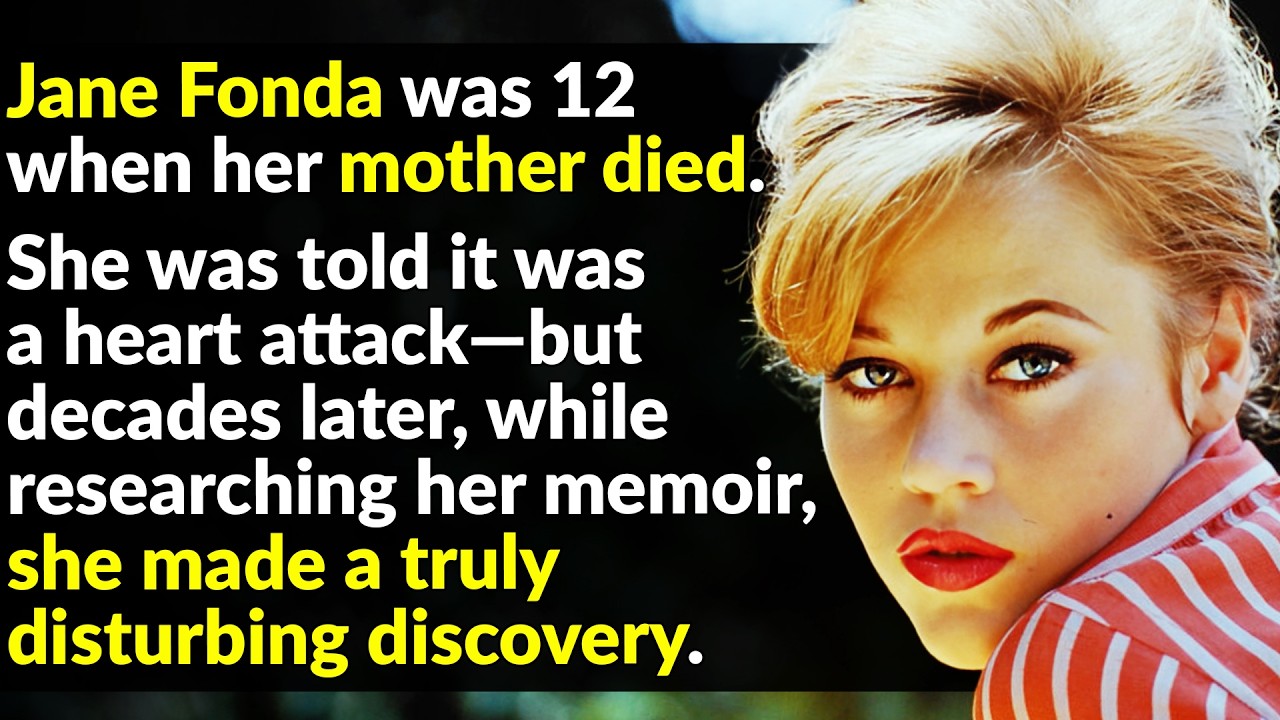
Jane Fonda, the iconic actress and activist whose life has been a tapestry of secrets, scandals, and reinvention, has revealed a devastating truth about her mother’s death that she buried for decades. At 12 years old, Fonda was told Frances Ford Seymour died of a heart attack. But while researching her memoirs in 2005, she uncovered medical records that exposed a far darker reality: her mother’s suicide was the culmination of a life marked by childhood sexual abuse, multiple abortions, and profound mental anguish.
The discovery came as Fonda, now 86, delved into her past for her autobiography, My Life So Far. With the help of lawyers, she obtained her mother’s medical files and sat alone, reading through them. The records revealed that Frances had endured ongoing abuse from her mentally unstable father and was sexually assaulted at age eight by a piano tuner.
 She also underwent nine surgical pregnancy terminations, a fact that left Fonda reeling. The scars her mother had shown her as a child, pointing to surgical changes on her body, were only a small glimpse into a lifetime of pain.
This revelation shattered the narrative Fonda had clung to for years. Her mother’s death, long attributed to a heart attack, was actually a suicide. Fonda learned the truth from a magazine at school, but she buried her feelings, striving for perfection to earn love.
The nightmares about her mother’s tragic end haunted her for decades, shaping her relentless pursuit of control over her body and image.
Fonda’s life has been a series of transformations, from screen siren to Oscar-winning icon, fitness tycoon, women’s rights warrior, and counterculture firebrand. Born on December 21, 1937, in New York City, she was named after Jane Seymour, Henry VIII’s doomed third wife, because her mother was a distant descendant. Her father, Henry Fonda, was emotionally distant, while her mother often shared too much.
When Jane was 11, her mother showed her a surgical scar and asked for her opinion, a moment that left young Jane confused and desperate to be perfect.
The divorce of her parents pushed Frances’s fragile mental state to the brink. Doctors recommended institutionalization, and one day, when a nurse brought her home for a visit, Jane refused to go downstairs to see her. She never saw her mother again.
Just months after Frances’s death, Henry Fonda married socialite Susan Blanchard, who was only nine years older than Jane. This new dynamic fueled Jane’s obsession with having a perfect body, driven by her father’s destructive remarks about her weight.
At boarding school, Jane took pride in being one of the thinnest girls in her class. She and her friend Carol Bentley experimented with unhealthy ways to control their weight, struggles that followed her through college, marriages, and into her early 40s. After two years at Vassar, she dropped out to study art in Paris, where she mingled with John and Jackie Kennedy, Aristotle Onassis, Picasso, and Ernest Hemingway.
She even skinny-dipped with Greta Garbo, who told her she had what it takes to act.
That boost in confidence led her to the Actors Studio in New York City, where legendary teacher Lee Strasberg saw her potential. Her breakthrough came in 1962’s Walk on the Wild Side, earning her a Golden Globe for most promising newcomer. But her personal life was a storm.
 She met French director Roger Vadim, who was 10 years older and dazzled her. Their relationship was a plunge into deep, unpredictable seas, with Vadim comparing her to his ex, Brigitte Bardot, and pressuring her to use her mother’s inheritance to bankroll his friends and gambling habits.
Despite the red flags, Jane married Vadim in 1965 in Las Vegas. The wedding night was a disaster: she found herself sharing a bed with her groom’s mother while he gambled away. Hurt and furious, she flew back to Los Angeles the next afternoon, asking herself, What have I done?
She buried the pain and moved on, starring in Vadim’s film Barbarella, which cemented her reputation as a screen siren but also drew criticism for its campy excess.
By the 1970s, rumors of marital problems were hard to ignore. Jane cut her long blonde hair into a bold, punk-inspired style, calling it her hair epiphany. She became more outspoken, especially about the Vietnam War, which deeply affected her.
After a speaking engagement, authorities stopped her at the Cleveland Airport, searched her luggage, and arrested her on charges of smuggling vitamins and prescription medication. She posed for what became her infamous mugshot, an experience meant to intimidate her but instead pushed her further into the spotlight.
Her performance in Klute in 1971 earned her her first Academy Award, but even that success couldn’t shield her from controversy. In 1972, she traveled to Vietnam, and a photo of her sitting on an enemy anti-aircraft gun sparked outrage, earning her the nickname Hanoi Jane. She became one of the most polarizing figures in America.
Meanwhile, her marriage to Vadim was quietly ending, and she began an intense relationship with her Klute co-star, Donald Sutherland, which lasted three years.
Jane then married political activist Tom Hayden in 1973, blending Hollywood fame with political activism. Their influence didn’t go unnoticed; authorities kept close tabs on them. But by the late 1970s, Jane felt unresolved about her relationship with her father, whose health was declining.
She found a project that felt personal: On Golden Pond, a quiet, emotional film she hoped would bring them closer and finally earn him the Oscar he had never won.
 The set was tense. Katharine Hepburn saw Jane as competition, and during an emotional scene, Jane asked her father if the lights were too bright for him to see her eyes. He shut her down with one icy line: It’s okay.
I’m not that kind of actor. Hepburn hugged Jane and whispered, He doesn’t know that he hurt you. Despite the difficulties, the film was a success.
Henry won the Oscar at last, too ill to attend, and Jane accepted it for him. Months later, he was gone.
Jane’s next success came from a very different place. What started as a practical way to fund her activism turned into a massive hit: Jane Fonda’s Workout became the best-selling home video of its time, launching a global fitness trend. But her husband, Tom Hayden, dismissed it as superficial, highlighting tensions in their marriage.
He became involved with a speechwriter 20 years younger than Jane, and after a tense confrontation, they separated in 1988 after 17 years together.
The breakup became a financial battle. At the time, Jane was earning $20 million a year, and under California law, Hayden could claim half. In the end, he walked away with $10 million, and Jane kept custody of their son.
Her next relationship was with billionaire media mogul Ted Turner, founder of CNN. But his high-energy lifestyle eventually wore her down. She later admitted that staying would mean losing herself, and they divorced in 2001.
After her divorce, Jane stepped away from relationships for several years. She later dated music producer Richard Perry, a relationship she described as fulfilling. When that ended in 2017, her focus shifted again.
She has never been quiet about her beliefs. In 2019, she was detained multiple times while protesting climate change outside the capital in Washington, D. C.
 In March 2020, she launched a political action committee aimed at challenging politicians who supported fossil fuels.
Her transformation from insecure girl to outspoken icon was on full display in a 2008 interview with Megyn Kelly. When Kelly brought up plastic surgery, Jane didn’t hold back. She paused, gave a sharp look, and asked, Do we really want to talk about that now?
She later said she was surprised by how inappropriate the question felt. Given her history and the pressure she had felt about her appearance for years, it’s not surprising she pushed back.
In 2005, while working on her autobiography, Jane obtained her mother’s medical records. The records revealed devastating facts: Frances had endured ongoing abuse from her mentally unstable father, was abused at age eight by a piano tuner, and faced repeated mistreatment from a family member during her childhood. She also went through nine surgical pregnancy terminations.
The scars Jane had been shown as a child were only a small glimpse into the much deeper pain her mother had carried throughout her life.
Even as she moved into her later years, Jane wasn’t done with acting. She found a whole new audience with Grace and Frankie, a Netflix show in which she starred alongside Lily Tomlin. The show ran for seven seasons and became one of Netflix’s longest-running originals.
Audiences loved seeing a different side of her, funny, sharp, and completely self-aware, proving she could still command the screen decades into her career.
Jane Fonda has never slowed down. Actress, author, activist, she continues to speak out on issues that matter to her from climate change to social justice. Through decades of criticism, controversy, and change, she has kept moving forward without losing her voice.
Her life, full of secrets and scandal, is a testament to resilience, a journey from a girl who buried her pain to a woman who confronts it head-on.