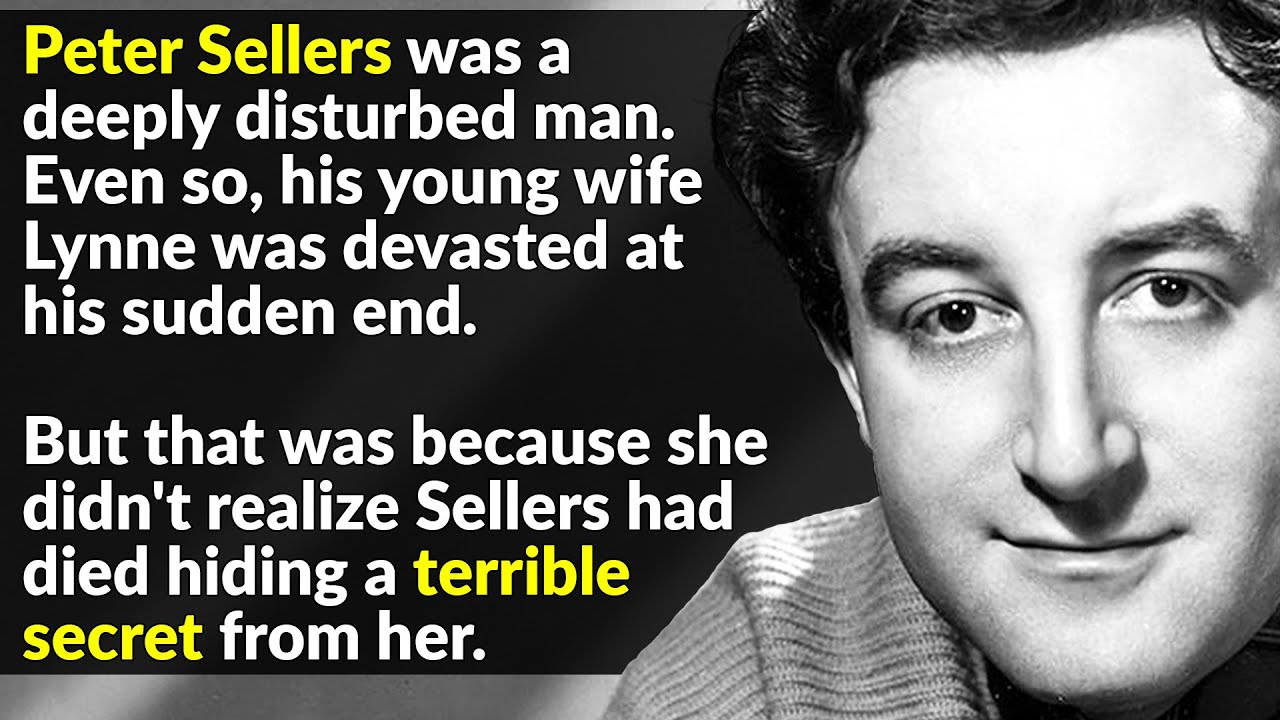
Peter Sellers, the beloved comedic genius behind Inspector Clouseau and the Goon Show, was a man of profound darkness, and newly uncovered details from his life paint a portrait of a tormented soul whose private demons far exceeded any role he ever played. Reports emerging from interviews with former friends, family members, and biographers reveal a pattern of psychological abuse, superstition, and erratic behavior that has long been hidden behind the mask of his on-screen charm.
Born into a dysfunctional family of variety performers, Sellers was just two weeks old when he was first carried onto a stage in Southsea, England. His parents, constantly touring, left him alone for weeks at a time. This childhood neglect, combined with an unnaturally close and controlling relationship with his mother, set the stage for a life plagued by insecurity and mental illness.
 Friend and fellow Goon Spike Milligan described the mother-son bond as “unhealthy for a grown man,” especially given that Sellers was named after his stillborn older brother.
Sellers’ obsession with superstition and the occult became a guiding force in his career and personal life. He regularly consulted astrologer Morris Woodruff and genuinely believed his actions were directed by the ghost of a music hall comedian named Dan Leno, who died in 1904. This belief extended to bizarre phobias: Sellers refused to wear or be near the colors green and purple.
His publicists had to pre-screen every hotel room for any hint of purple, or risk a violent outburst.
His personal relationships were marked by jealousy, control, and cruelty. In 1960, after falling in love with co-star Sophia Loren on the set of “The Millionairess,” Sellers woke his young son in the middle of the night to ask whether he should divorce his wife. The child was six years old.
He later declared he never wanted to see his children again after they answered a manipulative question about which parent they loved more incorrectly in his eyes.
 Sellers’ second marriage to Britt Ekland lasted just ten days after meeting, despite a nineteen-year age gap. He became paranoid and possessive, dictating what she could wear and insisting she spend every free moment with him. While she was filming a movie in London, Sellers had a medic falsely tell her she was too ill to work, leading to her firing and increasing her dependence on him.
The marriage collapsed into what Ekland later called “an atrocious sham,” ending in divorce shortly after Sellers’ mother died of a heart attack while he was on set, too consumed by his own drama to visit her.
On the set of “Casino Royale,” Sellers clashed violently with co-star Orson Welles, who referred to him as an “amateur.” The two refused to be in the same shot, and Sellers punched one of the directors. He left the film unfinished.
His on-set tantrums only worsened with age, often triggered by perceived slights or uncontrollable superstitions.
 Sellers’ fourth marriage to 23-year-old Lynn Frederick left her allegedly treated worse than any previous partner. Biographer Roger Lewis describes a pattern of psychological abuse that Frederick was ill-equipped to handle.
In 1979, Sellers poured his heart into his final acclaimed role as Chance the gardener in “Being There,” earning a Golden Globe and an Oscar nomination. But when his 15-year-old daughter Victoria jokingly called him a “little fat old man” afterward, he threw a drink in her face and ordered her to leave. When eldest daughter Sarah condemned the act, he sent a telegram that effectively ended communication for years.
Sellers’ health was in constant decline. He suffered eight heart attacks in three hours after inhaling amyl nitrates as a sexual stimulant, yet refused medical help. Friends and family begged him to see a doctor.
He collapsed on set in Dublin and went to Cannes two days later, ignoring all warnings. On July 22, 1980, hours before a reunion dinner with Goon Show colleagues Spike Milligan and Harry Secombe, Sellers suffered a final heart attack at his hotel in London. He was 54 years old.
 In a final, twisted joke, Sellers insisted that Glenn Miller’s “In the Mood” be played at his funeral—a song Milligan and Secombe despised. He had also been in the process of cutting his wife Lynn Frederick out of his will, but died before the paperwork was completed. The bulk of his multi-million pound estate went to her, leaving his children just £800 each.
Spike Milligan later said Sellers likely suffered from bipolar disorder, but he was fiercely opposed to any professional help. On “The Muppet Show” two years before his death, Sellers refused to appear as himself, instead trying on various costumes and accents. When host Kermit the Frog suggested he just be himself, Sellers replied: “I could never be myself, you see.
There is no me. I do not exist. There used to be a me, but I had it surgically removed.”
These disturbingly candid revelations confirm what many close to him always knew: Peter Sellers was a man who hid behind his characters because the real person was too fractured to face the world. His legacy as a comedy legend is now overshadowed by a darker truth that has only now fully come to light.