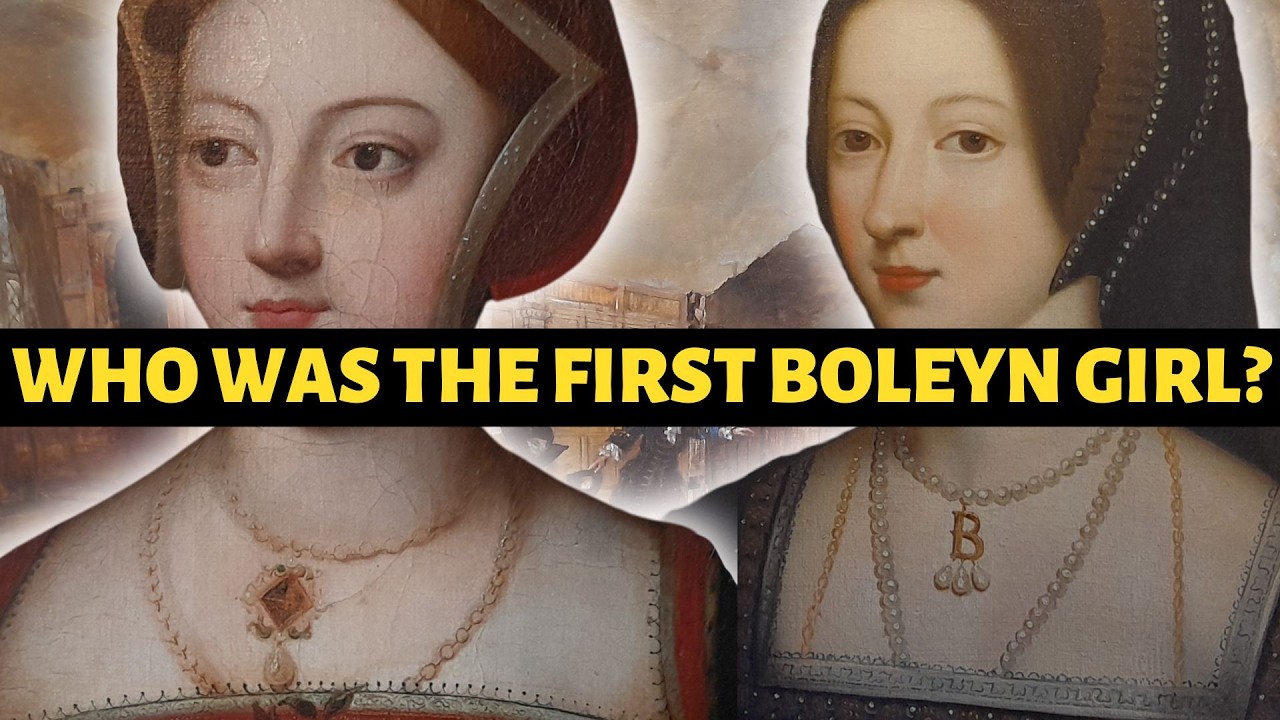
Historians have long been locked in a fierce debate over the birth order of the Boleyn siblings, and new analysis of surviving evidence is reigniting the controversy. The question of whether Mary Boleyn was older than her infamous sister Anne, the second wife of Henry VIII, has divided scholars for centuries, with no definitive record surviving from the Tudor era to settle the matter. Now, a detailed examination of letters, court records, and later biographical accounts is forcing a re-evaluation of the timeline, suggesting that Mary may have been the elder sister, born around 1499, while Anne likely arrived in 1501.
The mystery centers on the births of Mary, Anne, and their brother George Boleyn, all children of Thomas Boleyn and Elizabeth Howard. The exact year of their parents’ marriage remains unknown, but evidence points to a union no earlier than 1498. This sets the earliest possible birth for any child.
 Thomas Boleyn later recalled that his wife brought him a child every year at the start of their marriage, though at least two sons died in infancy. The lack of baptismal records or contemporary chronicles has forced historians to piece together clues from later events.
Anne Boleyn’s birth year is the most hotly contested. Many popular histories claim she was born in 1507, but a growing number of experts argue for 1501. The key evidence lies in her early career.
In 1513, Anne was sent to the court of Margaret of Austria in Mechelen as a fille d’honneur, a position typically reserved for girls around age 12. A letter she wrote to her father in broken French from that period shows handwriting and vocabulary far beyond that of a six- or seven-year-old, as would be required if she were born in 1507. The letter, dated by some scholars to 1513 or 1514, discusses becoming a woman of good reputation and uses words like orthography, indicating a maturity level consistent with a girl in her early teens.
Anne later moved to the French court in late 1514 to serve Mary Tudor, the new Queen of France, and then Queen Claude. Again, the role of maid of honor was suited to a mid-teen, not a child. If Anne were only 28 at her execution in 1536, it would have been strange for Henry VIII to discard her for the younger Jane Seymour, especially since Anne had been pregnant as recently as January 1536.
A mid-30s age makes more sense in the context of Tudor succession anxieties.
The 1507 birth year relies on three 17th-century sources: a biography of Jane Dormer, William Camden’s Annales, and John Weever’s Ancient Funeral Monuments. None of these authors knew Anne personally, and they do not cite their sources. Jane Dormer was born in 1538 and wrote her memoirs decades later, with a scribe possibly misremembering details.
 Camden had access to state papers but may have repeated court gossip. Weever likely copied earlier works. Historians suspect Anne may have lied about her age later in life to appear younger and more fertile as a bride for Henry VIII, which could explain why these later accounts recorded 1507.
The evidence for Mary Boleyn’s birth is even more fragmentary. She went to France with Mary Tudor in late 1514 as a lady-in-waiting, requiring her to be at least 12, so she was born no later than 1502. She married William Carey on February 4, 1520.
The minimum age for marriage was 12, but it was unusual for girls outside royalty to marry that young, suggesting she was older. She also became Henry VIII’s mistress in the late 1510s or early 1520s, and Henry was known to prefer mistresses in their mid-teens or older, not girls of 13 or 14. Later accusations of wanton behavior in France further imply she was at least in her mid-teens by 1514.
The strongest clue that Mary was the elder sister comes from a 1597 letter written by her grandson, Lord Hunsdon, to Lord Burghley. Hunsdon claimed the earldom of Ormond on the grounds that he was the senior surviving descendant of Thomas Boleyn through Mary, the elder daughter. If Anne were older, Queen Elizabeth I herself would have been the senior descendant.
Hunsdon would not have risked such a claim without being certain of the family tree. Although he did not get the earldom, and a later tomb inscription calls Mary the second daughter, that inscription contains errors, suggesting the family lore may have shifted over time.
 Thomas Boleyn’s reference to Anne as “la petite Boulin” in a 1514 letter to Margaret of Austria could indicate she was the younger daughter, though it might also refer to her small stature. Mary was brought home from France earlier than Anne and married in 1520, nearly two years before serious marriage negotiations began for Anne. This pattern suggests Mary was launched first, consistent with being the elder.
George Boleyn’s birth year is the most perplexing. He married Jane Parker in 1525 or early 1526, requiring him to be at least 14, so he was born no later than 1512. But a poem by George Cavendish, written 30 years after the events, states that George was admitted to the King’s Privy Chamber when “years thrice nine my life had passed away,” meaning age 27.
If he lost that position in January 1526, he would have been born around 1498 or 1499, making him the eldest sibling. However, Cavendish may have made a mistake or used poetic license. French diplomat Jean du Bellay in 1529 thought George too young to be ambassador, suggesting a birth year around 1504.
This is now the most widely accepted date, making George about three to four years younger than Anne and five years younger than Mary.
The conflicting evidence has led to a spectrum of scholarly opinions. Some, like Retha Warnicke, argue that Anne was born in 1507 and was the elder sister, with Mary born in 1508. Others, like Eric Ives and Jonathan Hughes, place Anne’s birth around 1501 and Mary’s around 1499.
 The lack of contemporary records means the debate will likely never be settled definitively, but the weight of circumstantial evidence now tilts toward Mary being the firstborn Boleyn girl.
For the public, the mystery adds another layer of intrigue to the already dramatic story of the Boleyn family. Anne’s rise and fall, Mary’s scandalous reputation, and George’s tragic execution alongside his sister continue to captivate. The birth order question may seem trivial, but it affects how historians interpret their relationships, their parents’ ambitions, and the dynamics that led to Anne becoming queen.
As new archival discoveries emerge, the timeline may shift again, but for now, the Boleyn siblings remain shrouded in uncertainty.
This breaking analysis comes as historians call for a fresh look at the primary sources, particularly the 1513 letter from Anne to her father, which has been digitized and re-examined. The letter’s handwriting and content are now being studied with modern forensic techniques. Meanwhile, genealogists are tracing the descendants of Mary Boleyn to see if any family records survive that could confirm the birth order.
The search for the truth continues, and the answer may lie in a dusty archive yet to be fully explored.