For decades, Robin Williams was the person millions of people turned to when they needed laughter.
The unstoppable energy.
The brilliant improvisation.
The ability to transform a simple moment into something unforgettable.
He was the alien who came to Earth in Mork & Mindy.
The unforgettable voice of Genie in Aladdin.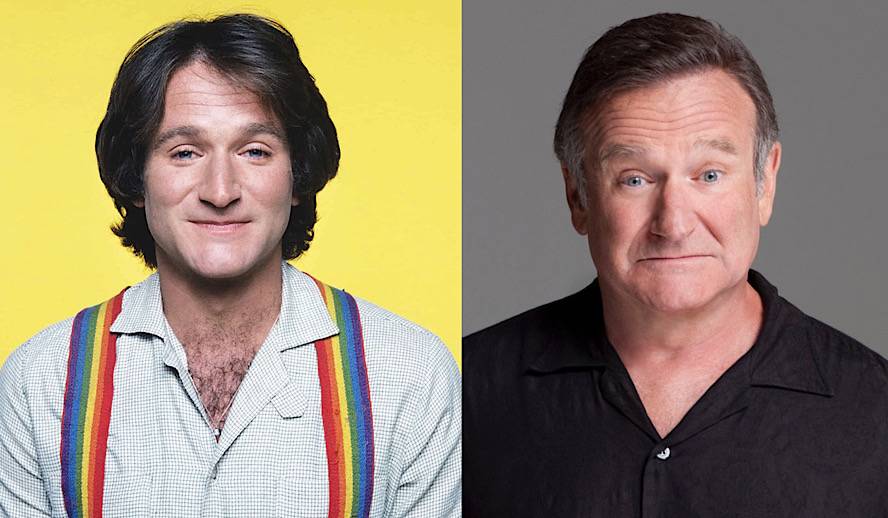
The actor who delivered powerful performances in films like Good Will Hunting, Dead Poets Society, and Good Morning, Vietnam.
To the world, Robin Williams seemed almost impossible to break.
But behind the laughter was a man who carried struggles that very few people understood.
After his death in 2014, his wife Susan Schneider Williams shared a deeper look into his final years, revealing that the problems he faced were far more complicated than many people realized.
His story was not simply about sadness or depression.
It was about a devastating illness that slowly changed the man everyone loved.
Robin McLaurin Williams was born in 1951 in Chicago, Illinois.
Growing up, he was intelligent, imaginative, and fascinated by performing.
As a young man, he discovered comedy and found a place where his unusual energy and creativity became strengths rather than obstacles.
He eventually moved to San Francisco, where he became part of the city’s legendary stand-up comedy scene.
Audiences immediately noticed something different about him.
Most comedians delivered prepared routines.
Robin Williams seemed to create entire worlds in real time.
His mind moved at incredible speed.
His impressions, voices, and observations came together in unpredictable ways that left audiences amazed.
His breakthrough came in 1978 when he was cast as Mork, the eccentric alien on Happy Days.
The character became so popular that it led to the hit series Mork & Mindy.
Almost overnight, Robin Williams became a television sensation.
But he was never just a comedian.
He wanted to prove he could do more.
In the 1980s and 1990s, he built one of the most respected acting careers in Hollywood.
In Good Morning, Vietnam, he combined comedy and emotion to create one of his most memorable performances.
In Dead Poets Society, he inspired audiences as the passionate teacher John Keating.
In Good Will Hunting, he showed his dramatic depth and won the Academy Award for Best Supporting Actor.
Then there was Genie in Disney’s Aladdin.
The role allowed Williams to combine everything that made him special—humor, emotion, imagination, and endless creativity.
Behind the success, however, Robin Williams faced personal battles.
Throughout his life, he struggled with addiction and worked hard to maintain sobriety.
He openly discussed the challenges of recovery and the difficulty of managing the pressures that came with fame.
In 2009, he also underwent heart surgery, adding another physical challenge to his life.
But the most difficult chapter came in his final years.
After his death, Susan Schneider Williams explained that Robin had been experiencing severe medical problems that were not fully understood at the time.
Initially, some people believed his struggles were mainly connected to depression or Parkinson’s disease.
But later examinations revealed something much more complex.
Robin had Lewy body dementia, a progressive neurological disorder that can affect memory, movement, thinking, mood, and behavior.
The disease caused symptoms that were frightening and confusing.
It affected the way he experienced the world.
For a man whose greatest gift was his mind, losing control over his own thoughts was an especially cruel challenge.
Susan described watching someone she loved struggle with changes that neither of them fully understood.
The Robin Williams audiences knew—the brilliant performer who could create magic instantly—was fighting a battle happening inside his own brain.
His final years were not a simple story of losing happiness.
They were a story of a person facing a serious illness.
A disease that changed his abilities and created enormous suffering.
Robin Williams passed away on August 11, 2014, at the age of 63.
His death shocked the world.
Millions mourned not only an actor but someone who had become part of their lives.
People remembered the laughter.
The characters.
The moments when he made strangers feel understood.
But his legacy goes beyond entertainment.
Robin Williams used his fame to help others.
He supported numerous charitable causes, including Comic Relief USA, which raised money to fight poverty and homelessness.
He also regularly performed for troops through the USO, bringing humor and comfort to members of the military.
That generosity reflected the person many friends described away from the cameras.
Someone who cared deeply about people.
Someone who wanted to make others feel better.
The tragedy of Robin Williams’ final years is that the world saw a man who brought endless joy, while privately he was facing an illness that few people recognized.
But his story should not only be remembered through the sadness of his ending.
It should be remembered through the millions of lives he touched.
Through every laugh.
Every inspired audience member.
Every person who found comfort in his work.
Robin Williams was not defined by his final struggle.
He was defined by the incredible amount of happiness he gave to the world.


