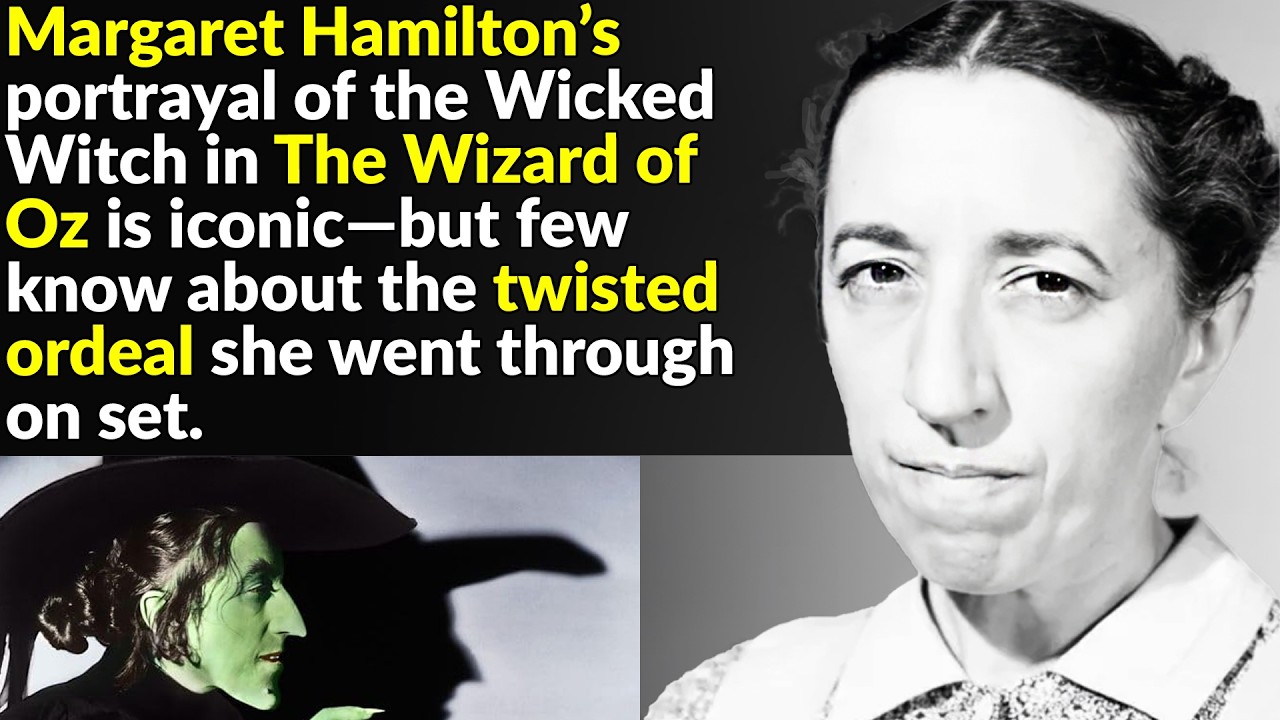
CLEVELAND, OHIO – The green-skinned cackle that has haunted childhood dreams for generations was born from a place of profound personal sacrifice and unimaginable physical torment. Margaret Hamilton, the actress who forever defined the Wicked Witch of the West in the 1939 classic “The Wizard of Oz,” lived a life far removed from the malevolent creature she portrayed, a life marked by heartbreak, devastating on-set accidents, and a quiet, heroic dedication to the very children her performance terrified.
Born in 1902 in Cleveland, Ohio, Hamilton’s journey to the yellow brick road began in modest obscurity. Before she could make children scream by simply walking down the street, she was their champion. As a member of the Junior League of Cleveland, she combined a love for performance with community service, acting in children’s theater and honing her craft.
 This passion for education led her to college in Boston and then to a teaching career in New York, a calling that would remain the bedrock of her identity even as Hollywood beckoned.
By her 27th birthday in 1929, the pull of the stage became irresistible. She took to the boards at the Cleveland Playhouse, delivering a program of heartrending songs. Two years later, she married Paul Meserve, the only man who would ever capture her heart.
But she was immediately torn between two worlds, her ambition for the spotlight clashing with the demands of her new marriage. A twist of fate soon settled the score. Accompanying a friend to an audition for the 1932 Broadway play “Another Language,” Hamilton unexpectedly landed a role herself, playing a sharp-tongued wife.
The play was a hit, capturing Hollywood’s attention. When MGM turned it into a 1933 film, Hamilton set off for Tinseltown. Her perfect diction, a gift from her stage background, gave her a distinct advantage in the era of the talkies.
She never signed a studio contract, working as a free agent and commanding an impressive $1,000 a week. But the cost was immense. Just as her career accelerated, her marriage crumbled, ending in divorce in 1938.
She made the difficult decision to raise her son, Hamilton Meserve, alone.
Even as she navigated the belly of the fame beast, she fought to give her son a normal upbringing. He later recalled how his mother protected him from Hollywood’s pressures, especially after witnessing what her close friend Judy Garland endured as a child star. Then came the phone call that would change everything.
Hamilton had been obsessed with “The Wizard of Oz” since the age of four. She assumed she would be perfect for Glinda the Good Witch. She was shocked when her agent told her she would be playing the Wicked Witch of the West.
 She needed the money. As a single mother, she struggled to balance filming with childcare, negotiating her working hours and accepting a five-week term just three days before filming began. In the end, she filmed for three grueling months.
She was lucky to make it off the set alive. Behind the scenes, Hamilton was so kind-hearted that the cast struggled to be afraid of her. Judy Garland formed a lifelong bond with her, affectionately calling her “Maggie.”
When MGM head Louis B. Mayer sent Garland on tour, preventing her from wearing a special graduation dress, Hamilton was furious. She called Mayer directly to berate him.
Hamilton put everything into her performance. The scene where the witch sets the Scarecrow’s arm on fire required multiple takes. She allegedly needed five attempts to get the right level of menace.
After the final take, she reportedly fainted from exhaustion. Her performance was so terrifying that MGM cut entire scenes, deeming her too scary for younger audiences. Hamilton herself saw the witch not as pure evil, but as a sad, frustrated woman.
This nuanced view would later inspire the novel and musical “Wicked.”
Not everyone shared her sympathy. Her neighbor’s nephew refused to meet her, terrified she might be like her character. Being a former teacher who loved children, Hamilton was always wary of the impact her role had on kids.
 She constantly tried to reassure them it was make-believe. In 1975, she appeared on “Mister Rogers’ Neighborhood” to soften her image. In 1976, she reprised the role on “Sesame Street,” but the episode aired only once after angry parents complained she was too frightening.
Hamilton learned to embrace the wickedness. In the 1970 film “Brewster McCloud,” her character wore red slippers as a cheeky nod to Oz. She never lost sight of her teaching roots, founding a kindergarten in a Beverly Hills church and serving as president of the local Board of Education.
One memorable day, she ordered a disruptive student to leave her class. That student grew up to be actor William Windom, who later starred alongside her in the 1971 film “The Anderson Tapes.”
She spent most of her life in Manhattan, but in the summers she escaped to Southport, Maine. When the government sold off lighthouses, she saw an opportunity. She and her son cleaned out their savings account and bought Cape Island, turning it into a family refuge.
Locals affectionately dubbed it “Witch’s Island,” though they knew her as anything but wicked. She made her final film appearance in 1982’s “Pardon Me for Living,” then retired to the island, living without electricity, using kerosene lamps and spending her days chopping wood.
Her peaceful retirement was a stark contrast to the harrowing experiences on the Oz set. The iconic scene where the witch disappears in a plume of red smoke nearly ended her life. During the second take, the copper-based makeup heated up, causing second and third-degree burns on her hands and face.
The producers used the first take for the final cut. Removing the green makeup from her tender burns required acetone, a strong solvent. The process was excruciating.
 She had to take six weeks off to recover.
She did not sue the studio, knowing she would never work again. She made one demand: no more fireworks. The studio did not listen.
Under the skywriting scene, her stunt double, Betty Danko, was supposed to ride a pipe designed to look like a broomstick. On the third take, the pipe exploded, leaving Danko with severe burns. She was hospitalized for 11 days and left with permanent scarring.
Hamilton, gravely serious, declined a fireproof costume for the scene and avoided the disaster that landed her double in the hospital.
The iconic green makeup was toxic. The copper-based paint was so dangerous that Hamilton could only consume liquids through a straw while in full makeup. The green tint lingered on her skin for months after filming, leaching toxins into her body.
Her lifestyle kept her in relatively good health into old age. Six months before her passing, she moved into a nursing home in Salisbury, Connecticut. She succumbed to a heart attack on May 16, 1985, at the age of 82.
The woman who terrified generations was, in truth, a gentle soul who spent her life teaching children, defending her friends, and finding peace on a remote island. Her legacy is not just a cackle or a green face, but a story of resilience, pain, and a heart that was anything but wicked.