2 September 2026
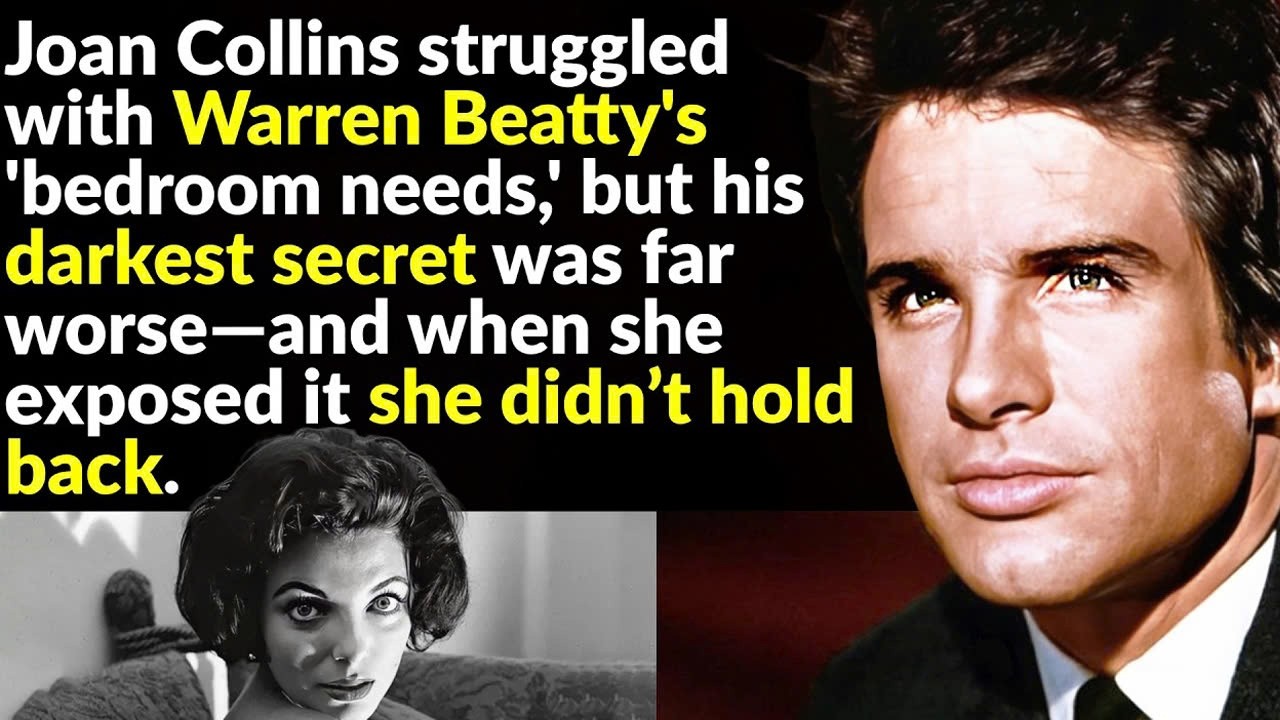
The legend of Warren Beatty, the insatiable Hollywood lothario who allegedly romanced 13,000 women, has long been a punchline in Tinseltown’s collective memory. But a deeper examination of his rise to stardom reveals a narrative far more unsettling than the playful rumors suggest, one defined by calculated manipulation, emotional devastation, and a pattern of behavior that left a trail of broken marriages and psychological wreckage in its wake. When Joan Collins finally broke her silence decades after their explosive affair, her words were not those of a woman reminiscing about a glamorous romance. She was exposing a truth she had buried for years, a reality that had little to do with sex and everything to do with raw power and the ruthless machinery of a man determined to conquer both the screen and the people around him. The revelation forces a re-evaluation of the charming facade that protected Beatty for so long. The story begins far from the red carpets of Hollywood, in the modest household of two Virginia school teachers. Warren Beatty and his sister, Shirley MacLaine, grew up in an environment devoid of industry connections, where fame was a distant fantasy. It was Shirley who exhibited the natural flair for performance, while young Warren was quiet, introspective, and seemingly content to observe the world from the sidelines. But Beatty was not content to live in his sister's shadow. As he matured, the bookish child transformed into a standout high school football player, driven by a desperate need to escape the confines of his Virginia upbringing. While college football scholarships offered a respectable path out of town, he chose uncertainty, enrolling at Northwestern University with the vague hope that it might lead him toward acting, only to find himself feeling boxed in and profoundly disappointed. Watching Shirley’s rapid ascent from Broadway to Hollywood sharpened his resolve but also intensified the pressure he felt to succeed. When he announced his intention to drop out of college, his parents were alarmed, yet they understood that resistance would only strengthen his determination. Shirley had already broken through the barriers he was still struggling against, and Beatty knew he was running dangerously late in a race he was determined to win. Fueled by a potent mix of rivalry and stubbornness, he moved to New York and began studying under the legendary acting coach Stella Adler. He was just one of many ambitious young men hoping to follow in the footsteps of her famous students, but Beatty stood out quickly. On the surface, he appeared laser-focused on his craft, but privately, another side of his personality was forming, one that would come to define his public persona for decades. Despite the playboy image that would later define him, Beatty described himself as a late bloomer, obsessed with sex from a young age but not losing his virginity until he was 20. Once that barrier was broken, he would spend years making up for lost time with a relentless appetite that shocked even his Hollywood peers. His early career moved quickly, turning small television roles into a supporting part on Broadway that earned him a Tony nomination. At just 22, he was suddenly closing the gap with his famous sister, and Hollywood came calling with fierce competition among studios to sign him. But his first serious misstep came when he signed with MGM, was handed a dreadful script, and panicked. To escape the contract, Beatty had to borrow money just to buy his freedom, a painful lesson that was only the first of many waiting for him in an industry that would both worship and be wounded by him. Warren Beatty was laser-focused on breaking into movies, willing to outmaneuver anything that threatened that goal, including the looming shadow of the Vietnam War. Long before the draft became unavoidable, he made a calculated move, joining the California Air National Guard in February 1960. A year later, he received a dishonorable discharge, which quietly made him ineligible for military service, ensuring no interruptions on his clear path toward Hollywood stardom. At the same time, his personal life was heating up just as fast as his ambitions. After spotting Joan Collins at a string of Hollywood parties, Beatty finally asked her out. She was older, more established, and instantly drawn to him. The chemistry was explosive, but it didn't take long for Collins to realize she was outmatched. Beatty's sexual appetite was relentless, even by Hollywood standards, leaving her exhausted and bewildered. She confided in her friend Joanne Woodward, who offered blunt advice: if she wanted to keep a 22-year-old like Beatty, she'd better keep up. Collins tried, but the strain showed. Then came Beatty's big break, his casting in his first film, Splendor in the Grass, opposite Natalie Wood. On paper, they were an odd pairing. Beatty was still technically involved with Collins and already developing a reputation for wandering, while Wood was newly married to Robert Wagner. He was untested in film while she had already made over 30 movies. Director Elia Kazan understood the stakes and pushed them mercilessly, demanding raw emotion and repeated intimate scenes. As Beatty and Wood were driven closer and closer on screen, their real-life partners watched from the sidelines with growing unease. Tension mounted quickly, and Collins cracked first, fleeing to Italy, leaving Wood's husband, Robert Wagner, to deal with the fallout. Wagner didn't exactly keep things under control. Soon, gossip columnists were buzzing about Beatty and Wood rehearsing far too intensely and far too privately. When the rumors reached Collins, she panicked, rushing back from Europe for just two days to confront Beatty. What followed was classic Hollywood chaos, a fight followed by a dramatic reconciliation taken to an extreme. Beatty proposed, ring in hand, and Collins returned to Europe believing she had shut the door on the affair. Whether she truly had remains an open question. The film was completed, careers were launched, and everyone moved on, but with Warren Beatty, stories like this rarely end cleanly. His next film paired him with screen icon Vivien Leigh, decades older than Natalie Wood, but the similarity wasn't age, it was fragility. When Beatty crossed paths with them, both women were struggling, exposed, and emotionally worn down, making them vulnerable targets. Almost immediately, the familiar pattern resurfaced. The tabloids jumped at the idea of an affair between Beatty and Leigh, and the rumor mill went into overdrive. In reality, that noise worked as perfect cover. Beatty was secretly involved with Susan Strasberg, but even she wasn't the person occupying his thoughts. Natalie Wood, meanwhile, had hit a breaking point while filming West Side Story, with her anxiety about her career spiraling out of control. Then the phone rang. It was Beatty. He hadn't let her go.…