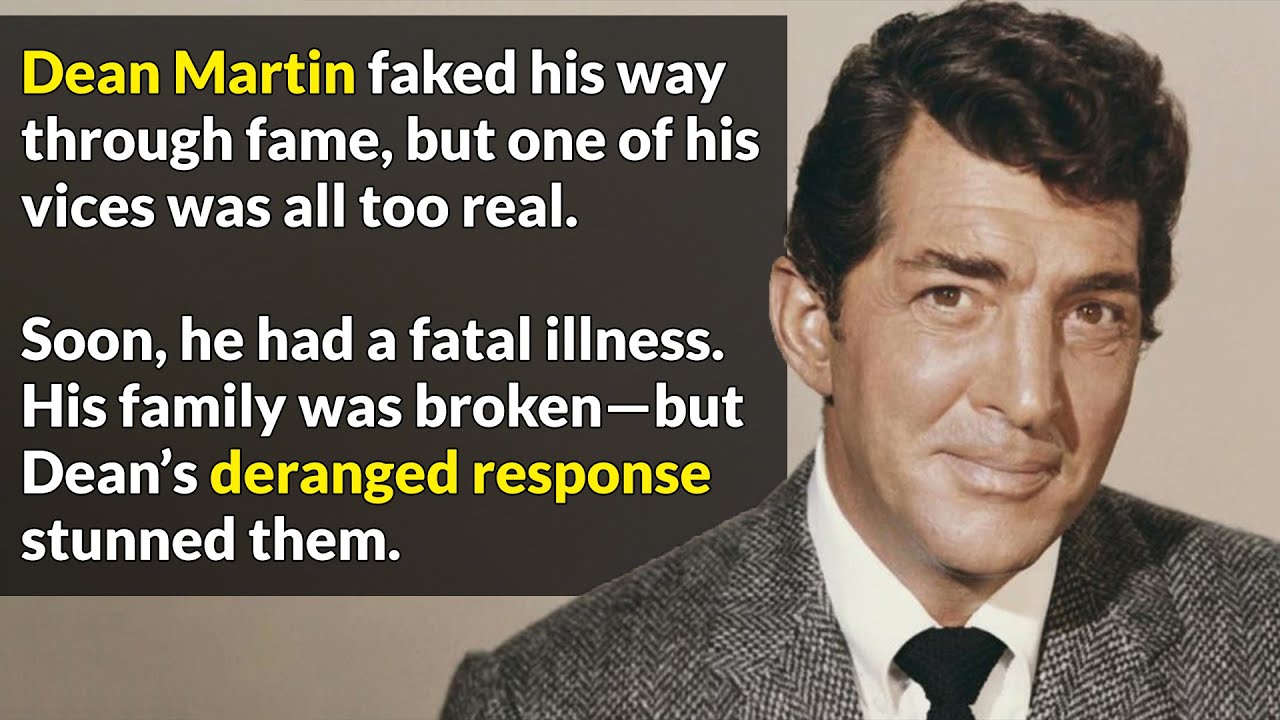
The man the world knew as the king of cool, the hard-drinking, chain-smoking playboy who seemed to glide through life with a glass of scotch in one hand and a cigarette in the other, was a carefully constructed illusion. Dean Martin, born Dino Paul Crocetti in Steubenville, Ohio, on June 7, 1917, was a shy, stammering child of working-class Italian immigrants who spent his early years being bullied for his broken English and thick accent. The legend of Dean Martin, the effortless entertainer who never seemed to break a sweat, was built on a foundation of struggle, pain, and a relentless drive to escape a life of poverty and violence.
He dropped out of school as soon as he could, following his father into the hellish conditions of a steel mill, but that brutal labor was just the beginning of a journey that would take him from illegal boxing rings to the highest peaks of Hollywood stardom, and ultimately, to a tragic end that few saw coming.
 Before he was the crooner who made women swoon, Dino Crocetti was a bootlegger during Prohibition, running liquor for shady characters and learning the hard edges of the street. Those years of defending himself against bullies prepared him for an even more brutal profession: prize fighting. Under the ring name Kid Crochet, he fought for money, but the ring was just a stepping stone.
In a desperate bid for rent money, he moved into a New York City apartment with another young Italian named Sunny King, and the two of them ran a secret fight club out of their home, charging patrons to watch them bare-knuckle box until one was knocked unconscious. It was a savage, dangerous way to survive, and Martin quickly realized he preferred to keep his teeth. He landed a gig at an illicit speakeasy casino, working the roulette tables and dealing cards, and it was there, in the smoky, shadowy lounges of the underworld, that he discovered his true calling.
He started singing, mimicking crooners like Perry Como, and the crowds loved him. He joined a popular local band, earning steady paychecks, but the name Dino Martini was holding him back. The anti-Italian sentiment that had ruined his school years reared its head again, and the bandleader, Sammy Watkins, told him he needed a new name.
Dean Martin was born, and the rest, as they say, is history.
Martin married for the first time at 24, to a woman named Betty McDonald, who married Dino Crocetti, the struggling lounge singer. They had four children together, but as Dino Crocetti transformed into Dean Martin, the marriage began to tear apart. In the mid-1940s, Martin found himself in the same lineup as a boisterous young comic at New York’s Glass Hat Club.
The kid’s name was Jerry Lewis, and right away, Martin could tell there was something special about him. Neither of them knew it at the time, but this was the start of one of the most beautiful and bitter feuds in show business history. They decided to work together, debuting as Martin and Lewis in Atlantic City in 1946.
It was a total, unmitigated disaster. The crowd wasn’t having it, and the club owner told them they had to come up with a better act before their second show or they’d be fired. Huddling in a dark alley behind the club, they decided to just wing it, throwing everything they had at the audience.
Martin sang, Lewis performed skits, and they ad-libbed banter throughout. It was a complete Hail Mary that somehow worked. The crowd went nuts, and the duo never looked back.
Their act quickly transformed into a sensation, taking them all over the Eastern Seaboard and eventually to New York’s legendary Copacabana. They made their TV debut in 1948 on the Sullivan Show to a rapturous reception, and they were ready to take their act into TV and film. But while Dean Martin’s career was rising, his marriage was going up in flames.
Betty McDonald preferred the struggling Dino Crocetti to the successful Dean Martin. They divorced in 1949, with Martin gaining full custody of their four children. McDonald retreated into obscurity in San Francisco, while Martin wasted no time finding a new woman.
He married Jeanne Biegger, a former Orange Bowl Queen, mere months after his divorce. Jeanne proved to be Martin’s longest love, and they remained married for nearly 25 years, though it was far from wedded bliss. In 1949, Martin appeared in his first movie, My Friend Irma, earning $75,000 with Lewis, but that was peanuts compared to what was coming.
Their agent negotiated one of the best deals in Hollywood history, giving them complete control over one film a year, as well as final say over all nightclub, radio, TV, and record appearances. That deal netted them millions, and the dynamic duo was quickly on their way to conquering Hollywood.
 But this was when the cracks started to show. No one could deny the chemistry between Dean Martin and Jerry Lewis on stage, but when the curtain fell, it was a different story. While Lewis always got to be the funny man, Martin felt trapped by always playing the straight man.
He wanted to mix up their formula, but Lewis refused. Martin grew more and more bitter, and the relationship grew tense and uncomfortable. Critics heaped praise on Jerry Lewis, claiming he was the real talent, while Martin seethed.
Lewis basked in the adulation, unconcerned and unsympathetic. Finally, while promoting their 1954 film Living It Up, something happened that pushed Martin too far. They posed for a promotional photo shoot for Look magazine, but when Martin saw the final cover, his blood ran cold.
They had completely cropped him out of the photo, leaving only Lewis on the cover. Martin was ready to move on, but they still had to finish their last movie together, Hollywood or Bust. Despite their playful attitude on screen, the set became excruciatingly awkward.
Martin and Lewis refused to speak to each other whenever the cameras weren’t rolling. Years later, Lewis would finally reveal the truth in his memoirs, placing the blame squarely on his own shoulders. The 50s saw him become one of the biggest stars in Hollywood, and all that success went straight to his head.
He treated the people around him like dirt, Martin included. Martin snapped, looked his old partner in the eye, and said, “To me, you’re nothing but a dollar sign.” They broke up for good in 1956, exactly 10 years after they first teamed up.
Lucky for Dean Martin, Jerry Lewis wasn’t his only friend in show business. He also happened to know another popular lounge singer, one he had met back in the 40s when he was still struggling. As Martin’s solo career grew, he and Frank Sinatra became friends.
In the late 50s and early 60s, Martin and Sinatra formed the Rat Pack, named after an earlier social circle of Hollywood artists. With Sinatra and Martin at the center, this legendary group included Sammy Davis Jr. , Peter Lawford, and Joey Bishop.
Their charm, style, and banter made them legends, and they knew the perfect place to take their act: Las Vegas. On any given night, you might see one, two, or all of them take the stage at one glamorous casino or another. The Rat Pack reached their height in the 1960s, pushing boundaries in ways no one expected.
Their jokes revolved around taboo themes like Martin’s heavy drinking and Sinatra’s constant womanizing. The group also delved into politics, supporting the civil rights movement and refusing to perform at clubs that barred African American or Jewish performers. Martin had made his name next to Jerry Lewis and then next to the Rat Pack, so it was time for him to set out on his own.
The Dean Martin Show began its 264-episode run in 1965. He completely improvised every show, which often set him down scandalous tangents. His off-the-cuff use of Italian curse words was charming to most American viewers, but NBC received a deluge of complaints from people who spoke the language.
 Despite the controversies, Martin was so popular he could continue doing whatever he wanted, and what he wanted to do was less. When he renegotiated his contract, he included a clause that meant he didn’t have to attend rehearsals. He struck a deal that let him spend the whole week on the golf course, only showing up for tapings.
By this point, he had an infamous reputation as a drinker, and his antics only added fuel to the rumors. But that wasn’t the whole picture. Dean Martin was America’s most lovable drunk, from the glass of scotch that remained in his hand throughout all his performances to his vanity license plate that read DRUNKY.
Everyone knew that Martin was the Rat Pack’s booze hound, but actually, the drink in his hand on stage was apple juice more often than not, and he was usually the first to call it quits at parties, preferring to spend time at home with his family. The whole lovable drunk shtick was an act, but the problem was he was too good of an actor. He played an alcoholic so convincingly in movies like Some Came Running and Rio Bravo that the tabloids started writing about his not-so-secret addiction.
When he became a singer, Dean Martin left his shady past as a bootlegger and bare-knuckle boxer behind, but that life still stalked him at every turn. His pal Frank Sinatra had mob connections all across the country, and the Rat Pack often performed for gangsters. One of the most infamous mobsters connected to the Rat Pack was Meyer Lansky, and Lansky had a beautiful daughter named Sandra.
Years later, Sandra dropped a bombshell in her memoirs, claiming to have had a passionate affair with longtime family man Dean Martin. The details were scandalous. According to Lansky, her affair with Martin occurred while his wife was pregnant with their daughter Gina.
She claimed that the pair had an unspoken pact to never discuss their families when they were together, so she didn’t know about it until later.
For decades, Dean Martin seemed on a constant upward trajectory. In 1972, however, he began to fall back to Earth. He filed for divorce from his wife of over 20 years, and just a week after that, the Riviera in Las Vegas canceled their contract with him because they thought he was too demanding.
Now 55, Martin was in the midst of a full-blown midlife crisis. Less than a month after his 24-year marriage ended, he wed Catherine Hawn, the receptionist at a Beverly Hills hair salon. He was 55, and she was 26.
They divorced less than three years later. Clearly, Martin was having some woman troubles, but in the midst of all that, he was about to rekindle one of the most important relationships of his life. Martin hadn’t spoken to Jerry Lewis in 20 years, so Frank Sinatra came up with a devious plan to change that.
During a telethon for the Muscular Dystrophy Association, Sinatra stunned Lewis by bringing Dino out on stage. The two men embraced, and the crowd erupted. They were never as close as they had once been, but they maintained a healthy friendship for the rest of Martin’s life.
Despite his onstage persona, Dean Martin was a family man first and foremost. He had eight children whom he loved and supported. He named his first son with his second wife after himself, and young Dean Paul Martin soon grew into the apple of his father’s eye.
 He sang and acted just like his pops, played professional tennis, and even became a fighter pilot. Dino brought immeasurable joy into his dad’s life, which made his terrible end all the more devastating.
On March 21, 1986, the 35-year-old Dean Paul Martin took part in a routine training mission over the California desert. During the exercise, his plane disappeared from radar over a particularly cloudy mountain range. The son of one of America’s most popular entertainers was missing, and the search was on.
Search helicopters and planes spent days scouring the mountains for any sign of Dino’s plane but came up with nothing. President Ronald Reagan, a longtime friend of Martin, even sent the nation’s most advanced spy plane to join the search. Meanwhile, Martin sat at home praying for news that the search parties had found his son alive.
He was willing to do anything to find his son, even hiring two psychics to help in the search. One of those psychics pointed them toward San Gorgonio Mountain. Three days after the plane went down, the search party approached the mountain and found what they had been looking for.
Dean Paul Martin’s aircraft lay demolished on the mountainside. There were no survivors. Anyone close to Martin could tell that he just wasn’t the same after his son passed.
He was depressed, demoralized, and defeated. Sinatra, still seeking any way to help him, dragged him along on a massive stadium tour, hoping to take his mind off his grief. Unfortunately, the plan backfired horribly.
Sinatra thought the adoring crowds would shake Martin out of his stupor, but they had the opposite effect. Martin vastly preferred smaller nightclub audiences, and he felt disconnected from the sea of faces in large stadiums. Old Blue Eyes still wanted to party until dawn as they had in the 60s, but Martin was old, tired, and depressed.
The tour had barely begun, and Martin was already at his breaking point. After a show in New York City, Frank was ready to party, but Martin had no interest in reliving the old days. Later that same night, he got on his private jet and flew back to LA, leaving his friends to continue the tour without him.
After his son’s passing, Martin put his career on the back burner and spent as much time as possible with his growing family. Unfortunately, he didn’t have that much time left. Martin may have walked the stage with apple juice in his glass, but the smokes were real.
In September 1993, doctors at Cedars-Sinai diagnosed him with lung cancer. They told him that he needed surgery immediately to prolong his life. To his family’s dismay, Martin refused the surgery and resigned himself to his fate.
He retired from public appearances at the start of 1995 and spent his final year with family and friends. He succumbed to acute respiratory failure at his Beverly Hills home on Christmas Day 1995 at the age of 78. Not much dims the bright lights of the Las Vegas Strip, but the passing of Dean Martin did.
The casinos where he had tread the stage for so many years all brought their lights low in his honor. It was a fitting tribute to the king of cool, a man who had spent his entire life hiding the pain, the struggle, and the heartbreak behind a carefully crafted mask of effortless charm. The world thought they knew Dean Martin, but they only knew the character he played.
The real man, Dino Crocetti, was a shy, stammering boy from Ohio who fought his way out of the steel mills and the boxing rings, who lost his best friend and his son, and who faced his own mortality with a quiet dignity that no one ever saw coming. The legend was wrong, but the truth is far more compelling.