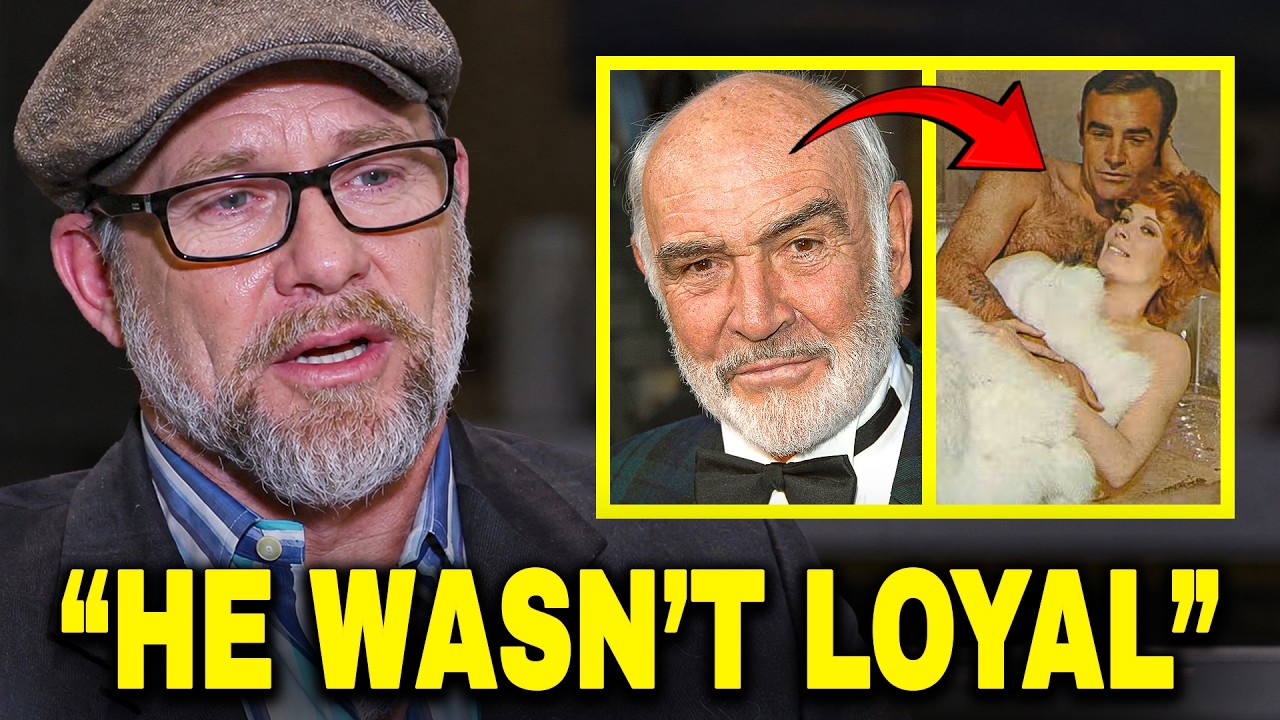
Sean Connery spent decades building one of Hollywood’s most guarded public images, but after his death, his children revealed a more complicated side to the man behind the fame. From a working-class childhood in Edinburgh to his transformation into the first James Bond, his life was marked by hard work, near misses, and controversies that never fully faded. Connery was born into poverty in Edinburgh, where his father worked in a factory and drove trucks while his mother cleaned houses to make ends meet. Before he turned 16, he was delivering milk through the city streets in the early morning hours.
He later admitted that at 14 he lost his virginity to an older woman serving in the Auxiliary Territorial Service during World War II. When he turned 16, he joined the Royal Navy, getting tattoos and training at the Gunnery School before serving on an anti-aircraft crew. His military career ended abruptly, however, when doctors discharged him on medical grounds after he developed a painful duodenal ulcer. Back in Edinburgh, he took whatever work he could find, including driving trucks, working as a lifeguard, polishing coffins, and modeling for art students.
Around that time, Connery became obsessed with bodybuilding, entering competitions and building an impressive physique. But he refused to give up football, a sport he loved growing up in Scotland. At just 23, he received an offer to join Manchester United, one of Britain’s most prestigious clubs. After initial excitement, he turned the offer down, worrying that a football career would be too short and leave him struggling later in life.
Instead, he auditioned for a local production of South Pacific and landed a role as a chorus member. Acting began to feel like a genuine future, and he slowly built a career throughout the 1950s with stage plays, television roles, and small film parts. During that time, he fell deeply in love with a woman named Carol Soppel, but the relationship ended because her Jewish family disapproved of her being with him. One night, members of the feared Valdor gang tried to steal his jacket in a pool hall.
When they followed him home later, six of them attacked him, but Connery fought them all off and earned a reputation as one of Edinburgh’s toughest men. Away from the streets, however, he was devoted to becoming a serious actor, reading Shakespeare, Ibsen, Tolstoy, and Proust, and taking elocution lessons to soften his thick Scottish accent. His big break came when he landed a role opposite Hollywood star Lana Turner in Another Time, Another Place. While filming in England, he offered to show Turner around London, an innocent gesture that enraged her boyfriend, American mobster Johnny Stompanato.
Stompanato flew from Los Angeles to confront Connery and pulled a gun on him. Connery disarmed him and knocked him to the ground, and producers banned the mobster from the set before Scotland Yard deported him. Even as his reputation grew, not everyone was immediately impressed. Photographer Julie Hamilton found him rough and off-putting when they first met, but changed her mind when she saw him in a traditional Scottish kilt.
She later described him as the most handsome man she had ever seen, and the two moved in together in London. In 1960, Hamilton was diagnosed with tuberculosis, and Connery turned down a major role in El Cid alongside Charlton Heston to stay home and care for her. The relationship ended suddenly when Connery admitted his feelings for actress Diane Cilento had changed after remarking on her eyes. Years later, he promised Hamilton that if he ever had a son, he would name him Jason in her honor.
Ironically, his relationship with Cilento introduced him to producer Harry Saltzman, who was looking for someone to play James Bond in an adaptation of Ian Fleming’s spy novels. Casting became a headache for producers. Fleming favored established stars like Cary Grant, who was only willing to do one film, and a nationwide talent search produced a winner who could not act. Connery walked into his audition wearing wrinkled clothes and behaving exactly like himself, relying on natural confidence and toughness rather than polished charm.
It worked, and he was cast as Bond in Dr. No, a decision that transformed his life and cinema history. Not long before the film premiered, Cilento finalized her divorce and discovered she was pregnant. Connery proposed, and the couple planned a secret ceremony in Gibraltar to avoid attention.
Political tensions in the region nearly derailed the wedding when Cilento was detained at the border over a passport issue and missed her ferry, but she made it in time. They soon welcomed a son, whom Connery named Jason, keeping the promise he had made to Julie Hamilton. Diane stepped away from acting to raise Jason and support her husband, accompanying him to the set of From Russia with Love. Fleming, who had originally preferred Roger Moore, changed his mind after the films became hits and began writing Bond with more of Connery’s personality before his death in 1964.
But Bond brought Connery growing frustration, and he worried about being trapped in the role. By 1965, Diane announced she was leaving him and taking their son with her. Connery quietly packed his belongings and left the family home before she even had the chance. They briefly reunited while he filmed Thunderball, but the marriage was hanging by a thread, with shouting matches echoing across the set.
Connery’s career continued to soar while Diane’s stalled, creating friction and competition between them. Through it all, Connery used his success to gain leverage in Hollywood, securing a role in Alfred Hitchcock’s Marnie to prove he could be more than just a spy. During filming of Thunderball, Connery insisted on doing many of his own stunts. One scene required him to swim through a pool filled with live sharks.
Crew members installed a plexiglass barrier to protect him, but a small gap remained, and one shark slipped through. Connery scrambled out of the water just in time, narrowly avoiding a horrific accident. By the end of the 1960s, Connery was exhausted. Before production began on You Only Live Twice, he told the studio he was finished with Bond.
He and Diane officially separated in February 1971. The producers signed George Lazenby to replace him, but Lazenby quit after just one film, leaving the franchise in crisis. Connery agreed to return for Diamonds Are Forever, negotiating an enormous salary and demanding that the studio finance two personal projects. He later used much of that paycheck to establish a trust fund supporting young Scottish artists.
After that, Connery enjoyed new freedom, working with director Sidney Lumet, starring alongside Michael Caine in The Man Who Would Be King, playing Robin Hood in Robin and Marian, and appearing in Murder on the Orient Express. Not every gamble paid off. In 1974, he starred in the strange science fiction film Zardoz, remembered largely for its unforgettable bright red costume. Director John Boorman later said Connery accepted the role because work had become surprisingly hard to find after leaving Bond.
By the early 1980s, Connery agreed to play Bond one final time in Never Say Never Again. The title came from his wife, who jokingly suggested it after he repeatedly insisted he would never play Bond again. Production descended into chaos, with Connery demanding script changes, choosing writers himself, and stepping in to solve problems. During fight training, martial arts instructor Steven Seagal accidentally broke his wrist.
When filming ended, Connery stepped away from acting altogether for nearly two years. He returned with a performance in The Untouchables that earned him the Academy Award for Best Supporting Actor, followed by the role of Professor Henry Jones in Indiana Jones and the Last Crusade. Controversy soon followed. In 1993, singer-songwriter Lynsey de Paul claimed she had secretly dated Connery while he was married.
Connery denied the allegations. Danish journalist Hell Burn later made similar claims, and Connery again denied everything. His wife chose not to comment publicly and remained by his side. Connery was also a strong supporter of Scottish independence, and his outspoken political views reportedly complicated his chances of receiving a knighthood.
He was passed over in 1997 and 1998, but in 2000, Queen Elizabeth II knighted him, officially making him Sir Sean Connery. In the late 1990s, Connery took on The League of Extraordinary Gentlemen, a production that became a nightmare. He and director Stephen Norrington clashed constantly, with tensions growing so intense that the two nearly came to blows. When Norrington failed to attend the film’s premiere, a reporter asked Connery where the director was.
Connery suggested they check the local asylum. The film became his final live-action role, and in 2006, he officially confirmed his retirement, saying he had grown tired of dealing with what he saw as the fools running modern Hollywood. Long after his retirement, an old chapter returned to the spotlight. In 2006, Diane Cilento published her autobiography, making serious allegations that Connery had been physically and emotionally abusive during their marriage.
Connery strongly denied the accusations, saying he did not believe violence against women was ever justified under any circumstances. But reporters then uncovered interviews from decades earlier in which he suggested there were situations where hitting a woman was not necessarily wrong. In a 1965 interview he made such remarks, and in a 1993 interview with Vanity Fair he added that some women wanted that kind of confrontation. The comments sparked widespread criticism and became one of the most controversial parts of his legacy.
The Stompanato story also refused to fade. Not long after the mobster was deported from England, he was fatally stabbed inside Lana Turner’s home. Turner’s teenage daughter admitted to the killing, saying she had acted to protect her mother. Los Angeles mob boss Mickey Cohen became convinced the teenager had not acted alone and allegedly ordered a hit on Connery, believing he had both the strength and the motive.
After receiving a threatening phone call at the Roosevelt Hotel, Connery quietly changed hotels as a precaution and carried on with his work. The threat eventually faded when legal proceedings concluded, and Connery continued his career without further incident. On October 31, 2020, Connery’s family and the James Bond producers announced that he had passed away peacefully in his sleep at the age of 90 at his home in Nassau, Bahamas. His son Jason later shared that his father had been ill for some time before his death.
Jason said the family was heartbroken, even though they had known the day was coming, and that the loss was devastating for those who loved him personally and for millions of fans around the world.