Elvis Presley had already become a global phenomenon by 1957, when at just 22 years old, he bought Graceland, a 10,000-square-foot colonial mansion on 13. 8 acres in Memphis, Tennessee. Over the next 20 years, until his death in 1977, the mansion grew into the 17,552-square-foot estate visitors know today, complete with 23 rooms, eight bedrooms, eight bathrooms, and five staircases. The property had a history long before Elvis moved in.
Built in 1939 by Ruth Brown Moore and her husband, Dr. Thomas Brown Moore, the home was named after Ruth’s aunt, Grace Toof Ward. Elvis filled the estate with an unusual collection of animals, including horses, dogs, a turkey named Bow Tie, a chimpanzee named Scatter, wallabies, peacocks, and a squirrel monkey. The infamous Jungle Room featured green shag carpeting on both the floor and ceiling, faux wood walls, carved furniture, and an artificial waterfall.
It later became a recording studio where 16 songs from Elvis’s final two albums were recorded. He also installed wrought iron gates with guitar-playing figures of himself, added stained glass peacock panels in 1974, and built a racquetball building in 1975. Despite the extravagance, daily life at Graceland could be surprisingly ordinary. The kitchen was constantly stocked with everything from ground round steak and biscuits to Pepsi, pickles, peanut butter, banana pudding, and brownies.
While much of Graceland has since been opened to the public, one part remained closed: the upstairs, which contained Elvis’s master suite. When Elvis died suddenly on August 16, 1977, at just 42 years old, the news stunned the world. In the months before his death, he had been struggling with serious health problems, prescription drug dependence, and significant weight gain. His girlfriend, Ginger Alden, found him unresponsive in the bathroom connected to his master suite.
He was rushed to Baptist Memorial Hospital, where doctors pronounced him dead at 3:30 p. m. An autopsy was conducted that afternoon. Initially, Dr.
Jerry Francisco announced that preliminary findings pointed to cardiac arrhythmia and suggested drugs had not played a role. Weeks later, toxicology results revealed multiple prescription drugs in Elvis’s system, including powerful painkillers and sedatives. The pathologists also identified evidence of diabetes and other chronic conditions. The precise cause of Elvis’s death has remained the subject of debate.
Cardiac arrhythmia was the official conclusion, while later interpretations have pointed to the combined effects of heart disease, obesity, prescription drugs, and other medical problems. His personal physician, Dr. George Nichopoulos, later acknowledged that he had prescribed thousands of doses of medications to Elvis, arguing that he sometimes substituted placebos because he feared Presley would obtain drugs elsewhere. Following a public viewing at Graceland that reportedly drew around 25,000 mourners, Elvis was initially buried beside his mother, Gladys, at a nearby mausoleum.
After an alleged plot to steal his body was uncovered, their remains were moved to Graceland’s Meditation Garden, where Elvis now rests alongside his parents, grandmother, daughter Lisa Marie, and grandson Benjamin Keough. When Graceland opened to the public in 1982, the second floor remained firmly behind closed doors. The upstairs contained Elvis’s master suite, a deeply personal area that had been restricted even while he was alive. There was also a more difficult reason: Elvis died in the bathroom connected to that suite, and according to long-standing accounts, the area has remained largely untouched.
Only a very small number of people, including Priscilla Presley, Lisa Marie, and the property’s curator, were permitted access. Even presidents who visited Graceland were reportedly denied access. One famous exception was Nicolas Cage, who was married to Lisa Marie Presley and was given the rare opportunity to enter the upstairs area. The estate has consistently defended the decision to keep the space private, and Graceland does not publish photographs of the upstairs.
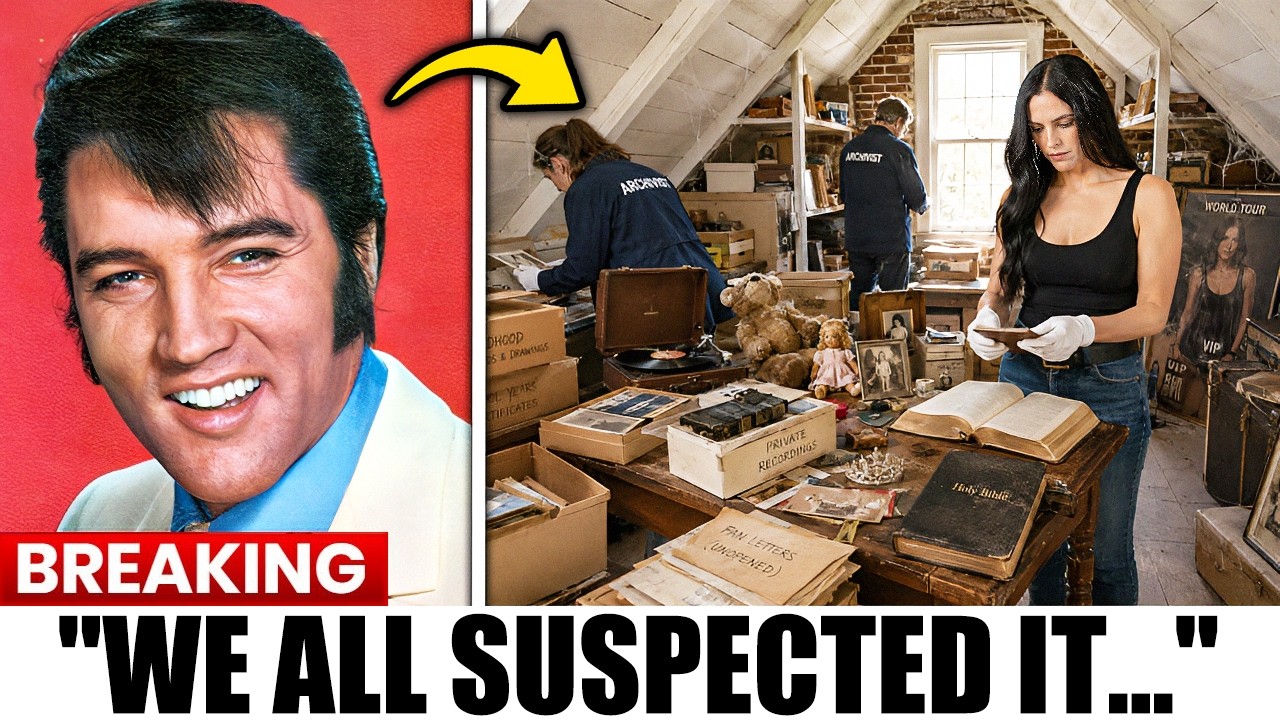
But above that private space was another area that remained hidden from public view: the attic. For 48 years, it sat locked away, untouched. When it was finally opened, the discovery was unlike anything anyone expected. According to archivist Angie Marchese, during a virtual tour of Graceland, the attic contained a mixture of family belongings and items Elvis no longer used.
Among the items were belongings that had belonged to Elvis’s mother, Gladys Presley, his army equipment, some of Lisa Marie’s baby clothes, old furnishings, and drapes. The attic was less like a secret room filled with glamorous treasures and more like a family storage space preserving pieces of the Presley family’s life. Gladys died in 1958 at only 46 years old while Elvis was beginning his military chapter, and her belongings remained part of Graceland. In 2024, Riley Keough, who became the sole owner of the Graceland estate after Lisa Marie’s death in 2023, offered an even more intimate look at the family’s history during an interview with Oprah Winfrey.
She showed some of Elvis’s most personal possessions, including a family Bible dating to 1957, Lisa Marie’s old golf cart key, and a battered black box Elvis reportedly carried everywhere. Inside were objects he considered deeply personal, including an American Express card that expired in 1972 and an old comb associated with his famous hairstyle. The battle over Elvis’s empire has been nearly as dramatic as his life. By the time his father, Vernon Presley, died in 1979, the family was facing serious financial problems.
Priscilla Presley became a co-executor and co-trustee and discovered just how difficult it was to maintain the estate. Elvis had earned an enormous amount of money, but lavish spending, expensive upkeep, and questionable business decisions had taken their toll. There was also the problem of Colonel Tom Parker, Elvis’s long-time manager, who had taken commissions that could reach extraordinarily high levels. Years after Elvis’s death, the estate accused Parker of fraud and mismanagement, leading to a lawsuit and an out-of-court settlement.
In 1982, Graceland opened to the public, transforming Elvis’s private home into a major tourist attraction and saving the estate financially. Lisa Marie inherited control of the trust in 1993, but she would eventually fight her own financial battles. In 2018, she sued her former business manager Barry Siegel, alleging mismanagement, while Siegel argued that Lisa Marie’s own spending was responsible. Then Lisa Marie died suddenly in January 2023, leaving behind a dispute over control of her estate that was eventually settled, with Riley Keough becoming the sole trustee.
Another battle developed around Priscilla herself. In 2021, she met auctioneer Brigitte Kruze, and the two entered into business arrangements centered on Priscilla’s name, image, and connection to Elvis. The relationship collapsed, and Priscilla accused Kruze and her associates of fraud and elder abuse, claiming she had been manipulated into signing agreements she did not fully understand. Kruze disputed those allegations.
The legal battle became part of a larger fight over Elvis memorabilia, including documents connected to Colonel Parker that the estate alleged had been improperly taken. Just when it seemed the estate had enough legal problems, a company called Nausany Investments produced documents claiming Lisa Marie had borrowed millions and used Graceland as collateral. Investigators determined the alleged loan was part of an elaborate fraud, and Missouri woman Lisa Janine Finley later pleaded guilty to mail fraud. The attic today remains off-limits, while many of its contents have been moved into the archives for preservation.
It does not contain one sensational secret. Instead, it holds something more valuable: pieces of the Presley family’s private life that fame could not erase.