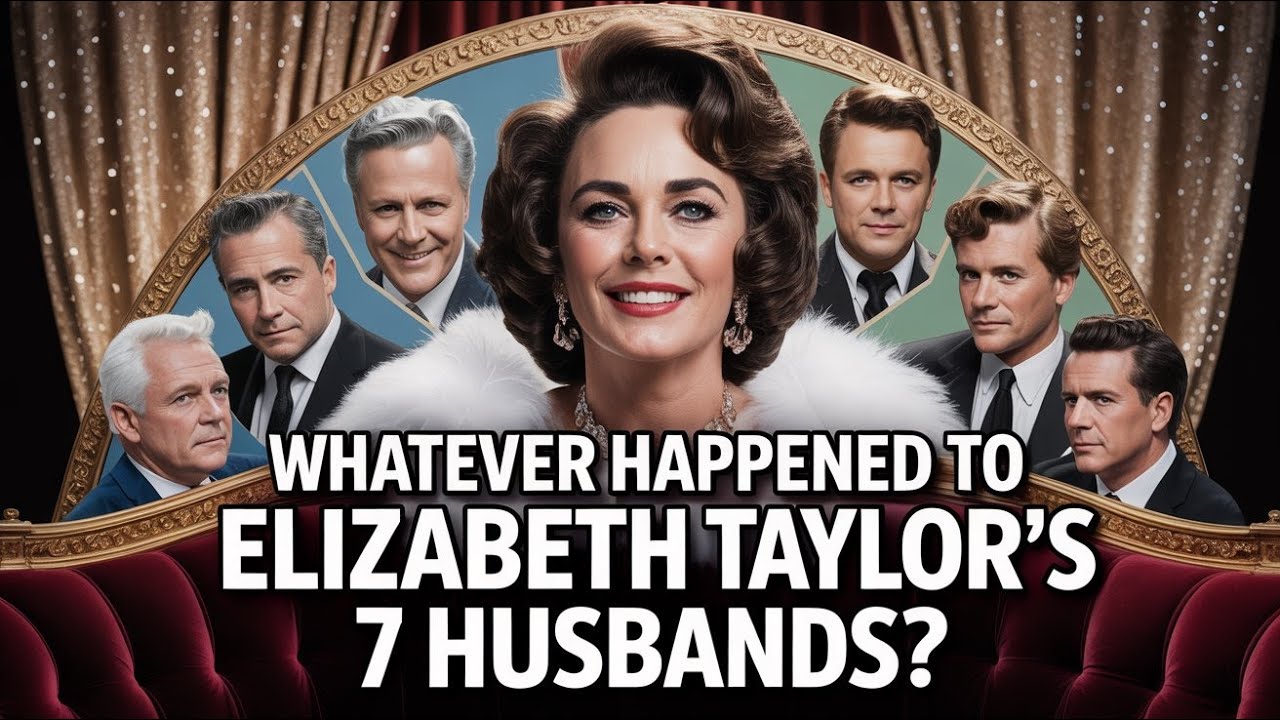
Elizabeth Taylor married seven times across her life, and each marriage marked a different stage in her personal evolution. Her first wedding, at age 18 to hotel heir Conrad “Nikki” Hilton Jr. , was promoted as a fairy-tale union between Hollywood royalty and financial fortune. The 1950 ceremony was even sponsored in part by MGM.
But the marriage collapsed within months. Hilton reportedly drank heavily, and Elizabeth later described emotional cruelty and physical abuse during their honeymoon. She filed for divorce after just eight months, a decision that put her in the public spotlight but also marked her first step toward asserting control over her own life. Her second marriage, in 1952, was to British actor Michael Wilding, who was 20 years her senior.
After the turbulence of her first marriage, Wilding offered calm and stability. They had two sons, Michael Jr. and Christopher. But as Elizabeth’s film career soared, Wilding’s career faded, and the couple grew apart.
The marriage ended in 1957, amicably, with both remaining committed to co-parenting. That same year, Elizabeth married producer Mike Todd, a larger-than-life figure who showered her with attention and affection. She later described this period as one of her happiest. Their daughter Liza was born in 1957.
In March 1958, Todd died in a plane crash. Elizabeth had planned to be on the flight but stayed behind due to illness. She was consumed by grief and later said she felt a part of herself had died with him. In the wake of Todd’s death, his close friend, singer Eddie Fisher, stepped in to comfort her.
Fisher was married to actress Debbie Reynolds at the time. What began as comfort turned into romance, and Fisher left Reynolds. The affair caused a major scandal, and Elizabeth was publicly labeled a homewrecker. They married in 1959, but the relationship quickly soured.
Fisher could not match the intensity of Elizabeth’s personality or her fame, and the marriage ended in divorce in 1964. She later admitted she had taken refuge in a mistake. While filming Cleopatra in Rome, Elizabeth began an affair with her co-star Richard Burton, who was also married at the time. The relationship became one of the most publicized romances in Hollywood history.
They married in 1964 and their relationship was marked by dramatic fights, reconciliations, lavish gifts, and heavy drinking. They starred in 11 films together. The couple divorced in 1974, then remarried in 1975, and divorced again in 1976. Despite the turmoil, Elizabeth consistently described Burton as the love of her life.
After his death in 1984, she revealed he had left unsent letters to her, and she kept a photo of him by her bedside. In December 1976, Elizabeth married U. S. Senator John Warner.
She traded movie premieres for campaign trails and political events in Washington. The transition was difficult; she later said she felt she had disappeared and became depressed in the role of a political wife. The marriage ended in divorce in 1982. By the early 1980s, Elizabeth was struggling with addiction to alcohol and prescription pills.
In 1983, she checked into the Betty Ford Clinic, becoming one of the first major celebrities to publicly confront addiction. During treatment in 1988, she met Larry Fortensky, a construction worker who was 20 years younger and unfamiliar with her fame. They married in 1991 at Michael Jackson’s Neverland Ranch, with guests including Liza Minnelli and Nancy Reagan. The marriage ended in divorce in 1996, but they stayed in touch, and she left him $800,000 in her will when she died in 2011.
Her first husband, Nikki Hilton, struggled with alcoholism until his death in 1969. Michael Wilding remarried and died in 1979. Eddie Fisher’s career never fully recovered from the scandal; he died in 2010. John Warner continued his political career and rarely spoke about their marriage.
Larry Fortensky returned to a quiet life in California. Elizabeth later reflected that she never became cynical about love. She described herself as a romantic realist who believed in love’s potential even after repeated heartbreak. She said each husband represented a different version of herself and a chapter in her growth.
Near the end of her life, her public legacy shifted from her film roles and marriages to her advocacy work, particularly her early and vocal support for AIDS research and awareness at a time when the issue was widely stigmatized.