For years, the story of Steve Carell’s departure from The Office was told as a clean, flattering narrative: he had decided the show had run its course, left at the top of his game, and moved on to Hollywood. The people who were actually there say that story is almost entirely wrong. Kim Ferry, the show’s hair stylist throughout its run, said plainly that Carell did not leave on his own merit and that he really wanted to stay. She described the loss as devastating to the crew because he was “the heart of our show.
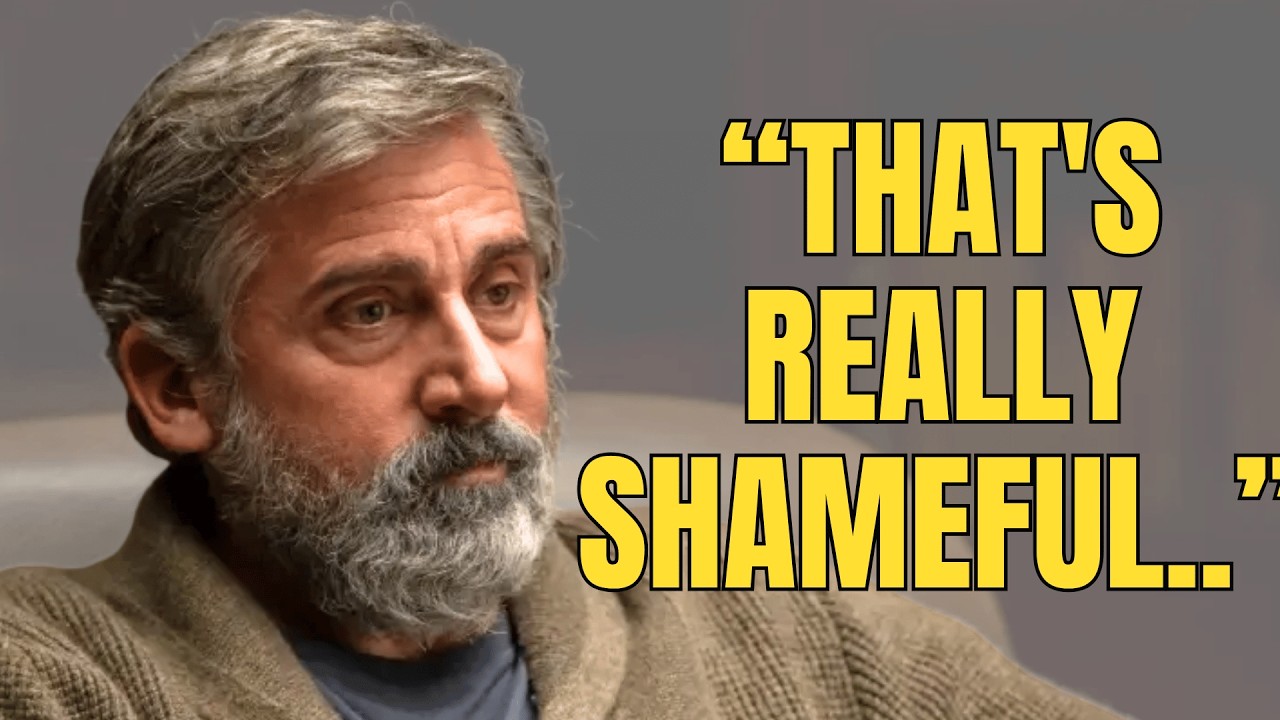
” Casting director Allison Jones called the whole situation “asinine,” and a boom operator who worked on every episode described a sequence of events that was ordinary, preventable, and driven by network inaction. Carell grew up in Acton, Massachusetts, the youngest of four boys. His father was an electrical engineer; his mother worked night shifts as a psychiatric nurse. He has said he made it his job to make her laugh when she came home exhausted, and that her laughter was the first audience that mattered to him.
He studied at Denison University, trained at Second City in Chicago, and worked a stretch at a post office before any of it paid off. His first significant television job was a sketch on The Dana Carvey Show in 1996, which lasted just seven episodes before cancellation. What the brief run demonstrated was that Carell had a rare quality: he could play a man completely sincere about something completely absurd without breaking character or winking at the audience. That sincerity became the foundation of everything that followed.
From there he moved to The Daily Show with Jon Stewart, building a reputation among industry insiders even while the wider public remained unaware of him. His supporting role in Bruce Almighty in 2003 made him a distinct presence in a film already crowded with Jim Carrey. The following year, his small role as dim-witted weatherman Brick Tamland in Anchorman produced some of the most quoted lines from a film already full of them. Producer Judd Apatow had been watching.
He approached Carell about writing a feature together built around Carell as the lead. The result was The 40-Year-Old Virgin, about a middle-aged electronics store employee who has never had sex and is dragged toward changing that. The film worked because Carell made the character sympathetic without making him pathetic. It opened in August 2005, earned $177 million against a $26 million budget, and the chest-waxing scene — shot with five cameras in a single take, using actual wax and actual pain — became one of the most discussed moments in comedy that year.
The film changed Carell’s position in Hollywood overnight, from reliable supporting presence to genuine movie star. That timing mattered enormously for what came next, though not in the way anyone expected. The Office had already been picked up by NBC. Producer Greg Daniels was adapting the British mockumentary created by Ricky Gervais and Stephen Merchant.
The central challenge was the boss. In the British version, David Brent was a man of almost no redeeming qualities. Daniels understood that American network television required a lead who could sustain an audience over many seasons — someone viewers would want to be okay even when he was a disaster. Several actors were considered seriously, including Paul Giamatti, Philip Seymour Hoffman, and Bob Odenkirk, who came genuinely close.
When Carell auditioned, the decision became clear almost immediately. He understood that Michael Scott’s foolishness and inappropriate behavior were powered by a need to be loved so overwhelming that it had become the obstacle to getting it. Michael was not stupid; he was desperate, and desperation played by the right person is both funnier and sadder than stupidity. The first season premiered in March 2005 to cautious confusion.
The pilot was adapted almost directly from the British original, leaving audiences either feeling it was redundant or simply finding it strange and cold. Reviews were mixed, ratings decent but not remarkable. NBC renewed it partly as a bet on what Carell’s theatrical success would do for the show’s audience. In the second season, the show found exactly what it was.
Writers leaned into Michael’s insecurity, his need for approval, and the gap between how he saw himself and how he actually appeared. Carell made audiences laugh at Michael and feel for him in the same breath. Ratings increased by nearly 40 percent. The show won the Emmy for outstanding comedy series, and Carell won the Golden Globe for best actor in a television series.
For the next several years, he ran two parallel careers. The Office grew into the kind of show people quoted at work the way previous generations had quoted Seinfeld. Simultaneously, his film career expanded with Over the Hedge, Evan Almighty, Get Smart, Despicable Me, and Date Night. Smaller roles in Little Miss Sunshine and Dan in Real Life pointed quietly toward territory he had not yet fully pursued.
In April 2010, Carell gave an interview to the BBC in which he mentioned in passing that his contract ran through season 7 and that the upcoming season would probably be his last. He was thinking out loud, not making an announcement. What he expected — what any reasonable person in his position would have expected — was some kind of response from the network: a conversation, an offer, something indicating NBC understood what they had in him. What he got instead was silence.
Brian Wittle, the boom operator and sound mixer who worked on the show for its entire run, described the sequence in Andy Greene’s book The Office: The Untold Story of the Greatest Sitcom of the 2000s. When Carell realized he received no response from the network, Wittle said, he thought, “Oh, maybe they don’t really care if I leave. Maybe I should go do other things. ”
Kim Ferry added a detail that made the situation more specific.
Carell had not been waiting passively. He had told his manager he was willing to sign a new contract. His manager contacted NBC. The network was told explicitly that Carell was prepared to stay for another couple of years.
A deadline came and passed for NBC to make him an offer. They did not make one. “He was like, ‘Look, I told them I want to do it. I don’t want to leave.
I don’t understand,'” Ferry said. “It just is mind-boggling how that happened. I feel bad because I think a lot of people think he did leave the show on his own merit, and it’s absolutely not true. ”
Casting director Allison Jones described the network’s handling of the situation as “asinine,” noting that Carell had been planning to stay and NBC simply failed to make him an offer.
Producer Randy Cordray pointed to an additional factor: Bob Greenblatt had become chairman of NBC Entertainment in 2011, and by multiple accounts was not a particular enthusiast for The Office. The show that had been the network’s most reliable creative asset for half a decade did not have a champion at the top at the exact moment it needed one most. Carell’s final season as Michael Scott, season 7, was among the best work the show did with the character. The writers gave Michael an actual arc, forcing him to reckon with the fact that his co-workers genuinely cared about him despite everything.
He left not because he was pushed out, but because something better had finally arrived: Holly Holiday, the woman from HR who seemed to understand and accept him without reservation. The farewell scene — Michael’s last morning in the office, shot without a microphone because he had removed his lapel mic — became a television moment that does not happen by accident. Carell has said he walked into the scene expecting to manage it and was, in his own word, “annihilated. ” The cast was in tears.
The crew was in tears. Everybody knew what they were losing. After leaving, Carell did what the public story said he had always planned to do: he went to Hollywood and made movies. What permanently changed his trajectory was Foxcatcher in 2014, Bennett Miller’s film about John du Pont, the deeply troubled heir who funded a wrestling program and ultimately killed one of its athletes.
The role required Carell to become unrecognizable, suppressing every instinct toward warmth that had made Michael Scott lovable. Miller’s mandate was simple: if anyone recognized Steve Carell for even a moment, the film was over. People reported sitting ten minutes into Foxcatcher before placing the face. The Academy nominated him for best actor.
He did not win, but the nomination signaled what the industry had been slowly recognizing: the fundamental skill — complete commitment, sincerity without irony — was the same in both comedy and drama. He went on to The Big Short, Beautiful Boy, and The Morning Show on Apple TV+, where he played a morning television anchor navigating the consequences of his own behavior in an era of accountability. When Stephen Colbert asked where that character had come from, Carell said, “It was completely fictional. ” The audience laughed at the obvious parallel to Michael Scott.
But the parallel was not quite right: Michael wants to be loved and does not understand why he keeps failing. Mitch Kessler wants to be exonerated and does not understand why that is not the same as deserving to be. The Office has become more widely watched since it ended than it ever was on air. By 2018, after Netflix acquired streaming rights, it was the most watched program on the platform — ahead of every Netflix original, ahead of Friends, ahead of everything.
A new generation found it and discovered a workplace full of ordinary people led by a man so convinced of his own specialness that the gap between his self-image and reality had become an ongoing tragedy dressed as comedy. When Carell sat across from Colbert and heard for the first time that The Office was beating everything on Netflix, his response was a single word: “Good. ”
The truth about why he left is not dramatic. A network had something irreplaceable and treated it as replaceable.
A man who wanted to stay was never asked to. A hair stylist, a boom operator, and a casting director watched it happen and spent years trying to correct the record. Steve Carell did not walk away from The Office.
Through the indifference of the people running NBC at a critical moment, The Office walked away from him.