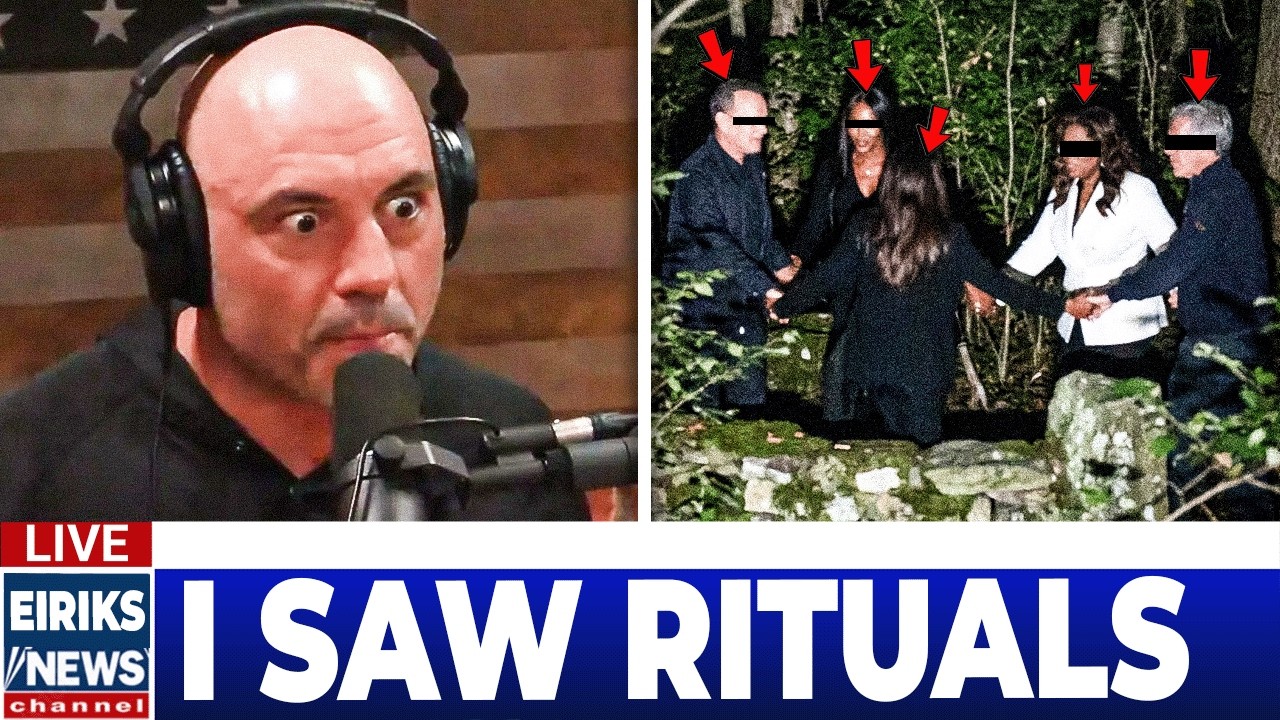
Joe Rogan has repeatedly used his podcast to describe Hollywood as an industry built on exploitation, coercion, and silence. Among his most striking claims is a story about a 1960s-era Hollywood executive who reportedly built a full bedroom inside his own office, before ever meeting the people who would walk through his door. According to Rogan, citing director Quentin Tarantino, the room was built in advance because the executive already knew exactly what he would ask of those seeking stardom. Rogan has said on his show that “the devil runs Hollywood,” a phrase he has used to describe an entertainment system in which success often requires trading something private or personal.
He and his guests have described this as a long-standing pattern, not an isolated scandal. The claim is that a small group of directors, producers, and music executives held the keys to fame and built their worlds around that unchecked power. Among the examples Rogan has discussed is comedian Dave Chappelle, who walked away from a reported $50 million to $100 million deal with Comedy Central in 2005. Chappelle left the country, flew to South Africa, and effectively disappeared from an industry that had just offered him life-changing money.
He later explained his decision using a parable about a baboon that traps itself by refusing to let go of salt inside a hollow log. Chappelle said he was smart enough to let go of the salt. Rogan has also pointed to the late Richard Pryor, who allegedly spoke openly about private parties in Malibu attended by the most powerful people in entertainment. According to Rogan’s retelling, Pryor said that anyone who talked about what happened at those gatherings quietly disappeared from the industry.
The punishment was silence: no explanation, no invitations, no career. The conversation has also circled around Justin Bieber and Corey Feldman, both of whom grew up inside the industry as children and have spoken emotionally about the harm they experienced. Rogan and his guests have noted that both men have stopped short of revealing the full story. In Bieber’s case, a widely discussed detail involves a period of 48 hours when Sean “Diddy” Combs reportedly had guardianship over him.
Bieber has since spoken openly about regretting how his childhood in the industry played out. The discussion around Diddy has intensified in light of his 2024 arrest on federal charges including sex trafficking and racketeering, as well as multiple civil lawsuits alleging sexual assault and abuse. Rogan and his guests have referenced compromising information, unfavorable contracts, and the use of drugs as tools of control, describing a system designed to trap people before they fully understand what they have signed. The article also turns to Oprah Winfrey and Harvey Weinstein.
For years, the two moved in the same circles and were photographed together. When the Weinstein scandal broke, singer Seal posted a photo of Winfrey and Weinstein standing arm-in-arm with the caption, “You knew and you said nothing. ” Winfrey later called the scandal a watershed moment and said many women in the industry felt pressured to smile, look the other way, and pretend nothing happened just to keep their jobs. Seal later clarified that his post was about the hypocritical and double-standard nature of Hollywood, not an attack on Winfrey personally.
Rogan has highlighted a particularly damning detail about Weinstein: reports indicated that harassment payouts were written directly into his business contracts. The more claims that piled up, the higher the penalty number climbed. This means his own company planned for his behavior in advance, in writing, before it even happened again. Despite decades of allegations and settlements, Weinstein continued working because the industry around him looked the other way.
He was eventually convicted of rape and sexual assault in New York and separately in Los Angeles, though his New York conviction was overturned on appeal in 2024. The article then connects these threads to Ellen DeGeneres and the death of Stephen “Twitch” Boss. Boss was the executive producer of The Ellen DeGeneres Show for nearly eight years. The show ended in 2022.
Weeks later, Boss died by suicide. Rogan and his guests have noted that there was an on-camera moment involving Diddy that reportedly left Boss visibly shaken, and questions about the timing of his death have never been fully answered. Boss was not an outsider; he was inside the circle every day, present for every booking and every guest who walked through those studio doors. A death that “still does not add up” is referenced in the video, without reaching a definitive conclusion.
The article also revisits a 2014 appearance by Jim Carrey on Jimmy Kimmel Live, during which Carrey made a hand sign connected to secret society symbols, grinning directly at the camera. At the time, it seemed like a joke. Years later, when the Epstein flight logs were unsealed, that moment began to look less like a joke and more like a warning. Rogan’s long-time guest Eddie Bravo had been talking about the same network for years before the documents became public.
Even Chris Tucker’s name appeared on the flight records. When asked about it, Tucker said he had no idea who he was really flying with and thought he was just joining a group of diplomats on a trip to Africa. Whether true or not, it illustrates how easily even famous and powerful people could become connected to that network. The pattern that runs through all these stories is consistent: a system that rewards silence, punishes those who speak, and protects the powerful at the expense of the vulnerable.
Rogan has positioned himself as one of the few public figures with a large enough platform to say these things out loud, and he continues to ask the same question, at what point does simply being close to something like this stop being an accident and start making you part of it?


