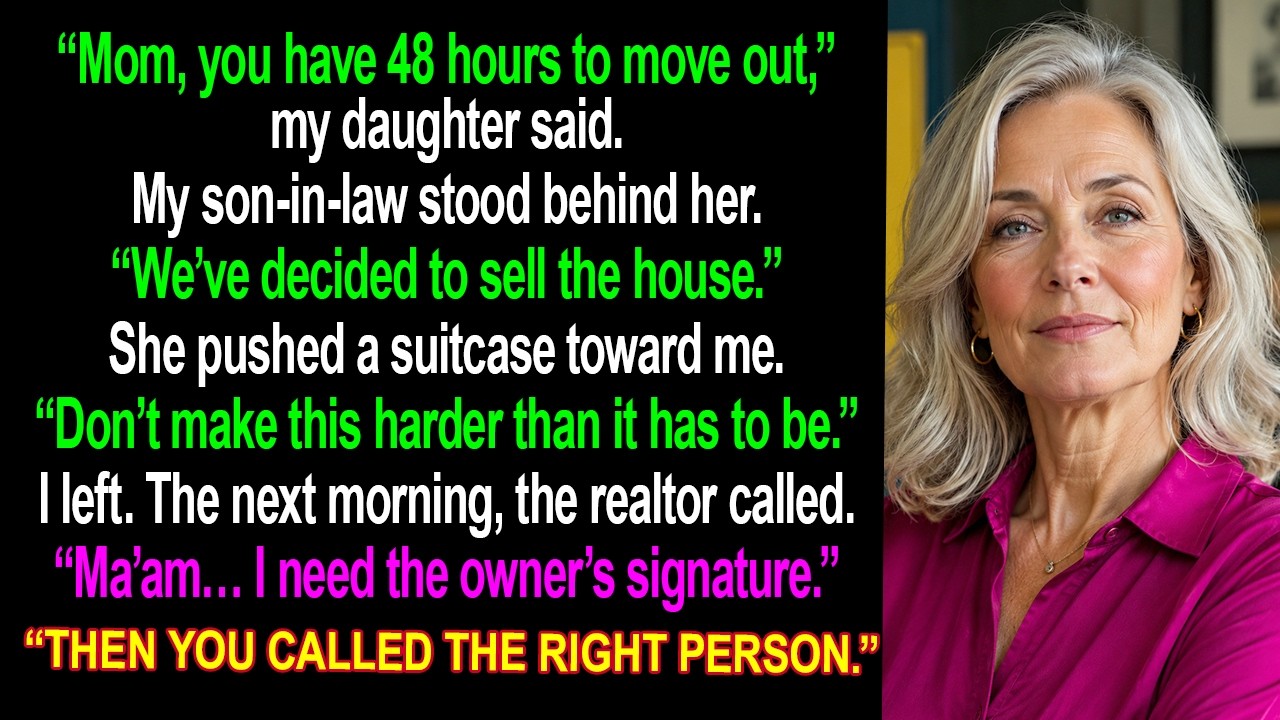
My daughter stood in my kitchen, one hand on the handle of an empty navy blue suitcase, and told me I had forty-eight hours to move out. For a second, I thought I’d misunderstood her. “We’ve decided to sell the house,” Jason said from the doorway, arms crossed. I looked from him to my daughter.
“Since when was that your decision to make? ”
She pushed the suitcase toward me. “Mom, don’t make this any harder than it has to be. ”
Twenty-four hours later, a real estate agent called me.
“Mrs. Sullivan, I’m sorry for the confusion, but before anything can move forward, I need authorization from the legal owner. ”
I smiled. “Then you called the right person.
”
To understand why my own daughter believed she could sell my house, you have to understand what happened the morning before that phone call. I’m Margaret Sullivan—Maggie, to everyone who’s known me. I was sixty-two, widowed six years, retired after over thirty years in county administration. Thomas and I had bought the house on Hawthorne Lane nearly thirty years earlier.
We raised my daughter, Aaron, there. We paid off the mortgage there. And after Thomas died, I learned how to live alone there. At least I had been, until two years ago, when Aaron, Jason, and their daughter Lucy needed somewhere to stay.
That morning had begun like hundreds of others. I was at the kitchen table with coffee and the newspaper when Aaron walked in carrying that navy blue suitcase. “Going somewhere? ” I asked.
She didn’t smile. “Mom, we need to talk. ”
Jason appeared behind her. He said nothing, which told me something was wrong.
He usually came in talking about work, the weather, whatever repair he thought the house needed next. Aaron pulled out a chair but didn’t sit. “Mom, you have 48 hours to move out. ”
I actually laughed once—not because it was funny, but because my mind rejected the sentence.
“Move out of where? ”
“Here. ”
I put down my coffee. Jason stepped forward.
“We’ve decided to sell the house. The market is good. This place is worth more than you realize. ”
“I know what my house is worth.
”
“You don’t need four bedrooms anymore. The upkeep is getting to be too much, and all this equity is just sitting here. ”
Thomas used to say that when someone talks about your money as if it were wasted simply because you still had it, you should pay very close attention. Aaron finally sat down.
“We found a really nice 55-plus community for you. Smaller place, no yard work. You’d have people your own age around. ”
“You found me an apartment.
”
“It’s not like that. ”
“What is it like? ”
Jason sighed. “If we sell now, there’s enough equity for everybody to get some breathing room.
”
There it was. Not me. Everybody. I looked at Aaron.
“And exactly whose money would stop everybody worrying? ”
Her face tightened. “Why are you making it sound ugly? ”
“I haven’t made it sound like anything.
I’m asking whose house you’re selling. ”
Neither answered. Then I noticed a glossy folder on the counter. Inside were photographs of a newer house—stone front, large kitchen, fenced backyard.
Not a retirement apartment. A family home. For them. “You’ve already found another house.
”
Aaron lowered her voice. “We’re trying to think about everyone’s future. ”
“No, you’re planning everyone’s future. ”
Jason’s jaw tightened.
“We’ve lived like this for two years, Maggie. Something has to change. ”
That almost impressed me. They’d moved into my home because his contracting business was struggling.
I’d charged them no rent. Most months, I bought the groceries and paid every utility bill. And somehow my generosity had become an inconvenience to him. From upstairs came the sound of Lucy moving around.
My granddaughter was eleven. Whatever happened between the adults, I would not make that child listen to us tear each other apart. So I stood. Aaron seemed relieved.
“Thank you. ”
“For what? ”
“For understanding. ”
“I haven’t said I understand.
”
I walked to my bedroom, packed medication, clothes, my laptop, toiletries, important papers, and the framed photograph of Thomas I kept beside my bed. When I returned, Aaron pointed toward the suitcase she’d brought. “You forgot that? ”
“No.
” I lifted my overnight bag. “I have my own. ”
Jason took my silence as defeat. “You’ll see this makes sense once things settle down.
”
I put on my coat. At the door, I turned toward Aaron. She looked nervous now. Maybe she’d expected tears.
Maybe an argument. Maybe she needed me to fight so she could tell herself I was being unreasonable. Instead I said, “Make sure Lucy knows I love her. ”
Then I left.
My friend Denise opened her door twenty minutes later and took one look at me. “What happened? ”
“My daughter gave me 48 hours to leave my house. ”
She stared, then took my bag.
Later, over tea, she asked the obvious question. “Are you really going to let them sell it? ”
I looked at Thomas’s photograph. “I left the house, Denise.
” I took a slow sip of tea. “I didn’t give it away. ”
At 9:14 the next morning, my phone rang. “Mrs.
Sullivan, this is Ben Walsh. I’m a real estate agent. Jason Carter contacted me about potentially listing the property on Hawthorne Lane. ”
I said nothing.
His voice became more careful. “We had a preliminary conversation about pricing. Before preparing anything, I checked the county property records, and the ownership doesn’t match what I understood from our conversation. ”
“What did you understand?
”
“That you were downsizing and the family had agreed to sell. ”
“I agreed to nothing. ”
A pause. “No listing has been created, ma’am.
Nothing has been signed. That’s why I’m calling you. Before anything could move forward, I would need authorization and a signature from the legal owner. ”
I smiled.
“Then you called the right person. ”
But I wasn’t finished. “What exactly did my son-in-law tell you? ”
He was quiet a moment.
When he spoke again, his tone was careful. “Mrs. Sullivan, I don’t want to involve myself in a family disagreement. I can only tell you what was represented to me.
”
“I understand. ”
“Mr. Carter said you were ready to downsize and that he and your daughter were helping handle the details. He said paperwork makes you nervous.
”
For thirty-two years, I’d worked in county administration—budgets, contracts, permits, meeting packets, purchasing records. I’d spent most of my adult life dealing with paperwork. I almost laughed. “Did he tell you I’d authorized him to act for me?
”
“Not specifically. He presented it as a family decision. That’s why I checked the ownership before taking the next step. ”
Ben explained that no listing agreement had been prepared, no photographs scheduled, no property put on the market.
He’d only discussed possible value and general market conditions with Jason. When he pulled the public record, only one owner appeared. Margaret Sullivan. “I appreciate you calling me,” I said.
After we hung up, Denise set her coffee down. “Well, apparently I’ve become a nervous old woman who can’t handle paperwork. ”
“You? ”
“That’s what Jason told him.
”
Denise muttered something I won’t repeat. I went home long enough to retrieve the file box Thomas and I had always kept in the bedroom closet. I didn’t need the deed to know the house was mine, but suddenly I needed to see my name. There it was.
I also checked the county property record online. Margaret Sullivan. Nothing had changed. What had changed was the way my daughter and son-in-law had begun thinking about it.
That afternoon, I sat across from Rachel Monroe, a local attorney who handled residential property matters. I told her everything, including that Aaron, Jason, and Lucy had lived with me rent-free for two years. Rachel listened without interrupting. When I finished, she said, “First, based on what you’ve shown me, they have no ownership interest in the property and no authority to sell it for you.
”
I let out a breath I hadn’t realized I was holding. “Second,” she continued, “don’t let anger talk you into doing something unnecessary. They’ve been living there with your permission for a substantial period. Their exact occupancy status matters.
Don’t change the locks, shut off utilities, or put their belongings outside. ”
“I wasn’t planning to. ”
“Good. If you decide their permission to live there is over, we document that properly.
If they refuse to leave after the appropriate notice, there’s a court process. ”
That sounded slow, ordinary, almost boring. That was exactly what I wanted. I didn’t want revenge that required me to become somebody I wouldn’t recognize afterward.
“What would you do? ” I asked. Rachel smiled slightly. “I’m your lawyer, Maggie.
I tell you what you can do. You decide what kind of mother you want to be while doing it. ”
I thought about forty-eight hours. Then I said, “I want to give them 30 days.
”
Rachel studied me. “Are you sure? ”
“They have Lucy. She needs somewhere stable to land.
”
That was the difference between us, I suppose. They’d handed me a suitcase. I was still thinking about where their child would sleep. On my way back to Denise’s, I stopped at the house for more clothes and some financial records.
No one was home. On the kitchen counter sat the glossy folder I’d noticed the previous morning. It was open. I wasn’t proud of looking, but it was sitting on my kitchen table, and across the top of the page were the words “Sullivan house—estimated sale.
” I read it. There was a projected sale price, estimated commissions and closing costs, a number beside “Mom—condo on downsizing,” then “pay off debt, down payment, moving, furniture. ”
I sat down. They hadn’t merely decided I should sell my house.
They’d divided the proceeds. Jason and Aaron had calculated how much of my own money I’d be allowed to keep for the smaller home they’d chosen for me. I traced one number with my finger. Thomas and I had spent years paying extra toward the mortgage whenever we could.
We skipped expensive vacations. We drove cars until they were nearly worn out. We celebrated the day we made our last mortgage payment with takeout Chinese food and a bottle of grocery-store champagne. That equity wasn’t an accident.
It was thirty years of our life. And now someone had reduced it to columns on a yellow legal pad. My phone rang. Aaron.
“Mom, what did you say to the realtor? ”
“Good afternoon to you, too. ”
“Jason said Ben won’t move forward. ”
“That’s correct.
”
“Why would you embarrass us like that? ”
That stopped me. “I didn’t call the realtor, Aaron. He called the person who owns the house.
”
“You know what I mean. ”
“No, I really don’t. ”
Her voice softened into the tone she used when she wanted me to believe she was being reasonable. “We’re in a difficult position.
You know that. ”
“I do. ”
“And you don’t need a house this size. ”
“That isn’t your decision.
”
“Mom, eventually this house is going to be mine anyway. ”
There are sentences that reveal more than the person saying them intends. That was one. “Someday is not the same thing as today.
”
“Aaron, that’s not what I meant. ”
“I think it’s exactly what you meant. ”
She exhaled sharply. “So what are we supposed to do?
”
I almost answered. Then I noticed two words written at the bottom of Jason’s page, underlined twice: “Fresh start. ”
Suddenly I understood why the numbers bothered me so much. Their fresh start required me to surrender the home Thomas and I had spent three decades building.
They’d planned their future around the assumption that mine could simply be reduced. “I’ll talk to you tomorrow,” I said. “About the sale? ”
“No.
” I folded the paper and placed it back exactly where I’d found it. I ended the call for the first time since Aaron had pushed that suitcase toward me. I wasn’t wondering whether I’d failed her as a mother. I was wondering whether helping her for so long had taught her the wrong lesson.
The next morning, I drove back to my house with a plain white envelope in my purse. Inside was the written notice Rachel had prepared—thirty days, not forty-eight hours. Not because Aaron and Jason deserved special treatment after what they’d done. Because Lucy did.
Because I wanted to be able to look back on that month and know I’d behaved like the woman Thomas married, not like someone reacting out of humiliation. When I pulled into the driveway, Jason’s truck was there. So was another car. I recognized Frank and Carol Carter, Jason’s parents.
I sat behind the wheel for a few seconds. Then I noticed the garage door was open. Boxes were stacked along one wall. I got out slowly.
Carol saw me first. “Maggie. ” She smiled in that strange way people do when they think everyone is supposed to be happy about something but aren’t sure the mood has reached the room yet. “We’re making progress.
”
I stopped beside the first row of boxes. Some had black marker across the top: “Keep,” “Donate,” “Storage. ” I looked inside the nearest open box. My winter blankets.
Another held serving dishes that had belonged to Thomas’s mother. A third contained framed photographs from the hallway. I turned toward Carol. “Progress on what?
”
Her smile faded. “The move. ”
Behind her, Frank emerged carrying a lamp from my living room. He stopped when he saw my face.
Jason came through the door a moment later. “Maggie, I can explain. ”
I looked at the boxes again. “How thoughtful.
”
He frowned. “We’re trying to help. ”
“That word is getting a lot of exercise around here. ”
Aaron appeared behind him.
“Mom, please. ”
Carol looked between us. “I thought you’d decided to downsize. ”
I turned toward her.
“I didn’t. ”
Silence. Frank set the lamp down carefully. “Jason told us you had.
”
Jason stepped forward. “It’s more complicated than that. ”
“No,” I said. “It really isn’t.
”
Aaron crossed her arms. “We talked about this. ”
“You talked at me. ”
“You left.
”
“Yes, exactly. ” I stared at her. “Aaron, leaving a room is not the same as signing over a house. ”
Frank looked at Jason.
“You said she agreed. ”
Jason’s face tightened. “She was upset. We knew she would be at first.
”
That sentence did something to me. Not because it was loud, but because it revealed how neatly they’d arranged my emotions in advance. If I objected, I was upset. If I resisted, I was confused.
If I said no, I simply hadn’t accepted what was best for me yet. I reached into my purse. “Then let me make something very clear. ” I handed Aaron the envelope.
She looked at it but didn’t open it. “What is this? ”
“Thirty days. ”
Jason stared at me.
“For what? ”
“To move out. ”
Aaron ripped the envelope open. Her eyes moved quickly across the page, then back to me.
“You’re evicting your own daughter? ”
“No. ” My voice stayed calm. “I’m ending the arrangement that let you live here.
”
“That’s the same thing. ”
“No, it isn’t. ”
She shook the paper at me. “You can’t be serious.
”
“I spoke to an attorney. ”
That silenced Jason for half a second. Then he said, “You got a lawyer involved. You got a realtor involved.
”
Frank looked away. Carol sat down on one of the boxes. I continued. “You’ve lived here with my permission.
I’m not changing the locks. I’m not putting your things on the sidewalk. I’m not turning off the power. You have 30 days to find another place.
”
Aaron’s face had gone pale. “Where are we supposed to go? ”
That question hurt more than I expected. Not because I didn’t care, but because she’d never asked it for me.
“That’s the question you should have asked before you handed me a suitcase. ”
She flinched. Jason stepped slightly between us. “This is ridiculous.
We were trying to create a solution for everybody. ”
“You created a solution using my property. ”
“You’re sitting on a paid-off house while your daughter is struggling. ”
Frank’s head turned sharply toward him.
I said, “And that makes it yours? ”
“No. ”
“Then stop talking like it does. ”
For the first time, Jason had nothing ready.
That should have been the end of it. But then Frank spoke. “So the house isn’t being sold. ”
Jason looked at him.
“No. Not right now. ”
Frank’s expression changed—not anger at first. Concern.
“What about the money? ”
Aaron turned toward him. “What money? ”
Jason closed his eyes briefly.
That tiny reaction told me everything before anyone said another word. Frank looked at his son. “The 12,000. ”
Aaron stared at Jason.
“What 12,000? ”
“Maggie,” Jason said quickly. “This has nothing to do with you. ”
I almost laughed.
Frank did not. “You told me you’d repay it when this house sold. ”
The garage seemed to grow still. Even Carol looked confused now.
Aaron took one step toward Jason. “You borrowed $12,000 from your father? ”
Jason rubbed a hand over his jaw. “It was for the business.
”
“When? ”
Frank answered for him. “Three months ago. ”
Aaron looked at me, then back at Jason.
“Three months ago. ” He said nothing. Her voice dropped. “Mom didn’t even know we wanted to sell three months ago.
”
Jason looked at his father. “I said we were considering options. ”
Frank’s voice hardened. “No.
You said the sale was coming. ”
Carol whispered. “Jason. ”
He turned toward me then, and I saw it.
Not guilt. Fear—not fear of me. Fear that the story he’d been telling different people was beginning to collide in one room. I didn’t need to raise my voice.
I didn’t need to expose him. He’d done that himself. Aaron still held the notice in one hand. The other had begun to tremble.
I wanted to comfort her. That instinct was still there. Motherhood doesn’t switch off just because someone hurts you. But I stayed where I was, because this time, if I rushed in to soften the truth, she might never learn from it.
Frank looked at Jason. “You used Maggie’s house to convince me that loan was safe. ”
Jason said, “I thought the house would sell. ”
I answered before I could stop myself.
“You thought my house would sell. ”
Nobody spoke. For the first time since this began, Aaron wasn’t looking at me as the problem. She was looking at her husband.
I left them standing in my garage. That may sound cold, but there are moments when staying only gives people another person to blame. Jason needed to answer his wife. Aaron needed to hear those answers without me standing between them.
And Frank deserved to know why his son had borrowed $12,000 against the expected sale of a house he didn’t own. So I picked up the box containing Thomas’s mother’s serving dishes, carried it back inside, and drove away. Aaron didn’t call that night. She didn’t call the next morning, either.
By the third afternoon, I was beginning to worry. Then Denise opened her front door and called toward the kitchen. “Maggie, it’s Aaron. ”
My daughter stood in the hallway.
She looked exhausted. No makeup. Hair pulled back carelessly. Dark circles under her eyes.
“Can we talk? ”
We sat at Denise’s kitchen table for a while. Aaron stared at her hands. Finally she said, “It’s worse than I knew.
”
I didn’t ask what she meant. I let her tell me. Jason still had debt from the contracting business. Two business credit cards.
A personal card they’d been using for groceries and household expenses before moving in with me. A payment plan for taxes left from a better year when Jason hadn’t set aside enough money. And Frank’s twelve thousand. “How much altogether?
” I asked. She gave me the number. It wasn’t the kind of debt that belonged in a crime story. It was worse in a more ordinary way.
It was the kind people accumulate one decision at a time while telling themselves next month would be better. “I knew about some of it,” Aaron said. “Not all of it. ”
“Why didn’t you?
”
“I trusted him. ”
I waited. She looked up. “You think I’m stupid?
”
“No. ”
“Then what do you think? ”
“I think married people should know what debts have their names attached to them. ”
Her eyes filled.
“He lied to me. ”
“Yes. So you understand why I–”
I held up my hand. “No.
Jason lied to you about the debt. He didn’t make you hand me that suitcase. ”
The words landed hard. Aaron looked down.
For a few seconds, neither of us spoke. Then she whispered, “I know. ”
That was the first honest thing she’d said about her own responsibility. She told me how it had started.
Jason had looked up recent home sales in my neighborhood and shown her what houses like mine were bringing. At first, Aaron said, she told him it wasn’t their house. Then he began talking about how I was getting older, how much easier a condo would be, how selling could solve everyone’s problems at once. “And eventually I–” she swallowed.
“Eventually I started thinking he was right about me needing a smaller house. About the money. ”
There it was. She wiped her cheek.
“I kept thinking that if the house was going to come to me someday anyway, maybe using some of the equity now wasn’t really taking anything from you. ”
I sat back. “Do you hear yourself? ”
“Yes.
No. ”
“Aaron, really hear it. ”
Her face crumpled. “I do now.
”
I thought about comforting her. Instead, I gave her the truth. “You stopped looking at my house as my security. You started looking at it as your inheritance, waiting for me to get out of the way.
”
“I never wanted you gone. ”
“You gave me 48 hours. ”
She closed her eyes. “I know.
”
A few minutes passed. Then came the question I’d expected. “What if we didn’t sell the whole thing? ”
I stared at her.
She rushed on. “What if there was some way to borrow against it, just enough to get the high-interest debt under control? We could pay you back. ”
“No, Mom.
”
“No. ”
Her shoulders fell. I reached across the table and covered her hand. That seemed to confuse her more than anger would have.
“I will help you make a plan,” I said. “I will not be the plan. ”
She began crying quietly. I told her what I was willing to do.
I’d watch Lucy while she and Jason met with a reputable nonprofit credit counselor. I’d help Aaron organize bills and make a household budget if she wanted me to. I’d sit beside her while she learned what accounts carried her name. What I would not do was sell my house, mortgage it, cosign, or hand them enough money to make the consequences disappear.
“You’re really done rescuing me,” she said. “No. I’m done confusing rescue with love. ”
That evening, Jason came to Denise’s house.
He didn’t come inside. I met him on the porch. “You turned Aaron against me. ”
“No.
You told her she can’t trust me. ”
“I didn’t have to. ”
His face hardened. “You have a paid-off house worth more than you need, and your daughter is drowning.
”
“More than I need. ”
“You know what I mean. ”
“I know exactly what you mean. ”
He paced once across the porch.
“What good is that house if keeping it costs you your family? ”
“What good is family if belonging to it means I stop being allowed to say no? ”
He stared at me. I could see anger fighting with shame.
Then he walked back to his truck. No apology. No explanation. Just a slammed door and taillights disappearing down Denise’s street.
At 10:43 that night, my phone buzzed. A text from Aaron. “We’ll be out before the 30 days are up. ”
I read it twice.
Then another message appeared. “But mom, there’s something else Jason told me about the realtor. ”
I sat up in bed. My fingers hovered over the screen.
For the first time, I wondered whether the plan to sell my house had begun even earlier than I knew. The next morning, Aaron called before eight. “I talked to Ben. ”
“Why?
”
“Because I wanted to know what Jason told him. ” A pause. “He told Ben you were ready to downsize. He said you got nervous about paperwork and that we handled most things for you.
”
I closed my eyes. I’d already heard that part from Ben, but hearing my daughter say it felt different. “Ben didn’t tell me anything private,” Aaron continued. “He only confirmed the messages I was included in.
”
“Included in? ”
“Jason copied me on some of them. ”
I waited. Aaron’s voice became smaller.
“I saw what he was saying, Mom. And you didn’t correct him. ”
“No. ”
That mattered.
It would have been easy for Aaron to make Jason the villain and herself the wife who’d been misled. But she’d stood beside him. She’d watched the story take shape and allowed it because the lie was useful. “I kept telling myself we’d explain everything once you agreed,” she said.
“That’s an interesting order. ”
“I know. ”
Before we hung up, Aaron told me Frank wanted everyone to meet that afternoon. I had no interest in sitting through another Carter family argument.
Then Frank called me himself. “I wouldn’t ask you to come,” he said. “Except Jason tied the loan directly to the sale of your property. I want everybody hearing the same facts.
”
So at three o’clock, I sat at Frank and Carol’s kitchen table. Jason sat across from me. Aaron sat beside him, but there was space between their chairs. Carol poured coffee.
Nobody drank. Frank placed a sheet of paper on the table. It wasn’t a formal bank contract—just a simple loan note between father and son. Twelve thousand dollars.
Then I saw the line near the bottom: “Repay upon sale of Sullivan property. ”
Frank tapped it with one finger. “You told me Maggie had agreed to sell. ”
Jason rubbed both hands over his face.
“I told you we were working toward a sale. ”
“No,” Frank said. “You told me it was happening. ”
“I believed it was.
”
Frank’s voice remained calm. “That isn’t the same thing. ”
Jason glanced toward me. “Maggie was always going to be taken care of.
”
I almost admired how easily he could turn control into generosity. Frank didn’t let him. “That’s not what I asked. ”
Jason leaned back.
“We were under pressure. ”
“You were trying to fix things with somebody else’s house,” Frank said. Jason’s jaw tightened. “We’re family.
”
Frank gave a tired shake of his head. “Family doesn’t turn another person’s property into collateral for promises. ”
Aaron stared at the loan note. “How long had you been talking to your dad about Mom’s house?
”
A long silence. “A few months. ”
She closed her eyes. Carol looked at her.
“I thought your mother wanted this. ”
Aaron’s face went red. For a moment, I expected her to defend herself. Instead, she said quietly, “I wanted her to want it.
”
Nobody spoke. That sentence carried more truth than any apology Aaron had given me so far. Jason looked around the table. “You’re all acting like I tried to steal the house.
”
I finally spoke. “No, Jason. You couldn’t steal it. That’s the part you didn’t plan for.
”
His eyes met mine. “You built promises around something you had no right to promise. ”
He looked away. Frank pulled the note back toward himself.
“I’m not asking for $12,000 tomorrow. I’m not interested in putting Lucy in the middle of this mess. ”
Jason looked surprised. “But you will repay it,” Frank continued.
“From your income. Not Maggie’s house. Not another loan based on somebody else’s property. Yours.
”
Jason nodded once. That meeting was the closest thing to public humiliation he faced. No shouting. No neighbors watching.
No dramatic police car in the driveway. Just his wife, his parents, and the woman whose home he’d already spent, sitting around a kitchen table while every version of his story finally met the truth. Sometimes that is worse. The house Jason and Aaron had hoped to buy disappeared from their plans.
Within a week, Aaron found a modest two-bedroom townhouse for rent. Jason sold his second vehicle—a newer pickup he’d insisted was necessary for the business—and used the proceeds to reduce some of the highest-interest debt. Aaron increased her hours at work. They met with a nonprofit credit counselor.
For the first time, their budget contained no imaginary money from me. They moved out on day twenty-six. I returned to the house that morning. Most of the boxes were already gone.
Lucy hugged me so tightly I could feel her trying not to cry. “This isn’t because of you,” I whispered. “I know. ”
“You can call me anytime.
”
“I know. ”
“And Saturdays are still ours, if you want them. ”
That finally made her smile. Jason carried the last box to the truck.
Then he returned and held out my house key. “You got what you wanted. ”
I looked at the key resting in his palm. Four weeks earlier, that sentence might have made me angry.
Now it only made me tired. I took it. “No, Jason. I got back what was already mine.
”
He looked at me for a long moment, then walked away. After their cars disappeared, the house became strangely quiet. I walked from room to room. No satisfaction came rushing in.
No victory music played. I simply had my home back. Then, when I entered the bedroom Lucy had been using, there was a folded piece of notebook paper on the desk. My name was written across the front.
“Grandma. ”
I opened it. Inside, in Lucy’s careful handwriting, were two sentences. “I hope you’re not mad at me.
I hope I’m still allowed to come home here sometimes. ”
I sat on the edge of her bed. For the first time since Aaron had pushed that suitcase toward me, I cried. Not because I regretted what I’d done, but because consequences rarely stop exactly where we want them to.
And I knew that if this family was ever going to heal, getting my house back could only be the beginning. The first night alone in my house, I slept badly. For two years, I’d complained silently about the noise—Jason leaving before seven, Aaron opening cabinets while talking on the phone, Lucy coming down the stairs two at a time, no matter how often I told her she was going to break her neck. Now I could hear the refrigerator humming from my bedroom.
I’d won the argument. I’d protected my home. And the silence still hurt. That surprised me.
People sometimes imagine that setting a boundary feels like slamming a door and walking away stronger. Sometimes it does. Other times you close the door and stand behind it, wondering whether you’ve just lost people you love. The next morning, I found Lucy’s note on the kitchen counter where I’d left it.
I called Aaron. “Is Lucy there? ”
A pause. “Yes.
”
“Can I talk to her? ”
A few seconds later, Lucy came on. “Hi, Grandma. ”
“Sweetheart, I found your note.
”
She went quiet. “I need you to understand something. None of this happened because of you. ”
“I know.
”
“And you never lost your place with me. ”
Another silence. “Can I still come Saturday? ”
I smiled.
“I was hoping you’d ask. ”
That Saturday, Lucy arrived carrying a backpack and a board game. I didn’t ask what her parents had said about me. I didn’t ask what she’d heard.
Children shouldn’t be used as messengers in adult wars. We made grilled cheese sandwiches and tomato soup, then spent an hour playing cards at the kitchen table. For the first time in weeks, the house sounded right again. Aaron came to pick her up shortly after six.
She stood on the porch. She didn’t walk inside. That was new. “Can I come in?
”
Four words. Simple ones. But I remembered how many times over the previous two years she’d entered without knocking, because this had gradually become “our” house. I stepped aside.
“Yes. ”
Lucy ran upstairs for the sweater she’d forgotten. Aaron and I stood in the kitchen. “Thank you for today.
”
“You don’t have to thank me for loving Lucy. ”
“I know. ” Then she looked at the table. “Could I come back tomorrow alone?
”
I nodded. The next afternoon, Aaron sat in the same chair where she’d told me I had forty-eight hours to leave. There was no suitcase this time. No folder.
No plan. “I owe you an apology,” she said. I waited. “I’ve apologized before, but I kept putting Jason in the middle of it.
Like, if he hadn’t lied about the debt, I wouldn’t have done what I did. ” She took a breath. “That isn’t true. ”
I said nothing.
“I knew the house wasn’t mine. I knew you hadn’t agreed. And I let him tell people you couldn’t handle the paperwork because it made everything easier for us. ”
Her eyes filled, but she didn’t look away.
“I treated something I might inherit someday as if I already owned part of it. ”
“Yes. ”
“And I made you feel selfish for wanting to keep what was yours. ”
“Yes.
”
She wiped her cheek. “I’m sorry. ”
I believed her. That didn’t mean the damage disappeared.
“I forgive you,” I said. Her shoulders dropped. Then I added, “Trust is going to take longer. ”
She nodded.
“I understand. ”
And that was when I knew the apology was different. The old Aaron would have asked how long. She would have wanted a deadline, a checklist, some way to complete forgiveness and get everything back to normal.
This Aaron simply accepted that I got to decide. She told me she and Jason had started working with a nonprofit credit counselor. They’d listed every debt. Aaron now had access to every account carrying either of their names.
They’d built a budget around actual income rather than expected money. Jason had made his first repayment to Frank. “How are you doing? ” I asked.
“Scared. ”
“That may not be a bad thing. ”
She gave a tired laugh. “No, I don’t think it is.
”
Then she said something I hadn’t expected. “Our budget has nothing from you in it. ”
I smiled slightly. “That’s a good budget.
”
Two weeks passed. Aaron called more often, but she stopped calling whenever something went wrong. That difference mattered. One Saturday evening, Jason came to pick Lucy up.
He stood at my front door after she ran to the car. “Maggie. ”
“Yes. ”
He put his hands in his pockets.
“I’ve been trying to figure out what to say. ”
I waited. “I keep coming up with explanations. The business.
The debt. Feeling like I was failing Aaron. ” He shook his head. “But every time I hear myself, it sounds like I’m asking you to excuse it.
”
For the first time, I saw something in him other than defensiveness. Not redemption. Not yet. But shame without anger attached to it.
“Then don’t explain it yet,” I said. He looked surprised. “When you’re ready to tell the truth without using it to make yourself feel better, you’ll know what to say. ”
He nodded.
“Okay. ”
Then he left. A week later, I went to the mailbox and found an envelope with my name written across the front in Jason’s handwriting. I almost left it unopened.
Instead, I carried it to the porch. The letter was three pages long. I read only the first sentence before I had to stop. “Maggie, I finally understand that the worst thing I tried to take from you wasn’t your money.
”
I sat there for a long time with the letter in my lap, because for the first time since this began, I thought Jason might finally understand what this had actually been about. I read Jason’s letter twice. The first time, I read it as the woman he’d tried to push out of her own home. The second time, I read it as his mother-in-law.
Those were two very different ways of reading the same words. Jason didn’t ask me to forgive him. He wrote about the business first. When it began failing, he’d felt ashamed.
Every unpaid balance became proof in his mind that he’d failed Aaron and Lucy. Then he started looking for one solution big enough to erase all the smaller problems. My house became that solution. He wrote, “I stopped asking whether it was mine to use.
I only thought about how much easier everything would be if you said yes. ”
Then came the part that mattered most. He admitted he’d pushed Aaron to speak to me because he knew I’d find it harder to refuse my daughter. That was the betrayal beneath the money.
He hadn’t simply counted my equity. He’d counted on my love. Several days later, Jason called. “Could I come by?
”
“Yes. ”
He arrived alone. For a moment, we stood in the same doorway where he’d once crossed his arms while Aaron told me I had forty-eight hours to leave. This time, his hands were empty.
We sat at the kitchen table. “I don’t know if the letter helped,” he said. “It did. ”
He nodded.
“I treated your future death like part of my financial plan. ”
The words were ugly. That was why they sounded honest. “There’s no decent way to dress that up,” he added.
“No,” I said. “There isn’t. ”
He looked down. “I’m sorry.
”
I believed he meant it. But forgiveness wasn’t going to turn two years of entitlement into a misunderstanding. “Then show me,” I said. He looked up.
For a long time. “I will. ”
And slowly, he did. Months passed.
Jason kept repaying Frank. Aaron stayed involved in every part of their finances. They remained in the townhouse rather than rushing toward another mortgage. Nobody asked me for a loan.
Nobody mentioned my equity. And nobody referred to my house as something Aaron would eventually own. The changes I noticed most were small. Aaron knocked.
Jason once noticed a loose cabinet hinge and asked, “Want me to fix that? ” He waited for my answer. That would have seemed ridiculous to me a year earlier. Now it meant something.
Sunday dinners eventually returned. Not every Sunday. Not because tradition demanded them, but because sometimes I called and invited them. Lucy still came most Saturdays.
The house became a family home again without becoming family property. I also went back to see Rachel. That experience had taught me something uncomfortable: I’d been careful about money but casual about assumptions. We reviewed my will.
We discussed who could act for me if I ever became unable to manage my own affairs. I checked beneficiary information and made sure the important documents were organized where the right people could find them. I didn’t disinherit Aaron to punish her. I also didn’t tell her what she’d receive.
One Sunday afternoon, after everyone else had gone outside, Aaron stayed behind. “Can I ask you something? ”
“You can ask. ”
She hesitated.
“Am I still in your will? ”
Months earlier, that question would have made me angry. Now I understood why she was asking. I set down my coffee.
“My will is for after I’m gone. Our relationship is happening now. ” She listened. “Let’s not confuse the two again.
”
Aaron nodded. “Fair enough. ”
That was all. No argument.
No bargaining. No wounded performance. I realized then that perhaps trust had begun returning without either of us noticing. The following spring, Denise and I finally planned the road trip we’d been talking about for years.
Nothing extravagant. A few days through the Blue Ridge Mountains, then into Tennessee. The morning we left, I opened the hall closet for my suitcase. My hand stopped.
There it was. The navy blue suitcase Aaron had pushed toward me months earlier. I’d eventually brought it back inside after finding it among the things they’d packed. For a long time, I couldn’t look at it without hearing her voice: “Mom, don’t make this any harder than it has to be.
”
That morning, I pulled it from the closet. I packed it myself. Denise arrived at eight. A few minutes later, Aaron and Lucy pulled into the driveway to see us off.
Lucy hugged me. “Bring me something. ”
“I thought you were going to say ‘have fun. ‘”
“That too.
”
Aaron laughed. Then she noticed the suitcase beside my car. Her smile faded slightly. Our eyes met.
Neither of us needed to explain what we were remembering. She walked over and touched the handle. “Have a good trip, Mom. ”
“I intend to.
”
She hugged me—not because everything had been forgotten, because it hadn’t. Forgiveness meant we could remember what happened without allowing it to decide everything that came after. I put the suitcase in Denise’s trunk. As we pulled away, I looked once at the house Thomas and I had worked so hard to keep.
I had spent much of my life believing a good mother should make her child’s road easier. Sometimes that’s true. But I learned something at sixty-two that I wish I’d understood sooner. Helping someone you love does not require becoming the thing they spend.
And a future inheritance is not permission to take control of someone’s present. The first time that suitcase left my house, my daughter had decided where I belonged. The second time, I did.