As the search for Emmanuel Haro entered its second week, investigators found themselves facing a troubling reality.
They still didn’t know whether they were investigating an abduction, an accident, or something else entirely.
Normally, missing child cases move in one direction.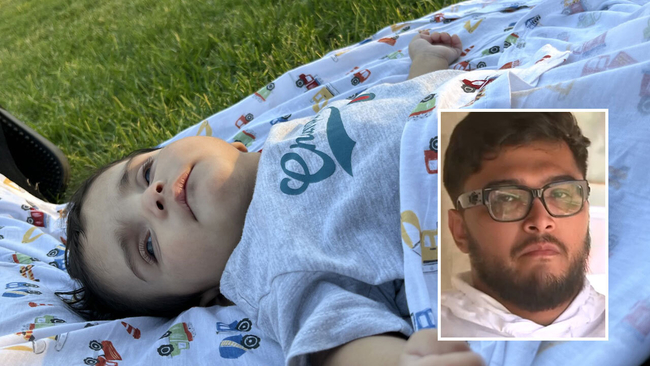
Evidence points toward a suspect.
Witnesses provide a timeline.
Security cameras fill in the gaps.
But the Emmanuel Haro case seemed to move in circles.
Every answer created another question.
Every lead appeared to contradict the one before it.
And the deeper investigators looked, the stranger the story became.
From the very beginning, authorities had focused heavily on the timeline inside the Big 5 Sporting Goods parking lot.
According to the original account, Emmanuel’s mother stepped out of the vehicle to change her son’s diaper. She later reported being attacked and losing consciousness.
When she woke up, Emmanuel was gone.
On paper, the sequence sounded straightforward.
In practice, detectives struggled to make every piece fit.
Investigators reviewed surveillance footage from nearby businesses, parking lots, and surrounding streets. They interviewed employees, customers, and anyone who might have been in the area during those critical minutes.
Yet no video clearly showed a stranger taking Emmanuel.
No witness definitively reported seeing a baby being carried away.
No vehicle was identified leaving the area with an infant.
The absence of evidence became almost as significant as the evidence itself.
As days turned into weeks, public attention intensified.
Social media users began analyzing every public statement.
Every interview.
Every photograph.
Every perceived inconsistency.
Entire online communities formed around the case.
Some believed Emmanuel had been abducted by a stranger who simply escaped detection.
Others argued that the lack of physical evidence pointed in a completely different direction.
The debate became so intense that investigators repeatedly urged the public to avoid speculation.
But speculation had already taken on a life of its own.
Then came another complication.
Several witness accounts appeared to conflict with one another.
One person claimed to have seen suspicious activity near the family’s vehicle.
Another described circumstances that seemed inconsistent with the reported timeline.
Some statements supported the possibility of an abduction.
Others raised additional questions.
None provided a breakthrough.
Instead, they created a maze of possibilities investigators still had to untangle.
Behind the scenes, detectives continued examining every aspect of the family’s background.
This is standard procedure in any missing child investigation.
When a child disappears, investigators must examine everyone closest to them.
Parents.
Relatives.
Friends.
Neighbors.
Anyone with access.
Anyone with opportunity.
Anyone with information.
That process often generates public suspicion, even when no criminal conduct is established.
In Emmanuel’s case, online discussions quickly focused on details from the family’s past. Old records resurfaced. Personal histories were scrutinized. Rumors spread faster than verified facts.
For the Haro family, the result was devastating.
They were living through every parent’s nightmare while simultaneously finding themselves at the center of public suspicion.
Yet despite all the attention, investigators remained remarkably careful with their public statements.
Authorities repeatedly emphasized that the investigation was active.
That leads were still being pursued.
That evidence was still being reviewed.
And that conclusions should not be drawn prematurely.
Those statements may have sounded routine.
But many observers noticed something important.
Investigators never appeared ready to commit fully to any single theory.
Not an abduction.
Not a family-related explanation.
Not any particular scenario.
Everything remained on the table.
That alone suggested the case was far more complicated than many people realized.
As weeks passed, Emmanuel’s photograph continued appearing across California.
On social media.
On flyers.
In news broadcasts.
His image became familiar even to people hundreds of miles away.
Yet familiarity did not produce answers.
No confirmed sightings.
No verified ransom demands.
No credible public breakthrough.
Just silence.
The kind of silence that becomes heavier with each passing day.
For detectives, one question continued to overshadow all others.
If Emmanuel was abducted, where was the evidence left behind by the abductor?
And if he wasn’t abducted, why had no alternative explanation emerged?
That question remains at the center of the investigation.
Because every theory still encounters the same obstacle.
Something happened in that parking lot.
Something significant enough to make a seven-month-old baby disappear.
And whatever happened, it occurred without leaving investigators the clear trail they expected to find.
Today, Emmanuel Haro is still missing.
Authorities continue to ask for information.
The family continues to seek answers.
The community continues to wait.
And somewhere within thousands of pages of reports, interviews, digital evidence, and investigative notes may be the detail that finally explains what happened that afternoon.
Until then, the case remains suspended between possibilities.
A missing child.
A fractured timeline.
Conflicting witness accounts.
And a mystery that refuses to give up its secrets.
Because after all the searches, all the interviews, all the headlines, investigators are still trying to answer the same heartbreaking question they asked on the first day:
Where is Emmanuel Haro?
And perhaps even more unsettling—
Who already knows the answer?
Sometimes a mystery stays unsolved because there are no clues. The most troubling cases are the ones where the clues exist, but nobody yet understands what they’re trying to say.