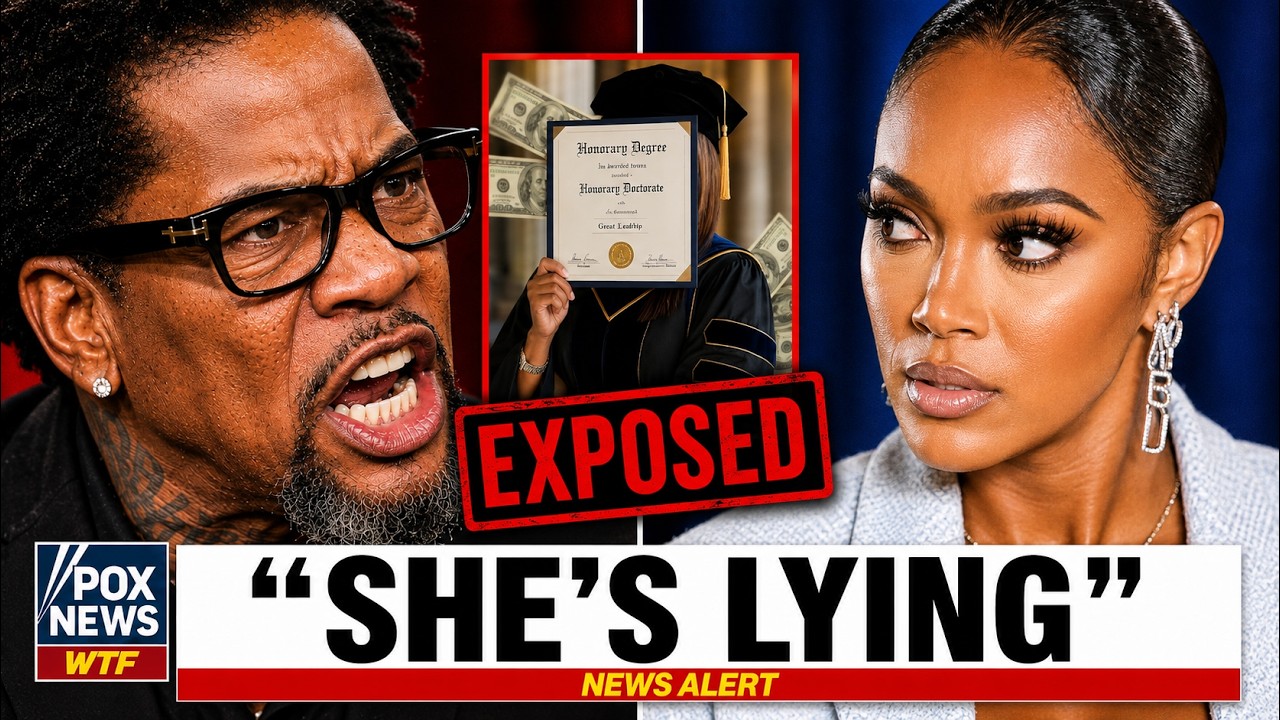
Cheyenne Bryant built a massive online following as a self-proclaimed doctor of psychology, amassing millions of followers and becoming a trusted mental health voice for Black women. Now comedian DL Hughley is leading a campaign to expose her, accusing her of running one of the most dangerous long cons ever pulled on the Black community. Bryant’s rise was fueled by claims that she held six degrees, including three doctorates and a master’s. She parlayed that credibility into positions like the presidency of an NAACP branch and appearances on major platforms like The Joe Budden Podcast and The Breakfast Club.
Fans saw her as a reliable street therapist, someone who understood real pain and provided guidance through serious mental health struggles. . The cracks began to show when she appeared on the Joe Budden Podcast weeks ago. During that conversation, she made what seemed like a throwaway comment about her credentials that, upon closer inspection, sounded like a major backtrack from her earlier claims.
People started digginginto her academic history, and the thread began to unravel quickly. . When asked about her degrees on The Breakfast Club, Bryant said her doctorate came from Argosy University, a now-defunct school that shut down amid bankruptcy. She claimed she could not access her certificate or official transcripts because the school was gone.
She added that pursuing a refund would erase all her academic credits entirely, a claimthat struck many as extraordinarily convenient. . However, records from closed universities are reportedly still accessible through third-party vendors like Parchment. Searches for Bryant’s doctorate reportedly turned up nothing where her credentials should be.
The only verified degree connected to her name is reportedly in apparel from Cal State Northridge, not psychology or Pan-African studies—the fields she built her expert identity on. She has not produced a diploma, transcript, or dissertation amid growing calls for proof. Her response has been that she does not owe anyone evidence of her education. .
In a recent podcast appearance, Bryant doubled downrather than course-correcting. She described her past as remarkably accomplished, claiming she bought her first house at 19, owned three retail stores on Melrose Avenue, ran a legal company, and carried 26 credit hours per semester all at once. When people searched for evidence of these achievements, they reportedly found no records or vintage photos from the Melrose scene that would likely exist if she had actually been there. .
Critics also point to how she handled actual clients. There are reports of people coming to her amid anxiety or PTSD, specifically seeking a Black woman therapist because representation mattered to them. According to these accounts, they received no intake forms, no clinical assessment, and no questions about their background. Instead, sessions reportedly consisted of Cheyenne talking about her own engagement, self-image, and worldview—sometimes ending with clients being told they were not high-value womenor that they were low vibrational.
One person reportedly paid $300 for a single hour, only to leave more distressed and needing a waitlistto get back into their actual licensed therapist’s care. One person who attended a session described the experience as leaving them in a worse state than when they arrived, eventually falling into depression. Another person dealing with PTSD and a traumatic brain injury said they reached out to Bryant looking for practical help, not just a platform for themselves, and were left disappointed by the experience. .
DL Hughley argues the stakes go beyond social media embarrassment. He contends that Bryant moved into a lane that belonged to licensed Black therapists with real credentials, crowding them out through superior access to platforms that were never positioned to challenge her methodology. She consistently appeared on shows where hosts were not equipped to interrogate therapeutic theory or academic credibility. Instead, she delivered confident, broadly relatable adviceand left crowned as an expert.
He called the phenomenon an exploitation of perception rather than mere appearance. He added that, in his view, each paid sessionwith Bryant under her claimed credentials risks constituting wire fraud, punishable by up to 20 years in federal prison per instance他也是指, if her claimed doctorate is false, the misrepresentation induces people to pay for services under false pretenses. . Allegations of fraud here remain accusations, with no criminal charges has been filed at this time.
. Some defenders have argued credentials are not everythingand that Bryant was effective in her role. Others compared her to figures who used honorary doctorates or pointed out that expertise does not strictly require a degree. One host who had Bryant on his podcast said he did not care aboutthe credential dispute because he found her brilliant.
There is also a claim circulating that the Black community built her, therefore it has no groundsto feel betrayed—an argument that critics have dismissed as insulting. Supporters also point out that some people access mental health support through nontraditional means, particularly those skeptical of mainstream institutions, though this does not address the credential question at the heart of the controversy. The NAACP chapter she led hasn’t commented publicly on the matter and she has not stepped back from public view. Bryant still wearsa chain around her neck that literally spells out “DOC,” a symbol that critics now call a document she cannot verify worn as jewelry.
They say the doctorate nobody can trace sits around her neck for the cameras, while the dissertation nobody has seen remains unavailable. Her public response has not included releasing any academic documentation, and the demand for evidence from her critics has only grown louder. The questions remain unresolved: where are the records, were real clients harmed, and what happens next for the empire she built. As of now, Bryant has not provided verifiable proof of her claimed psychology degrees, and the scrutiny shows no sign of fading.
.