When Errol Flynn married Patrice Wymore in 1950, she was not walking into a fairy tale. She was stepping into a storm that the public had already documented for years, a marriage that would become his last and her lifelong burden. Unlike Flynn’s first two wives, who fled or fought their way out of his orbit, Wymore stayed, even as his drinking, erratic behavior, and failing health consumed their years together. She gave up a rising career and a steadier life to remain beside a man she knew was broken.
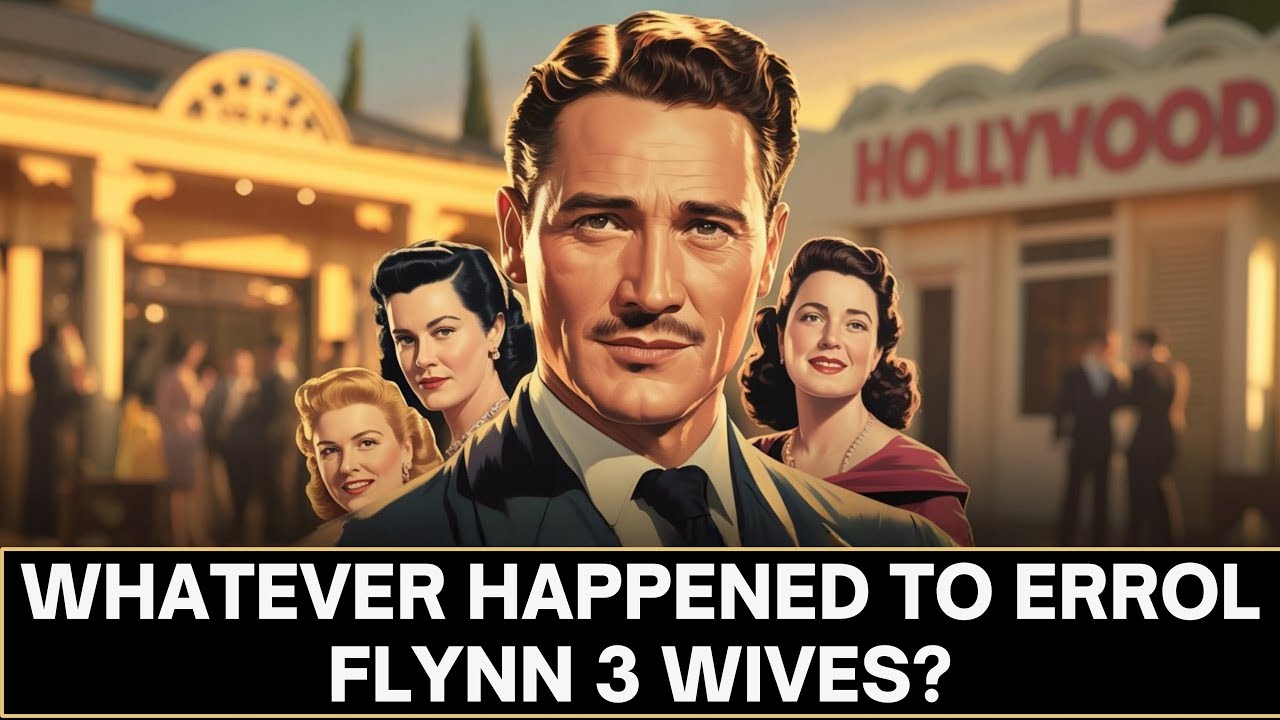
He died in 1959 of a heart attack at age 50 while on a publicity trip in Canada. Wymore flew his body home, never remarried, and spent the next five decades on his Jamaican estate, turning the chaos he left behind into a quiet legacy of endurance and grace. Long before she was Mrs. Flynn, the actress from Kansas was carving out a career in Hollywood.
She had a reputation for being grounded and gracious, a sharp contrast to the turbulence that defined Flynn’s life by the early 1950s. He was aging fast, worn down by years of excess. Yet she saw a man she chose to love, and they married the same year they met on the set of the western “Rocky Mountain. ” They had one daughter together, Arnella, born in 1953,efore Flynn’s life unraveled further.
The couple eventually moved to Jamaica, where Flynn had purchased a sprawling estate. Far from the Hollywood studio system and tabloid beat, Wymore tried to build a quieter life for their family. But Flynn could not escape his own habits. His drinking worsened, and his behavior grew increasingly erratic.
Friends recalled that Wymore took care of the home and their daughter while attempting to hold onto the man beneath the legend. In a rare moment of public remorse, Flynn told a journalist, “If anyone deserved better than me, it’s Patrice. “” When Flynn died, Wymore was 33 and faced a choice, retreat into grief or reinvent her life. She chose the estate.
She ran it as a working ranch, managing cattle, crops, and renovations, while raising Arnella mostly alone. Local Jamaicans did not see her as a distant Hollywood widow. They called her Miss Wymore, the strong American woman who worked alongside the land. The estate became her refuge, and a place she eventually opened to film historians, journalists, and curious fans who wanted to understand Flynn.
She gave tours and shared stories, always honest about his flaws, from his drinking to his womanizing, but never cruel. He wasn’t easy, she would say, but he was unforgettable. Her devotion carried her through profound griefas well. In 1998, their only daughter, Arnella, died from a heart attack at age 44, reportedly shaped by years of unhealthy living and emotional strain.
Wymore never spoke much publicly about that loss, but those close to her said it left a wound that never fully healed. She became more reclusive after her daughter’s death, stopped giving interviews, and lived quietly on the property she refused to sell. This place holds all my memories,she once told a friend. Selling it would be like erasing my life.
In 2005, she made a rare public appearance for a Turner Classic Movies tribute to Flynn, reflecting on his legacy with a soft smile. He was larger than life,and somehow still is she said. It was a quiet goodbye, a way of keeping him alive through memory. Wymore died in 2014 at age ̈87, ending her role as the last living link to Flynn’s chaotic and glamorous era.
She ensured in her will that the Jamaican estate would be preserved,hoping it might one day serve as a place of reflection or even a museum. I want people to know the real him, not just the headlines,she had said. Her death closed the chapter on two private tragedies that marked her years, but her public loyalty never wavered. While Wymore carried Flynn’s name until the end, her life also stood in contrast to the paths of her predecessors.
Flynn’s first wife, Lily Deita,a Frenchborn silent film star, married him in 1935 when he was still unknown. The marriage was passionate and explosive, marked by jealousy and public fights, and Lily, six years older, did not trust him. Her instincts proved right as Flynn’s career soared and his attention wandered. She filed for divorce in1942 citing cruelty,et desertion,and emotional neglect, and custody of their son, Shawn, became abitter legal war that dragged on for years.
After the split, Lily focused on raising Shawn, keeping him out of the spotlight, but tragedy struck in 1970 when Shawn disappeared while working as a war photographer in Cambodia. He was never found. Lily spent the rest of her life searching for him, hiring investigators, traveling through Southeast Asia,and refusing to accept his presumed death at the hands of the Khmer Rouge. She lit a candle on his birthday every year and kept a place for him at the table.
She died in 1994 at age89, still carrying questions no one could answer. Flynn’s second wife, Norah Eddington,came into his life under entirely different circumstances. In 1943, while Flynn was facing charges of statutory rape, a scandal that had rocked Hollywood, he met Eddington,a teenage clerk at the Los Angeles courthouse. She was 18,courthouse clerk, innocent,and far from Hollywood’s glare.
They married that same year while Flynn was still battling public outrage, and she later admitted she barely knew him. Yes, years later in a memoir, Eddington would describe the relationship as something other than Hollywood fantasy. In her 1960 memoir titled “Errol and Me,” she painted a portrait of a man both thrilling and terrifying, describing him as a storm, writing,”When he loved you, you felt like the center of the world. And when he didn’t, it was like being invisible.
“” They had two daughters together, but the marriage collapsed under the weight of his drinking and infidelity. She filed for divorce in1949, and afterward remarried twice, choosing a quieter life far fromsthe scandal. She passed away in2001 at age77. Though each of these women followed a different path after their years with Flynn, together their stories reveal the human cost behind the headline.
Lily was consumed by grief,and the search for her lost son. Norah rebuilt her identity, eventually finding stability far fromstthe Hollywood circus. And Patrice became the keeper of the flame, choosing endurance over escape. Their lives are not just footnotes to Errol Flynn’s fame.
They are separate stories of love, survival, and heartbreak, marked by the same man, brilliant, broken,and unforgettable, a man who could never be tamed. And in the end, it is their resilience, not his legend, that lingers longest.