For more than a century, Queen Nefertiti’s face has been one of the most famous images in the world.
Her elegant neck.
Her balanced features.
Her calm, flawless expression.
To millions, the bust of Nefertiti is not just a masterpiece of ancient Egyptian art. It is the face of beauty itself.
But modern scans have revealed something hidden beneath that perfect surface.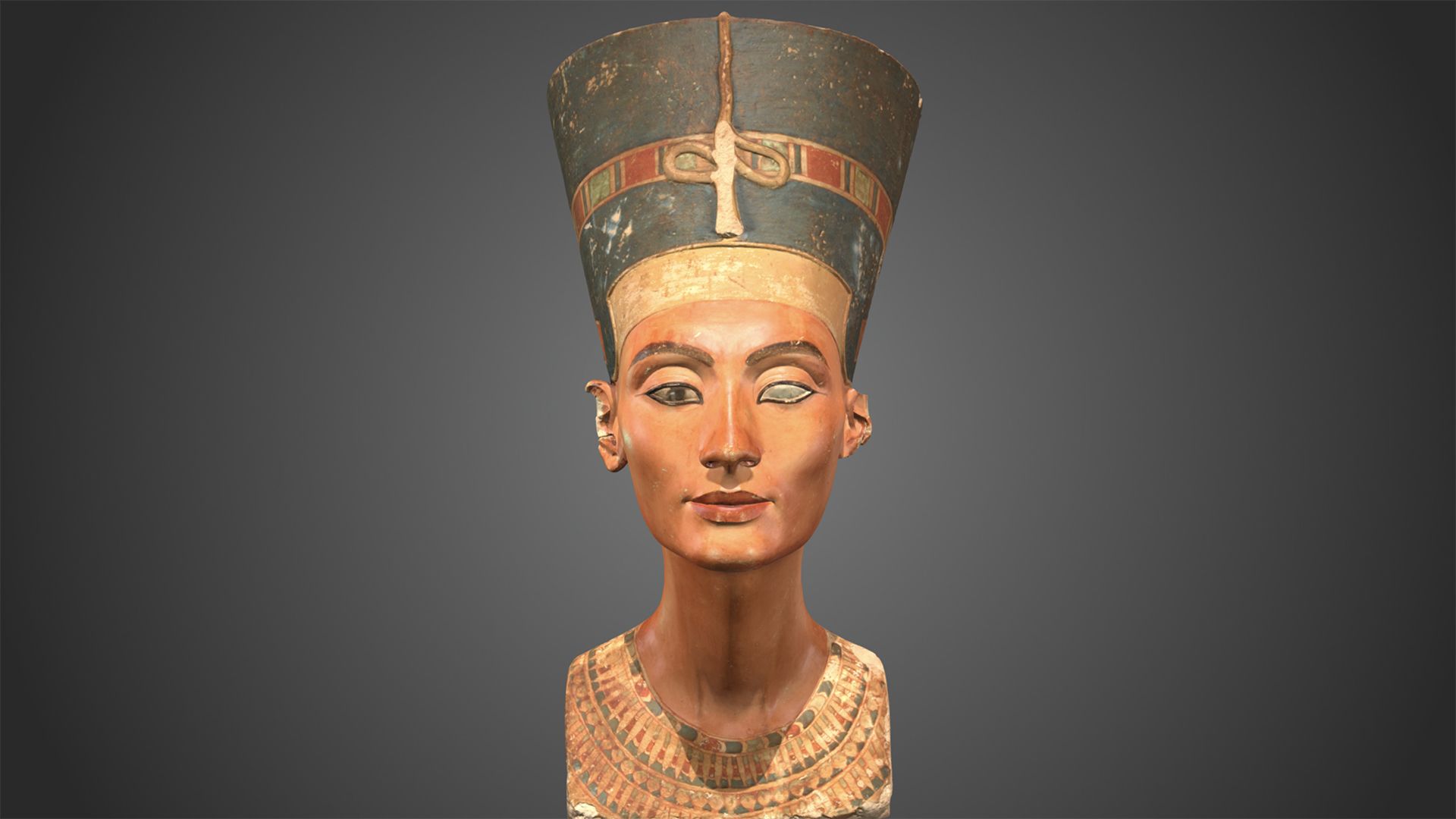
And what researchers found may change the way we understand one of Egypt’s most mysterious queens.
The bust was discovered in 1912 at Tell el-Amarna, the ancient city built by Pharaoh Akhenaten. It was found inside the workshop of the sculptor Thutmose, the artist believed to have created royal images for the court.
At first glance, the sculpture seemed almost impossibly perfect.
But when scientists examined it using CT scanning technology, they discovered that the outer plaster layer was hiding a different face underneath.
Beneath the smooth surface was a limestone core.
And that core showed a more natural version of Nefertiti.
The hidden face had a slightly different nose, uneven eyes, softer cheeks, and marks that suggested age and human imperfection.
In other words, the famous bust was not simply a portrait.
It was an edited image.
A royal ideal.
A face shaped for power.
This discovery raised a haunting question.
Why was Nefertiti’s real appearance covered?
To understand that, we have to return to one of the most turbulent periods in Egyptian history.
Nefertiti was the wife of Pharaoh Akhenaten, the ruler who tried to overturn Egypt’s traditional religion. He closed temples, weakened the old priesthood, and promoted worship of a single sun deity known as Aten.
It was a radical revolution.
And Nefertiti was not just standing beside him.
She became the public face of that new world.
Ancient reliefs show her performing rituals, wearing royal symbols, and even appearing in poses usually reserved for kings. She was not portrayed as a quiet queen in the background. She was shown as a figure of authority, power, and divine legitimacy.
That means her image mattered.
Her face had to represent stability.
Beauty.
Perfection.
Control.
The bust may have been less a personal portrait and more a political weapon—a model used to reproduce the ideal image of a queen during a fragile and controversial reign.
But the mystery does not end there.
Around the later years of Akhenaten’s rule, Nefertiti suddenly disappears from many historical records.
No clear death notice.
No confirmed tomb.
No final explanation.
For generations, historians assumed she may have died from illness or disappeared during political chaos. But some evidence suggests something far stranger.
Her name may not have vanished because she died.
It may have changed.
Some scholars believe Nefertiti later ruled under the name Neferneferuaten, possibly acting as pharaoh after Akhenaten. Certain inscriptions linked to this ruler appear to contain feminine markers, suggesting the mysterious ruler may have been a woman.
If true, Nefertiti was not merely a queen.
She may have become king.
But after her time, Egypt rapidly turned against Akhenaten’s religious revolution. The old gods returned. The new capital was abandoned. Names and images connected to Akhenaten’s movement were erased, altered, or buried.
That may explain why Nefertiti became such a shadowy figure.
Her image survived.
But her identity was attacked.
Artifacts later found in Tutankhamun’s tomb show signs of modification, with some objects possibly created for a female royal figure before being changed for the boy king. Names were altered. Titles were rewritten. History itself was reshaped.
Nefertiti may not have simply disappeared.
She may have been overwritten.
And that makes the scanned bust even more powerful.
The perfect face the world admires may not be the woman herself.
It may be the mask history allowed to survive.
A carefully constructed image created for a queen who lived through religious revolution, political danger, and perhaps even a hidden claim to the throne.
The scan does not destroy Nefertiti’s beauty.
It makes her more human.
Behind the flawless plaster was a real woman—older, more complex, and far more interesting than the legend.
For centuries, the world saw only the ideal.
Now science has shown us the secret beneath it.
Nefertiti was not just a beautiful queen frozen in time.
She was a ruler, a symbol, a survivor, and perhaps one of the most deliberately edited women in ancient history.
Her face was designed to rule.
But beneath it, the truth was waiting.