Bone fragments, ceramic sherds, and the usual debris of a Neolithic settlement were emerging from the dirt when the brush revealed something that stopped the excavation cold: a human skull, carefully modified after death, with clay packed into the eye sockets and nasal cavity. The face had been rebuilt with remarkable care and painted to suggest, almost, living features. It had been kept, curated, and displayed, likely interacted with in ways that the archaeological context can partially reconstruct but modern observers cannot fully comprehend. This practice of skull curation, the keeping and decoration of the bones of the dead for ritual purposes, ancestor veneration, or an ongoing relationship with deceased community members, is documented across multiple ancient cultures on multiple continents.
It is, by most contemporary standards, deeply strange. It is also, by the standards of ancient human practice, relatively mild on the strangeness spectrum, because ancient humans were cognitively identical to modern humans, while operating within cosmological frameworks so different that their practices often appear genuinely, comprehensively baffling in the archaeological record. The most famous examples of skull curation come from Jericho, dated to approximately 8,000 to 9,000 BCE, where plastered skulls with shells inserted in the eye sockets and ochre painted to approximate living features appear to have been displayed in homes. What were people doing with them?
Talking to them, probably. Consulting them, possibly. Maintaining a social relationship with the dead that the physical object supported and enabled. Once the dead are treated as ongoing presences rather than simply absent ones, keeping something of them physically present has a certain internal logic.
The weirdness is not in the skull but in the cosmological framework that treats death not as absolute departure, but as transition into a different mode of presence
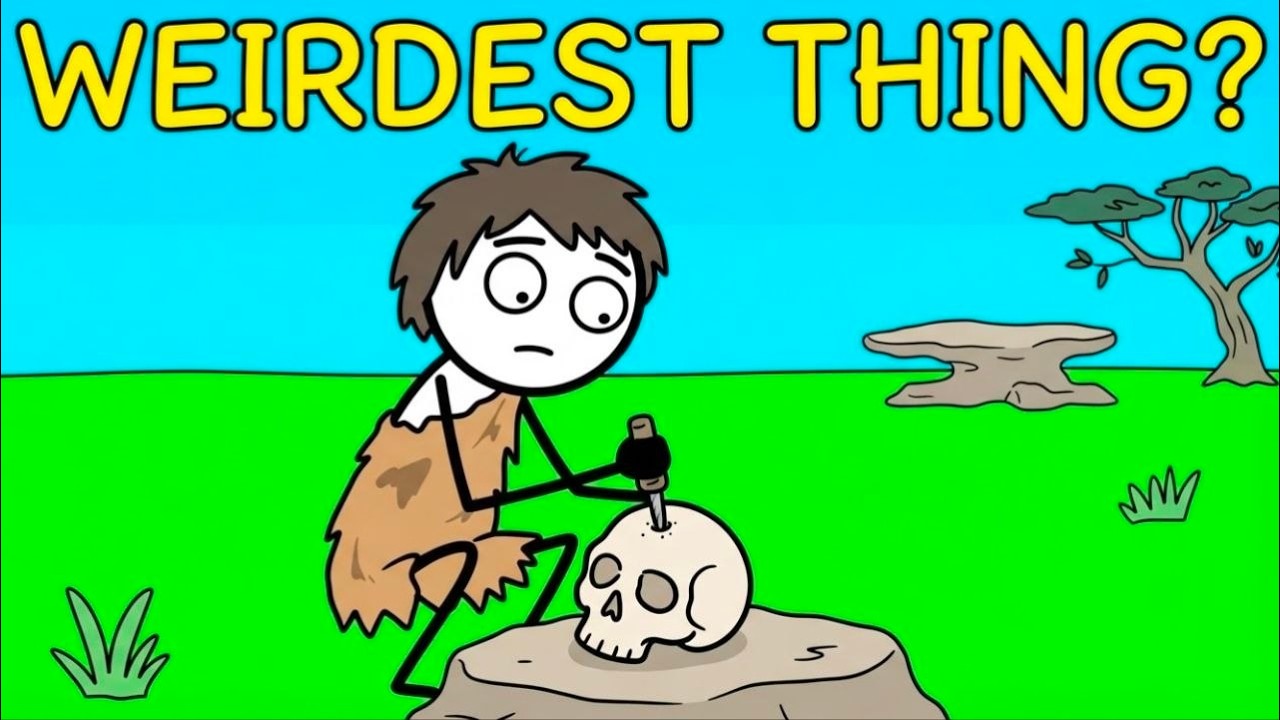
Trepanation, the deliberate drilling, scraping, or cutting of a hole through the living human skull, is the oldest documented surgical procedure in the archaeological record, found on every inhabited continent at dates ranging from10,000 years ago to the early historical period. Survival rates, estimated from bone regrowth around healed holes, are astonishingly high for procedures performed with stone tools. Some skulls show not just healing but multiple separate events: three, four, or in one documented case, five holes, each healed, indicating repeated skull drilling across a lifetime. The surgical skill required to drill through the skull without penetrating the brain, using flint, obsidian, or bronze, was not trivial, and achieving survival rates acceptable even by some modern neurosurgical standards was no accident
The motivations are debated.
Relief of intracranial pressure following head injury is the most medically comprehensible explanation and is probably correct in some cases. Ancient peoples empirically observed that some head injuries produced neurological changes and that trepanation sometimes improved the patient’s condition. But trepanation was also performed on individuals with no evidence of prior head trauma, and on skulls after death, presumably for ritual purposes. Trepanation discs, the circular plugs of bone removed during the procedure, have been found perforated, suggesting they were worn as pendants or amulets, possibly for protective or spiritual power believed to reside in contact with the living skull.
The combination of the medically motivated and the ritually motivated makes it impossible to separate these dimensions cleanly, because ancient people did not maintain the modern distinction between medical and religious treatment. Healing and ritual were often the same activity conducted by the same specialist. The person who drilled a hole to relieve a head injury and the person who drilled a hole to release a malevolent spirit causing seizures were doing the same procedure for reasons that were, within their framework, both rational
The Denisovans, an archaic human species known almost entirely from ancient DNA extracted from a handful of bone fragments from a Siberian cave, offer another peculiar vertigo. A pendant found in Denisovan Cave in Siberia, made from the bone of a large bird, perforated for suspension and decorated with carved lines, is jewelry made by a species that left almost no physical trace except in the genomes of their modern descendants.
The weirdness is not the jewelry itself; jewelry making is well documented in anatomically modern humans by 75,000 years ago. It is that these people probably had symbolic culture, aesthetic preferences, and personal adornment practices expressing social identity, and almost all of it is gone except for a few bone fragments in a cave and a stretch of DNA in living people who do not know they carry it
Göbekli Tepe in southeastern Turkey, dated to approximately 9,600 to 8,200 BCE, is one of the most archaeologically disruptive discoveries of the 20th century, precisely because it challenges the timeline of complex human behavior. The standard model held that monumental architecture required an agricultural surplus to support non-agricultural workers. You need to feed a construction workforce without those workers producing food themselves, which requires a food production system generating surplus.
Agriculture was supposed to precede monuments. Göbekli Tepe inverts this sequence: the monuments predate agriculture at the site. Hunter-gatherers built them, and the construction may, in fact, have driven the development of agriculture in the surrounding region, as the need to feed workers and pilgrims associated with this major ritual center created demand for reliable food surplus. The monument made the farm, rather than the farm making the monument
The site consists of enormous stone pillars carved with elaborate animal reliefs, foxes, cranes, vultures, scorpions, aurochs, arranged in circular enclosures, without metal tools or wheels.
What was happening there? The honest answer is that we do not fully know. The carved animals had symbolic significance that cannot be fully reconstructed without the cultural key, but the scale of construction, pillars weighing up to20 tons, implies a social organization capable of coordinating labor across a region in service of a shared purpose. That purpose appears to be ritual, possibly funerary, possibly cosmological, possibly connected to animal imagery in ways their cosmology encoded.
The weirdness is not the construction itself but the dedication of that capacity, at that scale, by people who were still hunting and gathering, to a purpose that leaves us with stone pillars and carved foxes and no cosmological manual
Ancient Egyptian mummification is familiar enough that its weirdness can be difficult to register, but examined from first principles it is extraordinarily strange. The full procedure involved removal of the brain through the nasal passage using a hook, the brain being considered the least important organ and discarded; removal of the internal organs through an incision in the left side of the abdomen and their placement in canopic jars; desiccation of the body with natron salt for 70 days; wrapping in hundreds of meters of linen bandageswith amulets placed at specific locations between layers; application of resins and oils; replacement in a succession of nested coffins; and deposition in a tomb equipped with everything the dead person might need in the afterlife: food, furniture, clothing, cosmetics, and shabti figurines who would perform labor on behalf of the deceased
The internal logic was the Egyptian belief that the physical body was necessary for the afterlife, that the soul, or complex of souls, required a physical home to return to. What makes this genuinely strange is the 70-day timeline, not arbitrary but calibrated to the astronomical cycle of the star Sirius, which disappears from the Egyptian night sky for approximately70 days each year before rising again on the horizon in conjunction with the annual Nile flood. The mummification period was cosmologically timed to align the dead person’s transformation with a celestial event associated with renewal and resurrection.
The body was not just being preserved; it was being processed in synchrony with the sky, an integration of the practical and the cosmological that appears throughout Egyptian culture
The Roman practice of haruspicy, the examination of the livers and other entrails of sacrificed animals to determine divine will, appears frequently in ancient sourceswitha matter-of-factness reflecting how thoroughly integrated it was in Roman public and private decision-making. Before major political decisions, military campaigns, and public ceremonies, trained specialists read the color, size, shape, and condition of the liver to discernthe divine response to the proposed action. The intellectual infrastructure was not trivial: the Etruscan tradition from which Rome inherited the practice had developed elaborate manuals, and some physical bronze liver models survive, mapping the organ’s surface into regions associated with different deities and categories of divine message. A trained haruspex could read the liver with extraordinary confidence, given that the practice remained central to Roman public life across centuries by some of the most sophisticated minds in the ancient world.
Julius Caesar is reported to have had haruspicy performed before his assassination, and the examination reportedly warned of danger, which Caesar famously dismissed, whether the story is accurate or retrospectively constructed. Roman senators, generals, and emperors made consequential choices about war and policy in consultation with the condition of sacrificed livers. This was the official decision-making protocol of the Roman state, maintained across centuries by educated, worldly, politically sophisticated people who found nothing internally inconsistent about it. Within a cosmology in which the divine communicated through the natural world, the condition of a liver was as legitimate a divine communication channel as any other natural phenomenon
The Viking practice of human sacrifice, documented in the ritual of blot, included hanging sacrifices in sacred groves where bodies and animals sacrificed alongside them were left for extended periods as offerings to the gods.
The sacred grove at Uppsala in Sweden reportedly maintained such offerings on nine-year cycles, with offerings of nine humans, nine horses, nine pigs hung in the trees. Ibn Fadlan, the Arab traveler who documented the funeral rites of the Rus Vikings along the Volga River in 921 CE, provides one of the most detailed contemporary accounts of Viking funerary practice, describing the elaborate ship funeral of a chieftain, including the voluntary sacrifice of a female slave who chose to accompany her master in death. Ibn Fadlan was a foreigner with no prior exposure to the practice, and his documentation of his own visceral reaction alongside the ritual details gives it a quality of unmediated encounter. He found it horrifying.
The participants found it sacred. The distance between those two responses is the entire distance of cosmological framework
The ancient practice of deliberate body modification, cranial deformation, dental modification, extensive tattooing, scarification, subincision, across dozens of cultures on multiple continents, represents a category of ancient weirdness where the individual practices are less strange than their global distribution. Cranial deformation, the deliberate reshaping of infant skulls while the bones are still soft, produced characteristic elongated skull shapes visible in skeletal material from Peru, Mesopotamia, Mesoamerica, Iron Age Europe, and ancient Egypt. These elongations were produced by cultural practices associated with beauty, nobility, or membership in specific social groups.
The weirdness is not in any individual practice but in the universality of the impulse: the determination of human cultures across every continent to use the body itself as a site of cultural inscription
What makes ancient human behavior truly strange? Beneath the skull curation, liver reading, and cranial binding is the scale and sophistication of the cosmological frameworks that made these practices coherent. Ancient humans were not doing strange things randomly. They were doing strange things as part of internally consistent systems of meaning, cosmologies that specified what the world was made of, how the divine communicated, what the dead required, what the future could be read in, what the body meant, what collective action was capable of.
These systems were sophisticated enough to organize labor of millions, persist across centuries, produce architectural achievementsthat still stand, and motivate practices of extraordinary complexity and cost. Understanding why ancient humans did the strangest things they did requires entering, temporarily and with imaginative effort, the cosmological frameworks from which those practices emerged. The skull decorated with plaster and ochre in Jericho 9,000 years ago was not irrational. It was a rational response to the belief that the dead remained present.
The Roman consul who paused a military campaign to re-examine entrails when the first exam produced ambiguous results was not superstitious in the dismissive sense; he was operatinga decision-making system with established protocols. Ancient humans were not weird. Their worlds differed from ours in their cosmological foundations, and when we observe their behavior from outside those foundations, the distance produces the appearance of weirdness. The real question is not what was the weirdest thing ancient humans ever did.
The real question is what practices of our own era, observed from 6,000 years of future distance by archaeologists brushing dirt from our cultural material, will appear as strange to them as the plastered skulls appear to us