A day in the life of an ancient child began not with an alarm clock or a screen, but with the pale gray light of dawn creeping through a mud brick wall. The first sounds were animals stirring in the courtyard and adults already moving through the darkness. What followed, based on evidence from bones, toys, clay tablets, tomb paintings, and the writings of people who lived it, was a day built around work, observation, play, and family. Privacy, as we understand it, did not exist.
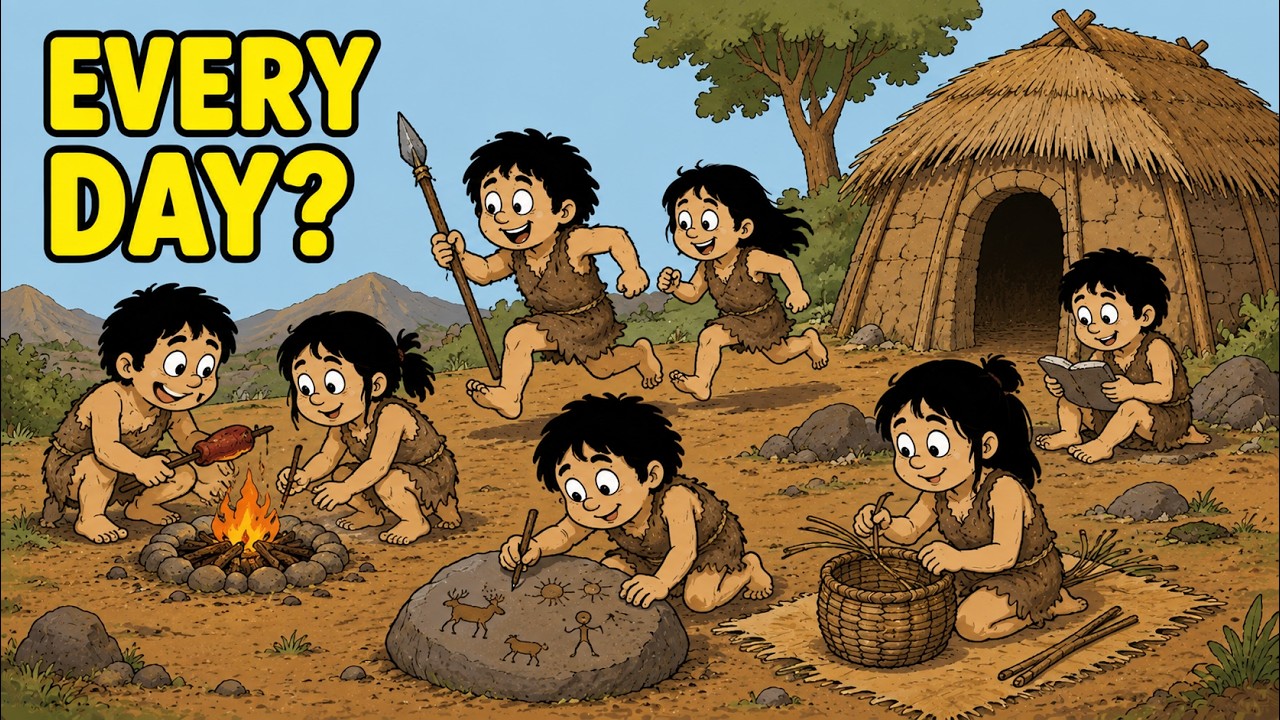
In nearly every ancient civilization, children slept pressed against parents, siblings, and grandparents, often on elevated wooden platforms lined with reed mats or on earthen floors covered in animal hides. In Rome, non-elite families crowded into multi-story apartment buildings known as insulae, where entire families shared a single dark room with no running water and only a small charcoal brazier for heat, a serious fire hazard. This closeness was not a sign of poverty in the modern sense. It was the default design of human domestic life for tens of thousands of years, where warmth, safety, and proximity were inseparable.
Within minutes of waking, the house became a workplace. There was no distinction between where the family lived and where it worked. Grain storage was in the same rooms where children slept in Egyptian farming households, and workshops were connected to kitchens in Mesopotamian urban homes. The fire needed fuel, the water needed fetching, and none of it waited.
Children were educated not in classrooms but through a process anthropologists call situated learning, where knowledge is embedded in actual activities. A child learned to grind grain not from a textbook, but by watching their mother do it every single morning for years, absorbing the body positioning, pressure, and technique until one day they tried it themselves. Even very small children were pulled into morning routines. The specific chores depended on location and family resources, but the pattern was consistent across cultures and centuries.
Small children carried small things, frightened birds off drying grain, fetched water in lightweight vessels, watched younger siblings, fed chickens, and swept dirt floors with bundles of straw. Fetching water was one of the most universal tasks, requiring walks to wells, springs, or rivers while balancing heavy earthenware jars. Bioarchaeological analysis of skeletal remains shows asymmetric muscle development and early wear on bones consistent with years of carrying heavy loads, meaning their bodies literally recorded what their days contained. Fuel gathering was another constant, with children often collecting dried animal dung, the primary cooking fuel in regions without abundant wood.
Play was a biological constant that no amount of work could eliminate. The archaeological record shows that ancient toys were functionally almost identical to toys from the last century. Jointed dolls made from carved wood, terracotta, and ivory have been found in Egyptian, Greek, and Roman contexts spanning more than 2,000 years, some placed directly in the hands of dead children. Ancient Egyptian craftspeople made mechanical pull toys, wooden crocodiles with hinged jaws that snapped open and closed when a string was pulled.
Excavations at Karanis in Egypt uncovered wheeled wooden horses, miniature furniture, and rag dolls. Hollow clay rattles containing pebbles, designed to make noise and ward off evil spirits, date back more than 4,000 years across Turkey, Bavaria, and Russia. Spinning tops made from turned wood, carved bone, and fired ceramic have been found across Mesopotamia, Egypt, and what is now the United Kingdom. Knuckle bones, the ankle bones of sheep or goats, were perhaps the most universal toy, used as both dice and a game resembling modern jacks, requiring zero manufacturing cost and delivering years of play.
Many of these games were structured rehearsals for adult life. Children in pastoral communities built miniature animal corrals from stones and mud and moved pebbles inside them to practice counting livestock. Farming children imitated planting and harvesting with small sticks. Girls in textile-producing households practiced the hand movements of spinning on miniature clay looms.
The game and the lesson were the same activity. The transition from play to productive work happened gradually. A four-year-old kept birds off grain, a seven-year-old herded goats through familiar terrain, a ten-year-old managed livestock independently, and a thirteen-year-old worked alongside adults at near adult capacity. The sharp boundary between learning and working that modern societies have created simply did not exist.
What work looked like depended almost entirely on where a child was born. For children in mobile hunter-gatherer groups, the environment itself was the curriculum. They learned the properties of hundreds of plant species, tracking animals by reading disturbed soil and bent grass, reading weather patterns, and managing fires. This knowledge came through inclusion, as children accompanied adults on foraging trips and gradually moved toward the center of the activity as their competence increased.
Footprints of children as young as two years old have been found deep inside cave systems in France, pressed into soft clay far from the entrance in complete darkness, with their handprints on the walls alongside adult handprints, showing they were brought into sacred underground spaces rather than left at the entrance. Agriculture changed childhood by tying it to the calendar. A missed planting window meant crop failure, a missed harvest window meant the stored grain rotted. In spring, children cleared fields and scared birds.
In summer, they weeded in the heat and cleared irrigation channels. In autumn, they worked the harvest, bending and cutting for hours. In winter, they processed grain, repaired tools, carded wool, and stockpiled fuel. There was no summer holiday, the agricultural calendar had no gaps.
Livestock care was among the most common responsibilities, requiring hours of sustained attention and real expertise, as losing an animal to a predator or wandering had real consequences for the household’s food supply. In ancient cities, childhood changed again. Urban children in Mesopotamia, Egypt, Greece, or Rome were surrounded by workshops opening directly onto public streets, where they could watch bronze casters judging molten metal by its color, fullers treading cloth, bakers sliding flatbread into clay ovens, and stone carvers shaping inscriptions. If a child’s family owned a workshop, education began the moment the child could reach the workbench.
The earliest years of apprenticeship involved no actual craft work, only preparing materials while watching skilled work at close range. Eventually, guided practice replaced observation, moving from watching to assisting to doing supervised work to performing the craft independently. This was how trade secrets transferred, a family that lost its skilled crafts person without training a successor lost its livelihood. Elite children occupied a distinct position.
In Pharaonic Egypt, children of noble families attended court schools called the *kap*, designed to produce administrators, military officers, and priests. Wealthy Roman children grew up in spacious domus compounds with paid tutors. Their education was oriented toward literacy, literature, rhetoric, legal principles, and social etiquette. But wealth did not mean freedom.
Marriages could be arranged years before puberty to secure political bonds, and the pressure to represent the family’s social position was constant. Gender shaped almost every aspect of childhood from very early ages. Boys were trained toward heavy fieldwork, livestock management, trade, or military service. Girls were trained intensively in domestic production, grain grinding, food preparation, textile work, and child care.
Spinning and weaving were not domestic hobbies but the primary form of female economic output, and training began in early childhood. Sparta was an exception, with state-sponsored physical conditioning for girls designed to produce strong mothers, a strategic rather than egalitarian motivation. In societies operating close to subsistence, where a bad harvest could mean starvation, children were economic participants integrated into adult life. Observation was the mechanism, apprenticeship was the method, and the household was the institution.
Watching a skilled person perform a task repeatedly builds neural pathways that support the movement pattern even before the body attempts it. A child who spent years watching a skilled potter was not starting from nothing when they finally touched clay. The lives of most ancient children were genuinely hard. Dental enamel hypoplasia, grooves that form when a child’s body is under severe stress from starvation or illness, appear at high rates in ancient children’s teeth.
Harris lines, dense bands that form when growth stops during illness and restarts, are found in skeletons across almost every population studied. Between 20 and 30 percent of infants in most ancient populations died before their first birthday, and up to 50 percent of children died before reaching 15. This mortality rate shaped cultural practices. The Romans had a ceremony called the *dies lustricus*, held eight or nine days after birth, when the infant was officially named and recognized as a legal person, a delay that postponed formal recognition because the first week of life carried the highest risk of loss.
Gastrointestinal infections were the dominant killer, made worse by baby bottles recovered from Roman sites, small clay vessels with narrow spout openings that were essentially impossible to clean adequately, with residue analysis showing cow, sheep, and goat milk, fermented grain gruels, and honeyed water that encouraged bacterial colonization. And yet ancient children still played. The Greeks played a chasing game called Bronze Fly, where a blindfolded child searched for playmates, a direct ancestor of blind man’s bluff. Hopscotch grids are scratched into stone paving across the Mediterranean.
Marbles, hide-and-seek, ball games, racing, and wrestling all persisted across millennia because they satisfy needs that have not changed. Stories served a completely different function. In societies where writing was rare, memory was the primary technology for storing knowledge. Stories told around hearth fires in the evening encoded practical knowledge, moral rules, family identity, religious obligations, and warnings about the world.
Aesop’s fables were moral philosophy delivered in a form compact enough to be remembered. The Greek poet Hesiod wrote down farming wisdom that had circulated orally for generations, and Mesopotamian proverbs were used explicitly as pedagogical tools, copied by students learning to write while absorbing moral instruction. Formal schooling touched only a small minority. Historians estimate that between 5 and 10 percent of the Roman Empire’s population could read at any functional level, concentrated among elite males, scribal families, and wealthy urban merchants.
In Mesopotamia, scribal schools called the *edubba*, the house of tablets, took students around age eight. Students mixed clay, shaped tablets, and inscribed signs with reed styluses. The curriculum progressed from controlling stylus pressure to copying exercises to memorizing thematic lists of legal, plant, and astronomical terms. Discipline was physical, with surviving tablets recording student complaints about being beaten for writing messily or speaking without permission.
In Greco-Roman schools, children wrote on wax-coated wooden tablets before advancing to papyrus, and teachers charged fees that not every family could afford. For those who attended, the school day occupied the morning, after which the afternoon resumed the daily labor cycle. As the sun dropped toward the horizon, the household shifted register. Families gathered around the domestic hearth or small clay oil lamps.
Shared meals were eaten from communal earthenware dishes: lentil stew, coarse bread, onions, a small amount of salted fish or cheese depending on what the household could afford. After eating, the evening continued with domestic tasks suited to dim light, spinning wool by firelight, repairing wooden tools, measuring grain. Children were present, not always working, with space for relaxation, conversation, jokes, and the particular quality of boredom children generate when finished with work. Roman tomb inscriptions placed by parents over the graves of children who died young praise their laughter, intelligence, and sweetness, the love unmistakable across the distance of time.
Before sleep came stories. In Egypt, children heard tales of the gods and protective deities like Bes. In Rome, they heard of military heroes and ancestral devotion that formed civic identity. The storytelling transmitted factual information, encoded moral rules, established family identity, and provided emotional comfort at the end of a demanding day, all with no infrastructure beyond a fire, a voice, and children who had not yet fallen asleep.
Children in ancient children’s graves were buried with beloved objects, not practical tools: a jointed doll with articulated wooden arms, a set of polished knucklebones, a small rattle still containing its pebbles 2,000 years after burial, a tiny pair of shoes too small to fit any adult. These objects were placed there because the people doing the placing understood who the child had been and what should not be left behind. There was no single ancient childhood. A hunter-gatherer child in Paleolithic Europe, an Egyptian farmer’s child, a Mesopotamian scribal apprentice, a wealthy Roman child, an enslaved child working in an urban workshop, these were radically different existences shaped by geography, social class, gender, legal status, and historical moment.
Recognizing this diversity is the story itself. What remains striking is not how different ancient childhood was from modern childhood, but how much of the underlying purpose remains identical. Both are structured to produce adults capable of surviving and contributing to the society they are entering. The tools changed, the timeline changed, the dangers changed, but the basic developmental needs of a human child, to observe competent adults, to practice skills through play, to absorb cultural knowledge through narrative, to form peer relationships, to gradually expand responsibility, have not changed at all.
Ancient children woke with the sun, fetched water, frightened birds off grain, played games with sheep bones, listened to stories about gods and heroes, and fell asleep against their families in the dark. And somehow, across all of that distance, they remain completely recognizable.