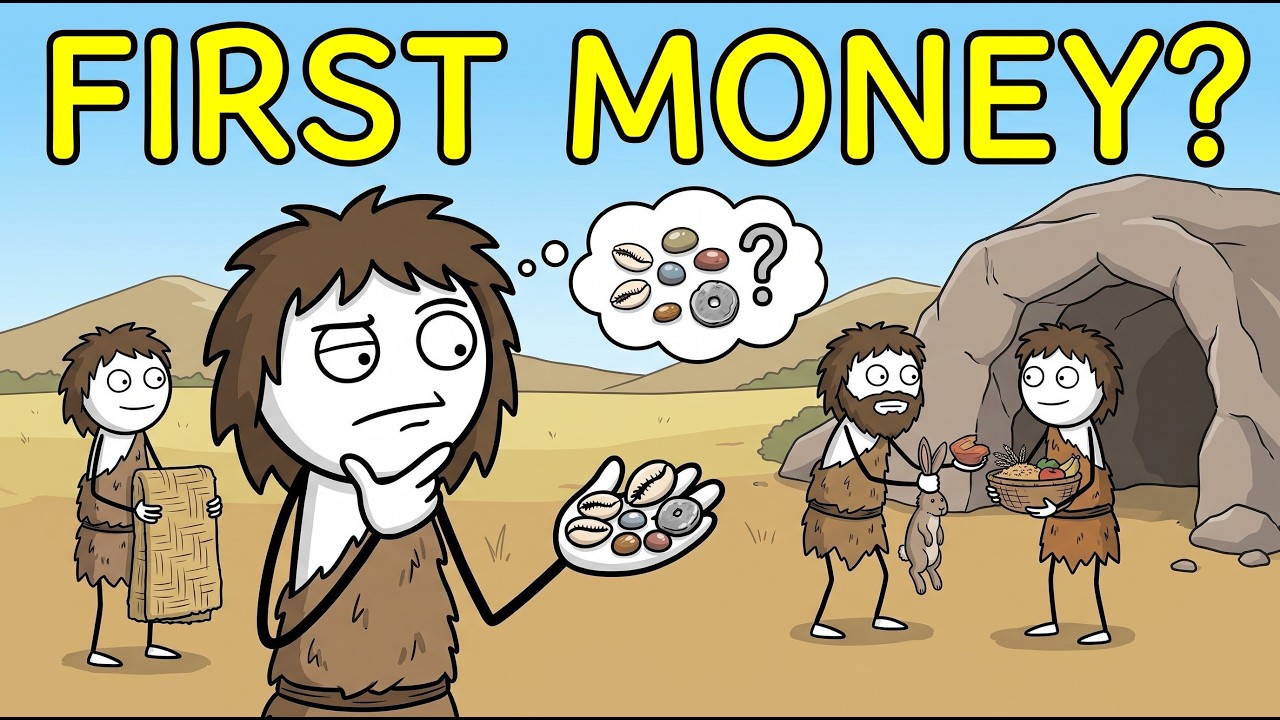
The story most people learned in school about the origins of money—that it evolved from barter—has no basis in documented human history. Social anthropologist Caroline Humphrey wrote in 1985 that no example of a pure barter economy has ever been described, let alone one that gave rise to money. Anthropologists instead point to a system of informal mutual obligation known as generalized reciprocity, where small groups tracked favors in their heads and enforced cooperation through social pressure. That system cracked when human settlements grew large enough that people could no longer know everyone, and the solution that emerged was not money but recorded debt.
Scholars argue that credit and accounting came first, with money developing later as a tool to make obligations portable. David Graeber’s 2011 book, Debt: The First 5,000 Years, challenges the conventional sequence presented in economics textbooks, arguing that credit preceded money and that barter only appeared between strangers lacking trust. The earliest evidence of this shift comes from Mesopotamia, where grain and silver served as units of account. The Sumerian shekel was originally a weight of roughly 8.
3 grams, used to measure both silver and barley, and most transactions involved no physical exchange at all—obligations were recorded on clay tablets. That recording system gave rise to writing itself. Archaeologist Denise Schmandt-Besserat traced cuneiform back to clay tokens used as early as 8000 BC to count grain and livestock. Over time, administrators pressed symbols onto clay tablets, creating the first written language not for poetry or myth, but for accounting debts.
By the reign of Hammurabi, roughly 1792–1750 BC, this debt economy was sophisticated enough to regulate interest rates, capping grain loans at 33. 3 percent and silver loans at 20 percent annually. Different parts of the world invented money independently, and not always in metal. Cowrie shells, collected from the Indian and Pacific Oceans, served as currency in China, India, and across West and Central Africa for roughly 3,000 years.
The Shang Dynasty adopted them as standard money, and the Chinese character for money is a pictograph of a cowrie shell. When natural shells grew scarce inland, people cast bronze replicas—copies of shells that had value not because of the material, but because of the form. On the island of Yap in Micronesia, communities used enormous circular stones called rai as currency. Some stones weighed several tons and could not be moved, so ownership simply shifted by mutual agreement.
One famous stone sank to the bottom of the ocean during transport, and the community still accepted it as money because everyone agreed it retained value. Economist Milton Friedman used this example to illustrate that money’s value depends entirely on social agreement, not physical possession. Coins appeared when humans began standardizing metal. The kingdom of Lydia in modern-day Turkey minted the first coins around 640–630 BC, using electrum, a natural gold-silver alloy.
A stamped lion’s head identified the issuing authority, transferring trust from the individual weighing metal to the state guaranteeing its value. Herodotus recorded that the Lydians were the first people known to use gold and silver coinage. King Croesus later introduced separate pure gold and silver coins through a refining process, and his name became a lasting proverb for immense wealth. Coinage restructured Greek society.
Athens produced the owl tetradrachm, which became the dominant Mediterranean trade currency, financed by silver from the Laurion mines worked by enslaved laborers. Historian Richard Seaford has argued that portable, anonymous wealth from coins helped break the political monopoly of landholding aristocrats and contributed to conditions that enabled Athenian democracy. China followed a separate path. After bronze replicas of cowrie shells, the Warring States period produced knife money and spade money shaped like tools.
In 221 BC, Emperor Qin Shi Huang unified the empire and abolished all regional currencies, mandating the ban liang coin—round bronze with a square hole, a design that remained standard for over 2,000 years. Rome scaled up coinage and then debased it. The denarius, introduced around 211 BC, became the backbone of the economy, and its name survives in the word dinar still used today. Successive emperors reduced its silver content, from Nero shaving it to around 93 percent to Gallienus producing coins that were mostly bronze with a thin silver wash.
The result was hyperinflation. In 301 AD, Emperor Diocletian issued an edict setting maximum prices on over a thousand goods, with death as the penalty for overcharging. The edict failed almost immediately—merchants simply stopped selling. Paper money was invented in China, roughly 700 years before Europe adopted the concept.
Tang Dynasty merchants used flying cash, paper receipts deposited in one location and cashed in another. In Sichuan during the Northern Song Dynasty, heavy iron coins—a string of a thousand weighing over 3 kilograms—created practical demand for something lighter, and private merchants began issuing paper notes. In 1024 AD, the Song government made issuance a state monopoly, creating the world’s first government-issued paper currency. The Yuan and Ming dynasties later overprinted, causing the notes to lose nearly all value, and the Ming government abandoned paper money entirely.
Medieval Italian bankers made money invisible. The Knights Templar allowed pilgrims to deposit funds in one country and withdraw them in another using letters of credit. The Bardi and Peruzzi banks of Florence collapsed in 1343 when King Edward III of England defaulted on massive loans financing the Hundred Years’ War. The Medici Bank, founded in 1397, developed bills of exchange that transferred value between cities without moving a single coin.
The gold standard tied currencies to physical metal beginning in the 19th century, but it collapsed in 1971 when President Richard Nixon ended dollar convertibility to gold. Since then, every major currency has been fiat money—valued by government decree and collective belief. A $100 bill costs roughly 17 cents to manufacture; the remaining value is pure agreement. That belief system may have ancient roots in the practice of debt forgiveness.
Michael Hudson’s research shows Mesopotamian kings regularly enacted clean slates, canceling debts and freeing debt slaves to prevent economic collapse. The Sumerian word amargi, meaning freedom, literally translates as return to mother. Biblical Jubilee laws reflect the same principle—periodic debt cancellation as economic survival. Modern digital money represents the latest layer.
In 2008, a pseudonymous creator named Satoshi Nakamoto published a paper proposing Bitcoin, and the first block of that blockchain embedded a headline from The Times of London about a bank bailout. The intent was to create money no government could debase. Whether it succeeds is debatable, but the impulse is ancient: distrust of whoever controls the currency. Humans did not invent money once.
They invented it in layers over thousands of years, each layer solving a problem created by the previous one. Debt came first, then writing to record it, then units of account, then portable commodities, then stamped coins, then paper, then invisible bank-ledger entries. Every civilization that independently developed agriculture independently developed some form of money, because the underlying problem is universal. Small groups can function on trust and personal memory; large groups cannot.
Money is the shared fiction that makes cooperation between strangers possible, and that trust remains the only thing backing the number on a bank screen today.