A 40,000-year-old vulture bone flute discovered in the Hohle Fels cave in Germany is the oldest direct physical evidence of music ever found. When researchers reconstructed the instrument, it produced a clear, controllable musical tone across a recognizable scale, demonstrating that its maker understood the precise relationship between hole spacing and pitch. The flute is not believed to mark the invention of music itself. A musical instrument is a tool that serves an existing practice, meaning music almost certainly emerged gradually through simpler, less archaeologically traceable methods long before anyone crafted a flute from bone.
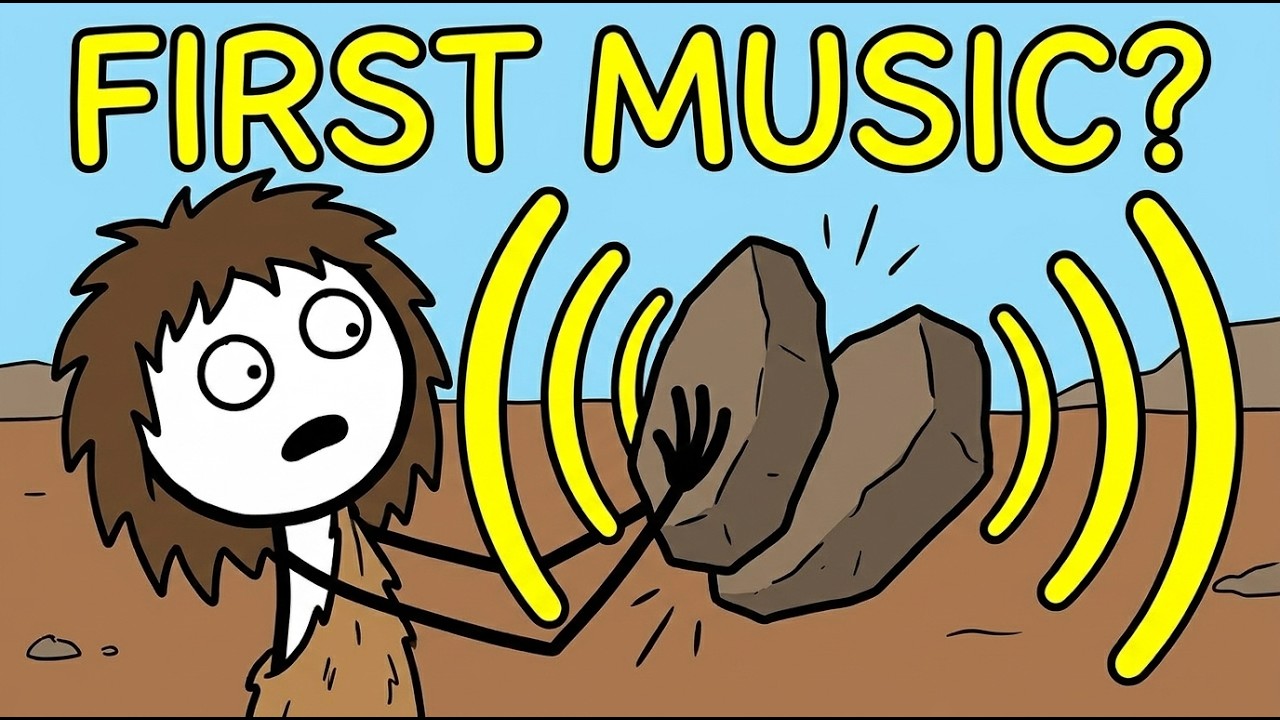
The human voice is the most obvious starting point. Present in every human group that has ever existed, it can produce melodic lines, harmonics, rhythmic patterns, and emotional expressiveness. If music evolved as a social practice, it evolved using voices before any other tool. Body percussion, including clapping, stomping, and slapping, also predates instruments.
These behaviors require no tool-making and leave no trace, yet they are documented across virtually every human culture. Great apes engage in rhythmic behaviors, including chimpanzees drumming on tree roots, suggesting the capacity for rhythm predates the split between human and chimpanzee lineages. Rhythm serves a distinct function from melody. Researchers have proposed the entrainment hypothesis, which holds that rhythmic sound synchronizes bodies and enhances social bonding and cooperation.
Collective work such as rowing, digging, and hauling becomes more efficient when synchronized, and rhythmic vocalization during work is documented across cultures as a practical coordination tool. Robin Dunbar’s work on music and social bonding suggests that group musical activity produces endorphin release through the same physiological pathway as physical grooming. Researchers have documented elevated pain thresholds, a proxy for endorphin release, in people who sang in groups compared to those who listened passively or engaged in other social activities. The acoustic properties of early human environments may also have played a role.
Archaeoacousticians have found that cave paintings in sites like Lascaux correlate with locations of greatest acoustic resonance. Early humans may have discovered that certain spaces produced extraordinary auditory effects, making those spaces centers for ritual and musical activity. Music and language share deep structural features. Both involve organizing sounds in time through learned, culturally transmitted systems.
Some researchers propose that they evolved from a common precursor called musilanguage, while others argue music evolved for social bonding and language developed separately for information transmission. Infant-directed speech, the melodically rich register adults use with prelinguistic infants, is higher pitched, more rhythmically regular, and more emotionally expressive than normal speech. Infants prefer it from birth, and it serves social bonding and emotional regulation functions that are more musical than linguistic in character. Research by Samuel Mehr and colleagues found that listeners from societies with no prior exposure to other cultures’ music could reliably identify recordings as associated with healing, ceremonies, love songs, or dancing.
This suggests music encodes social function in acoustic features recognizable across cultural boundaries. The universality of pitch hierarchies, the tendency of musical systems worldwide to organize pitches into similar structural relationships, may reflect properties of the human auditory system or natural harmonics of vocal production. Musical discovery was likely accidental. The resonance of hollow objects, the acoustic properties of spaces, and the way certain tempos produce involuntary movement synchronization required no intention to invent music.
Humans produced sounds during other activities, noticed interesting effects, and elaborated on them across generations. Geoffrey Miller’s sexual selection hypothesis proposes that musical ability functions as a costly signal of genetic quality and cognitive ability. Professional musicians show elevated reproductive success in some studied populations, though confounding variables complicate the effect. Neuroscience shows music processing engages the auditory cortex, motor systems, emotional centers, reward pathways, memory systems, and social cognition networks simultaneously.
This extensive integration is not what one would expect from a recently acquired cultural skill. The chills music produces are triggered by violations and fulfillments of expectations about melodic progression, reflecting deep integration into the brain’s emotional response architecture. A more controversial find, a cave bear femur from the Neanderthal site of Divje Babe in Slovenia dated to around 50,000 to 60,000 years ago, has holes some researchers interpret as a musical instrument. Others argue the holes are more plausibly carnivore tooth marks.
If genuine, it would push instrument origins back considerably and suggest music predated modern Homo sapiens. Tempos of roughly 60 to 120 beats per minute most reliably produce involuntary movement synchronization in humans. This range corresponds to normal walking pace, resting heart rate, and infant rocking pace, suggesting the nervous system’s entrainment response was calibrated to biologically significant internal rhythms. Every human culture studied has music.
Every human child responds to music with emotional engagement and rhythmic movement before learning cultural associations. The evolutionary timeline, with instruments appearing tens of thousands of years ago as products of practices that must have predated them, places music well within the period when our cognitive architecture was being shaped. Music was not an invention made after humans became fully human. It was part of what made us human, woven into social bonding, emotional regulation, group coordination, and cognitive development.
Humans likely discovered music repeatedly in different forms through accidental encounters with acoustic phenomena, then noticed, valued, repeated, and gradually elaborated those experiences across thousands of generations into the diverse global music culture that exists today. The vulture bone flute is impressive evidence of how far that elaboration had gone by 40,000 years ago, but it is almost certainly not the beginning of the story. The beginning was the first time a human made a sound and noticed that something about it felt worth repeating.


