For nearly seven decades, the fate of German submarine U-455 remained one of World War II’s enduring mysteries. The vessel vanished during the final months of the war, taking all 51 crew members with it and leaving behind a trail of unanswered questions.
When divers finally located the wreck in the Mediterranean Sea decades later, they expected to find another shattered casualty of naval warfare. Instead, what they discovered raised even more disturbing questions about the submarine’s final moments.
Resting more than 400 feet beneath the surface off the coast of Italy, U-455 appeared remarkably intact.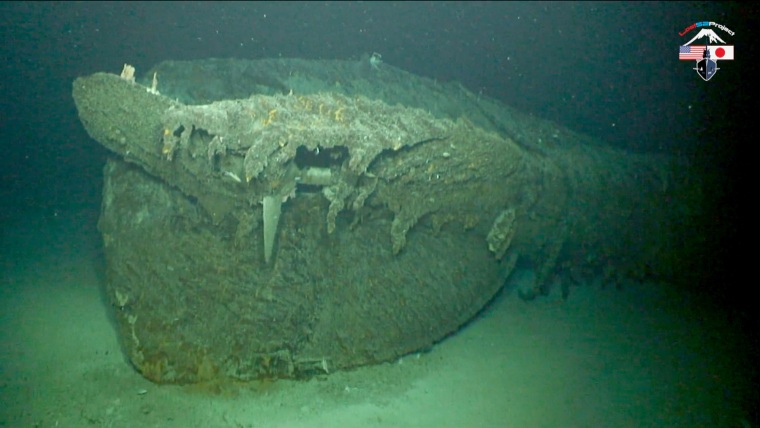
Unlike many World War II submarine wrecks that bear the unmistakable scars of torpedo strikes, depth-charge attacks, or catastrophic structural failures, U-455 seemed almost untouched. The pressure hull remained largely preserved. The conning tower still stood. Most unsettling of all, the hatches were closed.
It was as though the submarine had simply settled onto the seabed and never returned.
Commissioned into the German Kriegsmarine in 1941, U-455 was a Type VII-C submarine, one of the most common and effective U-boats deployed during the Battle of the Atlantic. Throughout its service, it participated in numerous patrols, attacking Allied shipping and surviving dangerous encounters across the Atlantic and Mediterranean theaters.
By early 1944, however, Germany’s submarine force was suffering devastating losses. Allied radar, sonar, aircraft patrols, and improved anti-submarine tactics had transformed the oceans into increasingly deadly hunting grounds for U-boats.
On April 6, 1944, U-455 departed Toulon, France, for what would become its final patrol. The submarine never returned.
German records offered no clear explanation for its disappearance. No Allied warship claimed responsibility for sinking it. No confirmed attack reports matched its last known position. The vessel simply vanished.
For decades, historians assumed U-455 had fallen victim to Allied forces somewhere in the Mediterranean. Yet without physical evidence, its fate remained uncertain.
Everything changed when Italian divers discovered the wreck in 2008.
Lying approximately 120 meters below the surface near Genoa, the submarine immediately attracted attention because of its unusual condition. Investigators expected to find extensive battle damage. Instead, they found a vessel that appeared almost frozen in time.
The bow showed signs of impact, but there was no evidence of a torpedo strike. The hull had not been ripped apart by an explosion. There were no obvious signs of a violent underwater battle.
Even more haunting was the realization that the entire crew was almost certainly still inside.
Because the hatches remained sealed and no evidence suggested an organized evacuation, experts concluded that the 51 sailors likely went down with the submarine. In accordance with international maritime practice, the wreck was treated as a war grave and left undisturbed.
The condition of the submarine forced researchers to consider alternative explanations.
One leading theory suggests that U-455 struck a naval mine while attempting to navigate through heavily defended Allied waters. Minefields were common throughout the Mediterranean during the latter stages of the war, and a collision could have damaged critical systems without immediately destroying the vessel.
If the impact disabled propulsion, steering, or ballast controls, the submarine may have lost its ability to surface.
Another possibility is even more chilling.
Some historians believe the submarine may have suffered a mechanical failure that left it trapped underwater. With batteries depleted and oxygen supplies running out, the crew would have faced a slow and inevitable death in complete darkness. Unable to communicate and unable to reach the surface, they would have been forced to wait as carbon dioxide levels rose and breathable air gradually disappeared.
The absence of catastrophic damage lends weight to this theory.
Unlike submarines destroyed by depth charges, which often exhibit massive hull deformation, U-455 appears to have reached the seabed largely intact. This suggests the vessel may have sunk under control rather than being violently destroyed.
For families of the crew, the discovery finally provided some measure of closure after more than sixty years of uncertainty. Yet the exact cause of the submarine’s loss remains unknown.
What happened aboard U-455 during its final hours may never be fully understood.
Did the crew know they were doomed? Were they attempting emergency repairs? Did they believe rescue might come? Or did the submarine simply vanish into the depths without warning?
The silent wreck offers few answers.
Today, U-455 rests where it came to a stop in 1944, preserved by the cold waters of the Mediterranean. It stands not only as a relic of World War II but as a haunting reminder of the dangers faced by submarine crews, many of whom disappeared without a trace beneath the oceans they sailed.
More than eighty years later, the submarine remains a tomb, its secrets still locked behind steel walls on the dark floor of the sea.