Sleepwalking is far more common than most people realize, with studies showing that between 15 and 30 percent of children experience it at some point, and between 1 and 7 percent of adults do as well. Yet despite decades of scientific study, it remains one of the strangest and most misunderstood behaviors the human brain produces. One of the most persistent myths is that waking a sleepwalker is dangerous and could cause a heart attack or severe psychological damage. That is entirely false.
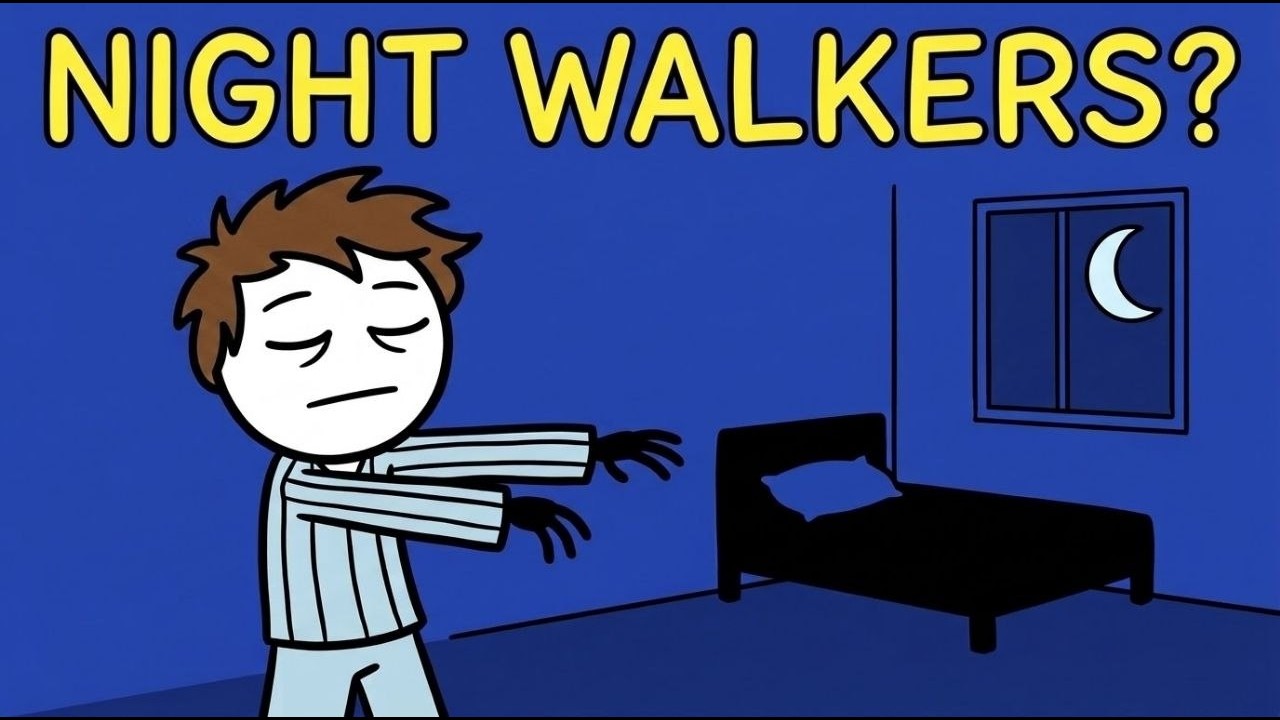
Waking a sleepwalker carries no medical risk, though it can be difficult because they are often confused and disoriented. In many cases, gently redirecting them back to bed is easier, but if waking them is necessary for their safety, it should be done. Another common misconception is that sleepwalkers navigate with supernatural precision. This is not accurate.
They manage familiar routes because the path from bedroom to kitchen is stored in motor memory. In an unfamiliar environment, their navigational abilities deteriorate rapidly. The discovery that sleep is not a single state came in 1953, when researchers Eugene Aserinsky and Nathaniel Kleitman at the University of Chicago identified rapid eye movement, or REM, sleep. Their work showed that sleep is structured and cycles through multiple stages.
Sleepwalking occurs almost exclusively in slow-wave sleep, the deepest phase of non-REM sleep, during which brain activity slows to its minimum and physical restoration is most active. Brain imaging studies of sleepwalking episodes have revealed something surprising. During an episode, the brain is not uniformly in deep sleep. The regions responsible for conscious awareness and self-reflection remain in a sleep-like state, but the regions controlling locomotion and spatial navigation show activation patterns typical of wakefulness.
The result is a person who is moving and navigating while the part of the brain that would normally observe and record the experience remains offline. Genetics plays a substantial role in sleepwalking. It runs strongly in families, and children with two sleepwalking parents have roughly a 60 percent chance of sleepwalking themselves. Sleep deprivation is another major trigger, as it drives the brain deeper into slow-wave sleep during recovery.
Fever, stress, certain medications, and alcohol can also increase the likelihood of episodes. Children sleepwalk far more often than adults, with peak prevalence between ages 4 and 8. This is partly because children spend much more time in slow-wave sleep, both in absolute terms and as a proportion of total sleep time. A young child might spend 40 to 50 percent of sleep in slow-wave sleep, while adults spend considerably less.
The developing brain also has less mature sleep-wake regulation systems, which may make partial arousal events more common. The range of behaviors sleepwalkers can perform is far broader than wandering down a hallway. Documented cases include cooking complete meals, leaving homes and walking long distances, driving vehicles, sending text messages, and making phone calls, none of which the person later remembers. Sleep-related eating disorder is a variant in which people eat during episodes, sometimes consuming foods they would never eat while awake.
Sexual behavior during sleep, known as sexomnia, is a recognized condition that has been presented as a defense in legal proceedings involving assault allegations. Rare but medically established cases of sleepwalking-related violence also exist. Individuals have injured themselves and others during episodes with no waking memory of the event and, according to forensic assessment, no waking-state motivation. These cases raise difficult questions about moral and legal responsibility when the part of the brain responsible for conscious agency was demonstrably inactive.
Sleepwalking is often confused with acting out dreams, but the two are different. REM sleep behavior disorder involves people physically acting out vivid dreams because the normal muscle paralysis that accompanies REM sleep fails. Sleepwalking, occurring in non-REM slow-wave sleep, is a partial arousal state in which motor systems activate without dreamlike conscious experience. Sleepwalkers awakened during an episode typically report mental blankness or fragmentary content, not a narrative dream.
Some researchers have proposed an evolutionary explanation for sleepwalking, suggesting that partial motor activation during deep sleep may have served a protective function in ancestral environments where predator threats were real. This remains speculative, but it connects to the broader observation that sleep is active and survival-relevant across species. Many prey animals sleep with one hemisphere of the brain at a time to maintain environmental monitoring, and the human sleep system may reflect similar evolutionary pressure. For most people, sleepwalking does not require medical treatment.
The primary approach is environmental safety, such as securing windows and doors, removing sharp objects, and installing stair gates. For those with frequent or dangerous episodes, clinical options include scheduled awakenings, medications that suppress slow-wave sleep, and addressing underlying contributors like sleep deprivation, stress, or alcohol use. What does not yet exist is a treatment that precisely targets the partial arousal mechanism without disrupting restorative sleep. That would require a level of understanding current neuroscience has not reached.
The deeper question sleepwalking raises is philosophical. The person moving through the house wears the same face and walks with the same gait, but the part of the brain that generates the continuous first-person narrative we call consciousness is absent. The body can be active while the self does not show up.
It is a reminder that the human brain is not a light switch, but a system of partially independent subsystems that can activate separately, a reality that challenges comfortable assumptions about consciousness and its relationship to behavior.