Scientists have measured that flies process visual information at up to 300 cycles per second, compared to roughly 60 cycles per second for humans, meaning their nervous systems register the world through far more distinct frames of time than ours. This is the core finding behind a larger scientific question: whether different animals genuinely experience time at different rates. The most directly measurable dimension is flicker fusion rate, the speed at which flickering light becomes perceived as continuous. Humans stop detecting flicker around 60 cycles per second, which is why 24-frames-per-second cinema appears smooth to us.
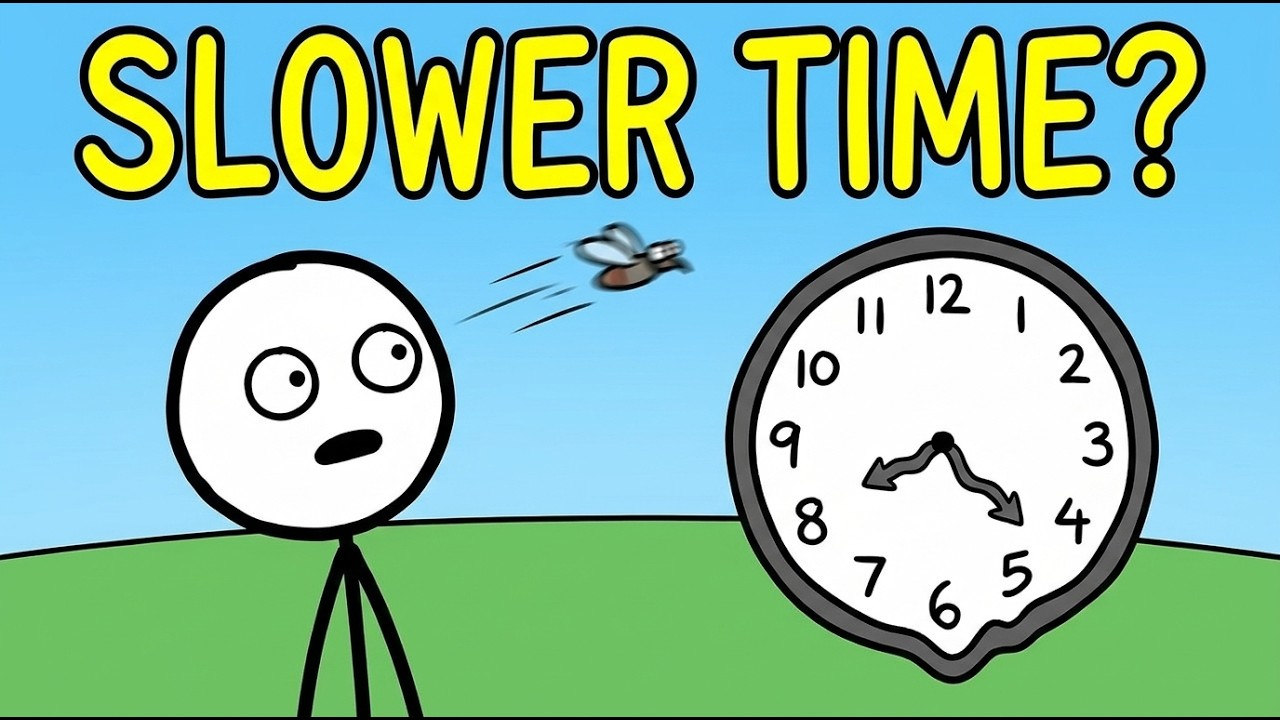
Dogs process at roughly 70 to 80 cycles per second, which is why older low-refresh-rate televisions sometimes appear to flicker visibly to them while looking perfectly smooth to humans. The implication is that for an animal with a higher flicker fusion rate, a given real second contains more distinct moments of visual processing, leading some researchers to suggest that time may functionally feel longer or slower to that animal. Hummingbirds represent an extreme example. Their hearts can exceed 1,000 beats per minute during flight, and their wings beat up to 80 times per second.
Research on avian flicker fusion rates indicates birds process visual information considerably faster than humans, with hummingbirds likely sitting at the faster end of the spectrum due to their extraordinary metabolic rates. Beyond visual processing, circadian rhythms represent a completely different timescale of temporal perception. The molecular machinery underlying these internal clocks, involving proteins whose concentrations oscillate across roughly 24-hour cycles, is remarkably conserved across species as distant as fruit flies and humans. However, research on cave-dwelling species that have lived in constant darkness for sufficient evolutionary time shows substantially weakened circadian rhythms, suggesting the precision of these clocks is maintained by ongoing selection pressure from light-dark environments rather than being a fixed biological constant.
Interval timing, the ability to perceive durations from seconds to hours, has been studied extensively through experimental conditioning tasks. A well-established finding across many species is scalar timing: variability in timing responses scales proportionally with the duration being timed, meaning animals are roughly equally accurate proportionately across a wide range of intervals. This consistency across wildly different species suggests a deep shared principle underlying interval timing in animal nervous systems. Temperature provides a particularly clear window into the relationship between physiology and time perception.
In ectothermic animals like reptiles and many invertebrates, increasing body temperature measurably speeds up the interval timing system, producing shorter time estimates for the same elapsed real duration when warmer. Endothermic animals show similar but less dramatic temperature effects because internal temperature regulation keeps their nervous systems in a narrower range. Researchers have also investigated whether animals possess anything resembling episodic memory with a temporal component. Scrub jays have been extensively studied in this regard, with experiments showing these birds remember specifically what food was cached, where each item was hidden, and how long ago each caching event occurred.
They use this information to preferentially recache perishable food that has been out of view long enough to potentially be pilfered. Whether this constitutes genuine episodic memory with subjective temporal awareness similar to human autobiographical memory is debated in comparative cognition. Regarding dogs specifically, research has found they show measurably different behavioral responses when owners return after longer versus shorter absences, with more intense greeting behavior following longer separations. However, whether this reflects genuine subjective experience of duration, simpler tracking of elapsed time through contextual cues, or the accumulation of motivational state cannot be determined from behavioral evidence alone.
What is clear is that dogs access temporal information through their olfactory world in ways humans cannot. The strength of a scent trail degrades at a predictable rate, allowing experienced dogs to read a chemical timeline of who was present and when, providing something like temporal depth to an environment. Long-lived animals raise additional questions. Elephants have demonstrated long-term memory of individuals, locations, and events extending across many years.
Whether this includes a subjective awareness of one’s own history or simply robust storage and retrieval of specific information is impossible to determine with current scientific tools. There is at least a plausible argument that temporal experience scales with the ratio of a current duration to the organism’s total lifespan, suggesting a year represents a considerably more compressed segment of time for an elephant near the end of a long life than for a mouse in the middle of its second year. Researchers caution that intellectual honesty demands distinguishing between measurable facts and inferential leaps. Saying an animal processes visual information at a higher flicker rate is a direct fact about neural processing speed.
Saying that animal therefore experiences time in slow motion requires assuming something about the relationship between processing speed and subjective experience that has not been fully established even for human consciousness. The hard problem of consciousness, why any physical process should give rise to subjective experience at all, remains unresolved even for our own species. Attention also modulates perceived duration. Research on human temporal perception shows time appears to pass faster when attention is fully absorbed and more slowly when attention is unoccupied.
If similar effects hold for other animals, species that spend significant time in highly vigilant predator scanning or prey tracking behavior might experience those intervals differently than species with lower attentional demands. Migratory birds reveal that temporal capacities go beyond moment-to-moment processing speed. Many species track time of year with remarkable precision using internal calendar mechanisms calibrated to day length, timing breeding preparation, migration onset, and stopover decisions that can be matters of life and death. Research has found internal circannual calendars, full year-length internal cycles operating in some species entirely independent of external time cues, allowing correct seasonal behavior to emerge on schedule even in constant laboratory conditions.
Very short-lived animals raise questions about proportional experience. A mayfly’s adult stage lasts between a few hours and a day, yet during this time these animals find mates, reproduce, and engage in synchronous mass emergence behaviors requiring temporal coordination. Whether the mayfly experiences its brief adult life as richly as a human experiences a corresponding fraction of a lifespan, or whether temporal experience requires biological complexity that mayflies lack, is a question current neuroscience cannot answer. The overall conclusion from this research is that time is not a single universal experience uniform across all animals.
Time is constructed by nervous systems rather than simply received from an external clock, and different nervous systems construct it differently. The second a fly experiences while dodging a hand is not the same second its human observer experiences, not in any relativistic sense, but because the computational and experiential content of that second differs fundamentally depending on the biology doing the experiencing. Based on measurable evidence across multiple dimensions, the scientifically careful answer to whether animals feel time differently is yes, almost certainly. Their visual systems process temporal information at dramatically different rates, their interval timing systems are calibrated to different physiological baselines and respond differently to temperature and metabolic state, their memory systems store temporal information through different architectures, and their attentional systems create different patterns of duration distortion.
The most honest conclusion is that time is something like a family of related experiences, each shaped by the specific sensory systems, metabolic rates, nervous system architectures, and cognitive capabilities of the particular animal doing the experiencing.