For two centuries, a single question about ancient Egypt has produced completely opposite answers, argued in lecture halls, painted onto museum walls, taught to schoolchildren, and then untaught a generation later: What color were the ancient Egyptians? The question has never been merely academic. Casting decisions for major films have been fought over in headlines, museum placards have been rewritten as institutions change their minds, and school textbooks in different countries teach flatly contradictory pictures of the same pyramids, the same pharaohs, and the same river. At the center of the argument is a deeper conflict over who gets to claim ownership of one of the greatest achievements in human history.
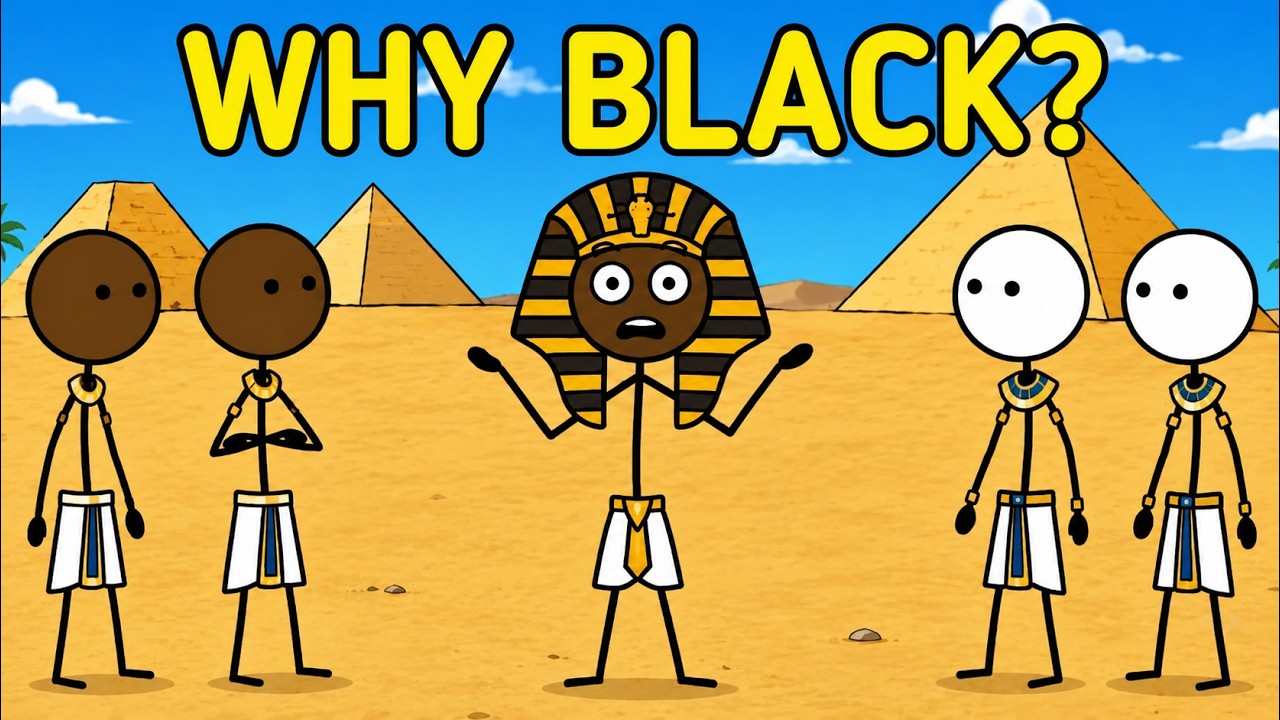
The origins of the dispute lie not in Egypt, but in 19th-century Europe. When European scholars began systematically excavating and cataloging Egypt, they faced a problem. Egypt was undeniably one of the most advanced civilizations the ancient world had produced, with pyramids, writing systems, medicine, and monumental architecture that were centuries ahead of comparable achievements elsewhere. And Egypt sits on the African continent.
That geography was deeply inconvenient for a colonial worldview that argued sub-Saharan Africa was incapable of producing advanced civilization. So a deliberate move was made in the scholarship of the era. Egypt was quietly reclassified, not as African, but as more Mediterranean, more Caucasoid, practically an honorary member of the European family tree, detached from the very continent it physically sits on. That single decision shaped textbooks for a hundred years.
In the mid-20th century, the pushback arrived with equal force. Scholars associated with the Afrocentric movement, most famously the Senegalese historian Cheikh Anta Diop, argued that ancient Egypt was not just African by geography, but black African by population, culture, and origin. The centuries-long effort to paint it otherwise was not scholarship, they argued, but theft, a civilization stripped from the people who actually built it. Two camps, two flatly opposite answers, both certain.
Both were working from a genuine gap in the evidence, because for most of that fight, nobody had a reliable way to check. That changed in 2017. A team of researchers ran something close to the ancient version of a modern ancestry test on mummies. Egypt’s heat and the chemistry of mummification are brutal on genetic material, and most previous attempts to extract usable ancient DNA had failed.
Using mummies from a site called Abusir el-Meleq, spanning roughly 1400 BCE to 400 CE, they finally sequenced real ancient genomes. The result surprised almost everyone. Genetically, these ancient individuals showed their closest ties not to populations of sub-Saharan Africa, but to ancient populations of the Near East and the Eastern Mediterranean, including the Levant and parts of Anatolia. It was not the Caucasoid Mediterranean branch 19th-century Europeans had claimed, but it was also not the sub-Saharan African population the Afrocentric case had staked its strongest claim on.
Neither 200-year-old argument walked away fully vindicated. The same study found something else, something hardly anyone was asking about. When researchers compared those ancient genomes to modern Egyptians living in the same region today, modern Egyptians actually carry noticeably more sub-Saharan African ancestry than their ancient counterparts did. The population did not stay frozen in place.
It shifted substantially sometime after the Roman period, almost certainly tied to more than a thousand years of trans-Saharan trade and forced migration, including centuries of slave trade routes that moved people north across the desert long after the pyramids were already older than the Roman Empire is to us. That means ancient Egyptians and modern Egyptians are not genetically quite the same population. The Nile Valley kept absorbing new people for 3,000 more years after Giza was finished. Scientists are appropriately cautious about how far to stretch those numbers.
One study, one site, a few dozen mummies pulled from one narrow slice of a 3,000-year civilization. A single Middle Egyptian sample may not speak for Upper Egypt near the Nubian border or for the Delta pressed against the Mediterranean coast, two regions that almost certainly looked different from each other and from this. A few dozen genomes over 3,000 years makes the limits of the study obvious fast. But there is another part of the story that almost nobody talks about, and it may be the real answer hiding underneath the entire 200-year fight.
The ancient Egyptians did not divide people the way we do. Walk into an actual New Kingdom tomb painting and you will not find a black versus white binary at all. You will find four distinct groups painted in four distinct colors, because the Egyptians themselves were intensely interested in cataloging the peoples around them, just not along the lines we would recognize. Egyptian men were painted reddish-brown, Egyptian women a lighter yellow ochre.
To the south, Nubians were painted black, often shown with their own distinct hairstyles, jewelry, and status. A specific, respected, and occasionally rival kingdom, not an undifferentiated other. To the east, Asiatics from the Levant were painted yellowish-tan, bearded, in different dress. To the west, Libyans were lighter-skinned, tattooed, with feathers worked into their hair.
Four categories, not two, painted side by side by artists who clearly saw meaningful difference between all four groups and felt no need to collapse it down to a simple binary. The categories were built on nationality, geography, and culture as much as anything you would call skin tone. And Nubia was never a footnote to Egypt’s story. For an entire stretch of history, Nubian kings ruled Egypt outright, founding its 25th dynasty and sitting on the throne of the pharaohs themselves.
Taharqa was among them, commissioning monuments up and down the Nile. The idea of Egypt as ethnically sealed off from black Africa does not survive contact with Egypt’s own history painted by Egyptians on Egypt’s own walls. When the question gets asked, “Were the ancient Egyptians black? ” it is not only an empirical question anymore.
It is a modern binary forged largely out of 19th-century pseudoscience and the specific weight of transatlantic slavery, retroactively stapled onto a civilization that organized human difference along an entirely different set of lines, changed dramatically over 3,000 years, and left behind exactly the kind of partial, regionally patchy evidence that lets two opposing sides each find what they came looking for. Here is what the evidence, taken together, actually supports. Ancient Egypt was ethnically and genetically diverse, shifting over both time and geography. Its population carried real ties toward the Near East.
It was deeply intertwined culturally and dynastically with Nubian Africa to its south. And it was absolutely unambiguously African by geography, by trade, by self-conception, by the gods it worshipped, and the river it depended on. Egypt was never separated from Africa. It was also never one single uniform population you could hand a single label to.
Not black in the way that word functions in a modern conversation, not white in the way 19th-century Europeans needed it to be. The face behind the glass case is not going to answer the question people walk in with. Not because the science failed, but because the question was never really about that face. It was about who 200 years of very different people needed that face to be.
Colonial scholars protecting a Eurocentric story of civilization, Afrocentric scholars reclaiming a stolen one, modern geneticists just trying to read what is actually written in the bones. Colonial Europe needed Egypt white and rewrote the textbooks to get there. Afrocentric scholarship needed Egypt black and pushed back with everything it had. Genetics finally showed up in 2017 and handed back something closer to the Levant than either camp was expecting.
Modern Egyptians, it turned out, carry more sub-Saharan African ancestry than the ancient samples do, the exact opposite of what most people would have guessed walking in. Underneath all of it, the Egyptians themselves, 4,000 years ago, were quietly painting a world with four colors in it, not two, on the walls of their own tombs. The pyramids have been standing for 4,500 years. The idea that human beings sort neatly into a small handful of races is, by comparison, barely 200 years old, younger than the argument about ancient Egypt itself.
The people who built one of history’s most staggering civilizations never once asked themselves the question we have spent two centuries fighting over.


