Just before dawn, a settlement falls silent. Children sleep, animals are tied near the enclosure’s edge, and a fire has burned down to almost nothing. Then figures emerge from the tree line. They move fast and low, knowing exactly where they are going.
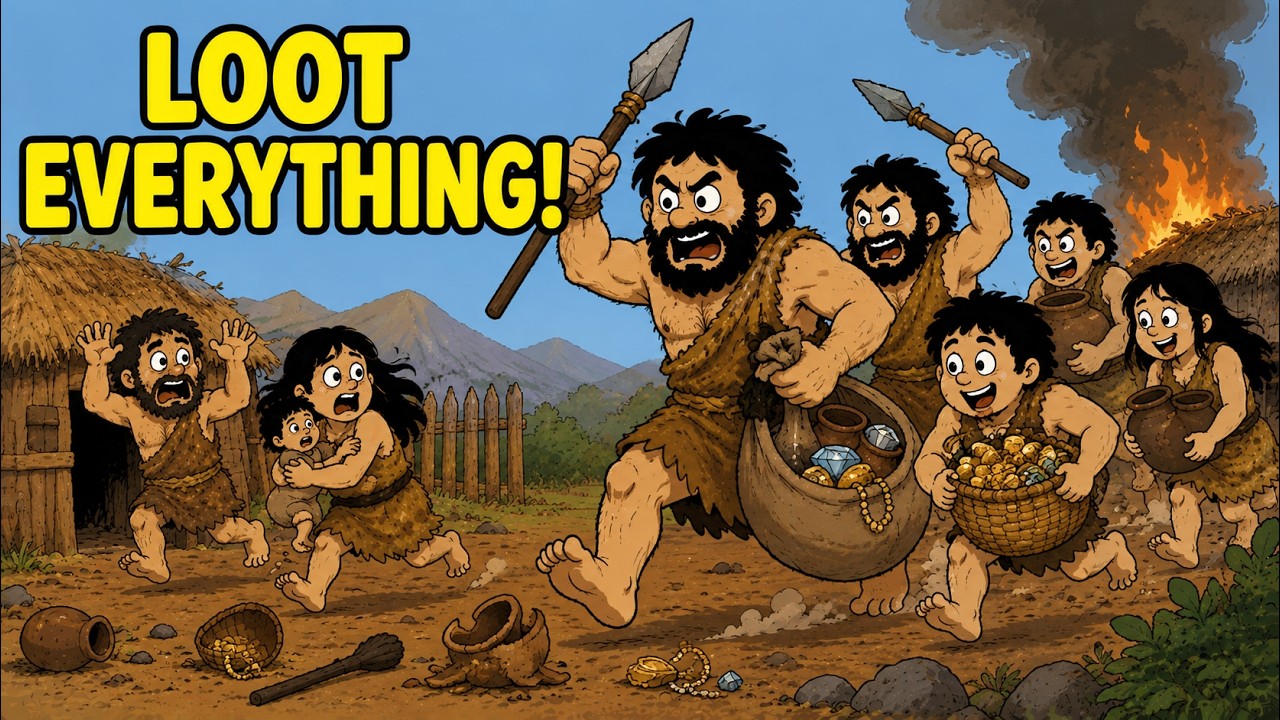
Within minutes, the animals are gone, a few people are dead, others are missing, and the attackers have vanished back into the darkness. This was not a rare event in the ancient world. It occurred across every continent and in every era before the rise of large organized states. A small group would cross into another group’s territory, take what they wanted, and leave.
No army, no declaration, no formal occupation—just a strike, a retreat, and weeks of silence before people felt safe enough to sleep again. For a long time, historians and scientists assumed the answer was obvious: ancient people were violent because that is what humans do. But that explanation turns out to be wrong in almost every important way. The groups doing the raiding were often not desperate, starving, or afraid.
Some had enough food, animals, and land—and they still went. The real question is what was actually driving them to raid. Raiding is not the same as war. A raid is a fast, limited attack designed to grab something specific and get out: livestock, stored grain, people, or status.
The goal is not to conquer or hold territory. Raiders do not want to govern the people they just hit. War, by contrast, involves standing armies, prolonged campaigns, sieges, supply lines, political negotiations, and permanent domination. Raiding requires none of that.
Twelve people who know the terrain can execute a raid with wooden weapons and sandals, which is why raiding existed long before empires, kings, or professional armies. The most straightforward explanation for raiding is resources. Food, water, arable land, and hunting territory were real pressures in a world without grocery stores or supply chains. But scarcity does not automatically produce raids.
It narrows options and increases pressure. A community watching its harvest fail for the second season looks across the valley at a neighbor with full granaries and asks a question any desperate person in history has asked: what happens if we take it? Yet resource pressure was not always the driver. Plenty of raids in the historical and archaeological record happened when the attacking group was doing reasonably well.
Other forces pulled people toward violence even when hunger was not the immediate threat. The single most important material resource in the ancient world was the domesticated animal—cattle, sheep, goats, and horses. These were not just food sources. They were the closest thing to a savings account, a stock portfolio, and a line of credit all in one body.
A large herd meant caloric security, social capital, and future wealth because animals reproduce. Crucially, unlike a field of crops, a herd can be moved. A field of barley cannot be carried away in the dark, but a herd of 30 cattle can be driven across 20 miles of open terrain by four people in a single night. This highly valuable, self-reproducing, portable asset class became the central target of raids across nearly every pastoral and agropastoral culture on Earth.
Wherever domesticated animals existed, raiding for them existed. In many documented cases, the target was people. In societies where every able-bodied adult represented thousands of hours of agricultural work, acquiring an adult worker through capture was economically efficient in the coldest possible sense. Captive women were taken for reproductive purposes, domestic labor, or both.
Skilled craftsmen were taken because their knowledge could not be reproduced quickly. Children were sometimes taken and raised as members of the capturing group. The institution of captivity varied enormously, from harsh enslavement to adoption into kin groups. The taking of people was a flexible tool deployed in different ways depending on what the community needed.
There was also something else raiders could carry home—reputation. In a world without police, courts, or contracts strangers were compelled to honor, survival depended on what other communities thought of you. Were you a group that hit back hard when provoked? Were you a group whose young men had proven themselves in real conditions?
A community known for fierce retaliation was significantly less attractive to raid than one known for passivity. Young men who fought well in raids became more marriageable and more likely to lead. The social returns were real and often large relative to the material gains. This creates a situation where the incentives do not care whether the underlying behavior is beneficial.
If status rises every time you successfully raid a neighbor and falls every time you refuse, the system pulls you toward raiding regardless of whether your community actually needs what you are stealing. The incentive structure becomes self-sustaining, leading to the revenge trap. Group A raids Group B, taking cattle and killing two people. Now Group B faces a decision with almost no good options.
If they do not respond, they signal to every neighboring community that they can be attacked without consequence. Their deterrence value collapses. So they raid back. Now Group A faces the same calculation.
The original cattle are gone, but there are new deaths, new humiliations, and new obligations to honor the killed. Both groups are now attacking each other in what each understands to be self-defense. The cycle runs forward. The bio-archaeological record shows this pattern clearly.
Sites across Neolithic Europe, the American Midwest, the margins of the Sahara, and coastal East Africa show evidence of repeated violent encounters between the same regional groups across multiple generations. The violence is not random. It clusters around certain communities and territories—the fingerprint of a feud, not a single explosion of desperate aggression. The site at Crow Creek in what is now South Dakota, dated to around the 14th century, contained the remains of nearly 500 individuals in a mass grave, with evidence of scalping, dismemberment, and burning.
The region had been under severe drought stress in the years leading up to the massacre. The drought did not cause the massacre by itself. It compressed resources, elevated tensions, and accelerated a cycle of violence that was already present. Climate does not cause wars, but it turns up the pressure on systems already under stress.
The Talheim death pit in what is now Germany, dated to around 7,000 years ago, contains 34 individuals killed systematically with stone tools and arrows. The pattern of wounds suggests execution, not chaotic battle. The proportion of adults to children suggests young women were taken rather than killed. This was a raid that escalated to massacre.
The archaeological evidence around Talheim shows it belonged to a network of early farming communities that were trading and sharing pottery styles across a wide region. These were not isolated brutes but integrated community members who, under whatever pressures that moment produced, organized mass violence against neighbors they almost certainly knew by name. The people who committed these raids were not a different kind of human. The same communities that show massacre sites also show evidence of long-distance trade, shared ceremonial practices, and careful sustained agricultural labor.
Both things are true at the same time about the same people. Geography determined vulnerability to raids. Open plains and steppes were ideal environments for mobile raiders who could cover enormous distances and disperse across terrain that made pursuit nearly impossible. Dense forests and mountain valleys made it harder to move large groups quickly.
Coastlines created a particular dynamic—water is a highway for mobile attackers and a vulnerability for settled coastal communities. The most attractive targets were communities with concentrated visible wealth in geographically exposed locations. As economies became more complex, wealth became more concentrated, sharpening the incentive to raid. Trade routes created predictable flows of valuable goods through predictable geographical corridors.
Raiding a trade route was not the same as raiding a village; it was hitting the circulatory system of an entire regional economy. The more valuable the route, the more it was worth defending and the more it was worth attacking. Economic development did not automatically produce security. It produced wealth, and wealth without the capacity to defend it was a vulnerability.
Storage facilities created another vulnerability. A foraging band carries its wealth or knows where to find more. A farming community accumulates its wealth in a granary that sits in the same place every year. Any group within a day’s travel knows it is there.
The defensive architecture surrounding ancient granaries, from the mud-brick storage of early Mesopotamian villages to the stone-walled granaries of prehistoric American settlements in the Southwest, reflects how communities understood their stored food as their greatest point of vulnerability. The relationship between pastoral nomads and settled agricultural communities maps almost perfectly onto the logic of raiding. Pastoral groups were mobile, skilled riders and trackers whose wealth was already in the form most easily converted into military strength. Agricultural communities had concentrated wealth and reduced mobility—almost exactly the vulnerability profile a raider looks for.
But these communities needed each other. Pastoral groups needed grain, metal tools, and manufactured goods; agricultural communities needed animal products, transport services, and trade networks. In stable conditions, they traded. The shift to raiding happened when something disrupted the equilibrium: a drought, a political breakdown, or a shift in power that made one side feel it could take what it needed more cheaply than it could buy it.
The structural factors that produced peaceful exchange were the same ones that, when they failed, produced violence. Droughts in particular show up repeatedly in the archaeological record as events preceding dramatic spikes in violent conflict. The 14th-century historian and sociologist Ibn Khaldun described a process where pastoral communities would periodically erupt into large-scale raids and conquests at the expense of weakened settled civilizations, driven by what he called asabiyyah—group solidarity forged by shared hardship and mutual dependence. His observation made six centuries ago without modern archaeology maps remarkably well onto what the physical record now shows.
One of the most psychologically interesting drivers of ancient raiding was fear as a structural condition. The anthropologist term for this is the security dilemma. Two neighboring communities have no shared authority above them—no court to resolve disputes, no police force to deter violence, no contract both sides must honor. Neither can fully know the intentions of the other.
If Group A sees Group B building a stockade and more young men carrying weapons, is Group B preparing to defend itself or to raid? The cost of assuming the best and being wrong is catastrophic—losing cattle, food stores, people, and possibly life. So Group A prepares its own defense. Group B sees this and faces the same calculation.
The trap closes. Both communities behave in ways that look aggressive from the outside even though both believe they are acting defensively. The pressure builds until someone makes a preemptive strike to prevent the attack they are now certain is coming. The archaeological record of this process is the fortified settlement.
Palisades, ditches, stone walls, and watch towers appear across the ancient world not as evidence that people were constantly attacked, but that they were constantly afraid they might be. As political structures grew more complex, raiding transformed from a tactical behavior into a policy instrument. When a leader could call on 300 fighters instead of 30, the calculus shifted. When an early state could field several thousand, raiding became conquest.
Successful leaders discovered that organized violence could be made more profitable at scale. Warriors rewarded with plunder attracted more fighters. Larger operations targeted more heavily defended settlements. The feedback loop between military success and political power became self-reinforcing, from ancient Mesopotamia and early dynastic Egypt to Bronze Age Greece and the Yellow River Valley of ancient China.
The early Assyrian kings kept meticulous records of their campaigns that read remarkably like the logic of a raid: specific goods taken, specific numbers of captives, specific cities burned or spared. The scale was imperial, but the logic was ancient. The economics of organized violence created a seductive loop. Military campaigns brought back wealth that funded the court, paid soldiers, and built monuments.
The ruler’s prestige depended on continued success, which required continued campaigns. The state became dependent on violence to function. When campaigns failed, the whole system was vulnerable to collapse. There is a direct line between a 12-person raiding party stealing cattle in a Neolithic valley and a Bronze Age king organizing a campaign to extract tribute from a distant city.
The underlying calculation is the same: the expected gain from organized violence outweighs the expected cost. The people on the receiving end of raids paid an enormous price that the historical record tends to underrepresent. A four-hour raid could destroy food stores that took eight months to accumulate. A single night’s loss of animals could eliminate the caloric buffer that kept a community alive through a hard winter.
Survivors retreated to more defensible, often less fertile locations. They built walls instead of additional storehouses. Regions that experienced repeated raiding over generations showed a consistent pattern of settlement contraction, defensive consolidation, and economic disruption. Raiding was a regional economic force that depressed development and redirected enormous amounts of human energy from productive activity into security.
Cooperation turned out to be a more powerful long-term strategy than violence in most conditions. Marriage alliances were among the most effective tools—when your daughter lives in the neighboring settlement and your grandchildren are growing up there, raiding that settlement becomes a different calculation. You have kin inside the wall. Formalized gift exchange created another layer of protection.
The anthropologist Marcel Mauss documented how reciprocal gift-giving created obligations that functioned as de facto peace treaties. Raiding your gift partner breaks the relationship and imposes public costs, making it an expensive choice relative to maintaining the relationship. Sanctuary rules—cultural prohibitions on harming travelers, guests, and traders—created protected corridors of communication and exchange that made negotiation and trade more productive than the alternative. The fundamental insight from this evidence is that ancient humans were not violent by nature or peaceful by nature.
They were opportunistic and highly flexible. They could cooperate at extraordinary scales when structural conditions made cooperation more profitable than violence. They could organize devastating raids when structural conditions made violence the most attractive available option. The same communities and the same individuals oscillated between these modes across their lifetimes.
Were ancient people more violent than modern people? The answer is complicated. Lawrence Keeley’s research in the 1990s found that the proportion of deaths attributable to violence in many pre-state populations was substantially higher than in modern industrialized nations—between 10 and 60 percent of individuals in some samples showed evidence of violent death. But this comparison requires care.
Modern states have monopolized violence through police, courts, and armies that deter external aggression. Ancient communities had none of these institutions. Violence rates were high partly because the institutional frameworks that reduce violence were absent. Modern states are also capable of organizing violence at scales ancient raiders could not have conceptualized; the 20th century alone saw organized violence that killed tens of millions.
The difference is not that humans got less violent. It is that humans built institutions—legal systems, states, international agreements—that channel violent impulses away from everyday behavior and concentrate them in specific regulated contexts. Those institutions are fragile. They can be built and can collapse.
The archaeological record shows communities that had peaceful periods lasting centuries followed by catastrophic episodes of mass violence. The institutions of peace are achievements, not defaults. The skull from Nataruk in Kenya, dated to around 10,000 years ago, still has obsidian points embedded in the bone. The obsidian is not local—the attackers carried their weapons across terrain they knew well, targeted this group, and left.
This is not random or instinctive aggression. It is organized, planned, deliberate collective violence that required real coordination, before states, before writing, before formal armies. The capacity for organized collective violence is not a product of civilization. It is a product of being human.
Ancient humans raided because the structural conditions of their world—the absence of central authority, resource competition, social incentives around status and reputation, the retaliatory trap, the security dilemma—made raiding a rational response to genuine pressures. When those conditions changed and communities built institutions that made cooperation more profitable than violence, raiding rates declined. Not because humans changed, but because the world around them changed. The structural conditions that produced ancient raiding did not disappear from human history.
They disappeared in some places for some periods under specific institutional arrangements that took enormous collective effort to build and maintain. The underlying drivers—resource competition, status incentives, retaliatory cycles, fear of what a neighbor might do—did not become biologically extinct. They became managed. Where management breaks down, they still produce the same outcomes they always have.
The real mystery of ancient raiding is not why it happened; given the world it happened in, it was almost inevitable. The real mystery is how, starting from scattered settlements and no overarching authority, humans managed to build anything else at all: alliances between groups that had every reason to fear each other, trade networks across regions where raiding was endemic, and ceremonial relationships that created islands of reliable peace in seas of potential violence. Ancient humans did not raid because they were simply more violent than us. They raided because, like us, they lived in a world where survival, fear, wealth, identity, and power were constantly colliding.
The question the archaeological record leaves open, still visible in the fracture patterns of 10,000-year-old skulls, is this: if the capacity for both extraordinary violence and extraordinary cooperation has always been present in the same species, what determines which one wins?