The roar of 100,000 fans at Silverstone was swallowed by a single, collective gasp. It was July 3, 2022, and the British Grand Prix had just witnessed an accident that defied physics and terrorized the world. Zhou Guanyu’s Alfa Romeo had been launched skyward at nearly 300 kilometers per hour, flipping over the tire barrier and slamming into the catch fencing with a force that tore the survival cell from its chassis.
For 27 agonizing seconds, the car lay upside down, wedged between the metal fence and the barrier, invisible to the cameras and the frantic eyes of the paddock. George Russell, who had triggered the initial collision, sprinted down the track, his helmet still on, his face a mask of dread. No one knew if Zhou was alive.
 The silence was deafening. Then, the message crackled over the radio: the driver was conscious. He was okay.
He was completely unharmed. The reason was a titanium ring, a seemingly simple piece of engineering that had been mocked and resisted just years earlier. The Halo had done its job, absorbing the impact that would have otherwise crushed Zhou’s skull.
But the road to that moment of salvation was paved with the blood of those who came before him, a grim timeline of tragedy that forced Formula 1 to evolve from a death-defying spectacle into a science of survival.
The first major crack in the sport’s fatalistic armor appeared not in Formula 1, but in the feeder series, on a summer day at Brands Hatch in 2009. Henry Surtees, the 18-year-old son of 1964 World Champion John Surtees, was competing in a Formula 2 race, following in the footsteps of legends who had once battled on that historic circuit. The race seemed routine until Jack Clarke spun out, his car slamming into the barriers.
It was the kind of incident that happened a dozen times a weekend. But as marshals rushed to the scene, a loose wheel, torn from Clarke’s suspension, bounced across the track at over 140 kilometers per hour. It struck Henry Surtees square on the helmet.
He was knocked unconscious instantly. By the time the marshals reached him, the life was already draining from his body. He was airlifted to the Royal London Hospital, but hours later, the motorsport world lost one of its brightest young stars.
Henry’s death was a brutal wake-up call, exposing the terrifying vulnerability of an open-wheel driver’s head. His father, John, a man who had tasted the ultimate glory in the sport, became a relentless advocate for change. He founded the Henry Surtees Foundation, dedicated to improving safety and supporting drivers with traumatic brain injuries.
His efforts led to the doubling of wheel tethers by 2011, but behind the scenes, engineers were already sketching the blueprints for something far more radical: a cockpit protection system.
Just as that progress was gaining momentum, the sport was plunged into a darkness it hadn’t seen in decades. October 5, 2014, the Japanese Grand Prix at Suzuka. The race was held under the shadow of an approaching typhoon, rain lashing the track, visibility reduced to a gray blur.
On lap 42, Adrian Sutil spun out at the Dunlop corner, crashing into the barriers. It was a minor incident, a blip on the radar. But instead of deploying a safety car or red flagging the race, race control left the track under green flag conditions, with a recovery crane parked on the runoff area.
One lap later, the unthinkable happened. Jules Bianchi, the young Frenchman driving for Marussia, lost control at the exact same corner. His car slid off the track and disappeared beneath the crane.
The impact was measured at 254 Gs, a force no human body is designed to survive. The marshals scrambled, their faces pale with horror. Bianchi was unconscious, his helmet having done all it could, but it wasn’t enough.
He was rushed to Mie Prefectural Hospital with severe brain trauma. He underwent emergency surgery and was placed in a medically induced coma. For nine months, the world prayed.
But on July 17, 2015, the news arrived that shattered the paddock. Bianchi had passed away. He was the first driver to die from a race incident since Ayrton Senna in 1994.
 The tragedy was compounded by the agonizing truth that it was avoidable. Why was a crane on a live track? Why wasn’t the safety car deployed?
The accident was a damning indictment of the sport’s complacency, and it ignited a firestorm of change that culminated in the introduction of the Halo.
The Halo was ugly. It was heavy. It obstructed the driver’s view.
When it was first tested, the drivers revolted. Max Verstappen, then a young prodigy, famously declared that the excitement was gone before he even sat in the car. The paddock was divided, with many arguing that it ruined the aesthetic purity of the open-cockpit machines.
But the FIA, driven by the ghosts of Surtees and Bianchi, pushed forward. They knew that the statistics were clear: head impacts were the leading cause of fatal accidents. The Halo, a three-pronged titanium structure weighing just seven kilograms, could withstand the weight of a double-decker bus.
It was a solution to a problem that had killed dozens of drivers over the decades. And then, on November 29, 2020, the debate was settled in the most dramatic and terrifying way possible. The Bahrain Grand Prix.
The race started cleanly, but on the first lap, Romain Grosjean made a sharp move across the track, clipping the front wheel of Daniil Kvyat’s car. The impact sent Grosjean’s Haas spearing into the steel barrier at over 220 kilometers per hour. The car split in half, the fuel tank ruptured, and a massive fireball erupted.
For 27 seconds, there was no movement, no word. The world watched in horror as the flames engulfed the wreckage. The commentators were speechless, uttering expletives as they struggled to comprehend what they were seeing.
Then, a figure emerged from the inferno. Grosjean, his hands burned, his visor scorched, climbed over the barrier and stumbled into the arms of the medical team. He had survived.
The Halo had borne the brunt of the impact, slicing through the steel barrier like a hot knife through butter, creating a space for his head to survive. Grosjean would never race in Formula 1 again, but he left with something far greater: his life. The Halo, once reviled, was now hailed as the greatest safety innovation in the sport’s history.
The shadow of Bianchi’s death stretched far beyond the engineering labs. It reached into the heart of a young Monegasque driver named Charles Leclerc. Bianchi was Leclerc’s godfather, his mentor, his friend.
When Bianchi died, Leclerc carried the weight of that loss into his own career. In 2019, at the Belgian Grand Prix, Leclerc was on the cusp of his first Formula 1 victory. He had taken pole position, and the paddock was buzzing with the possibility of a fairytale win.
But on the second lap of the race, in the Formula 2 support event, tragedy struck again. Anthoine Hubert, a French driver and Leclerc’s childhood friend, was involved in a horrific crash at the high-speed Raidillon corner. Giuliano Alesi had spun out, and Hubert, unsighted, plowed into the barriers.
 Moments later, Juan Manuel Correa, unable to avoid the wreckage, slammed directly into Hubert’s side pod at nearly 200 kilometers per hour. The impact was measured at over 70 Gs. Hubert was rushed to the medical center, but his injuries were beyond recovery.
At 18:35 local time, the FIA announced the unthinkable: Hubert had been killed. The motorsport world was in mourning. But among the grief stood Leclerc, his face set like stone.
He had lost his godfather, and now he had lost his best friend. A week later, at the Italian Grand Prix, Leclerc drove the race of his life. He won, and as he crossed the finish line, he dedicated the victory to Hubert.
“It was good, but yeah, difficult to enjoy on a weekend like this,” he said, his voice cracking. He had carried his friend to the top with him, but the victory was bittersweet, a stark reminder that the sport they loved could still exact a terrible price.
The echoes of these tragedies reverberate back to a weekend that remains the darkest in Formula 1 history: the 1994 San Marino Grand Prix at Imola. The season had begun with a fierce rivalry between Ayrton Senna and Michael Schumacher. Senna, the three-time world champion, was desperate to reassert his dominance.
But the weekend was cursed from the start. On Friday, Rubens Barrichello crashed heavily, surviving with a fractured nose and a concussion. On Saturday, the unthinkable happened.
Roland Ratzenberger, an Austrian rookie in just his second Grand Prix, suffered a front wing failure at over 300 kilometers per hour. His car slammed into the wall at the Villeneuve corner. He was killed instantly.
It was the first death in Formula 1 in 12 years. The paddock was in shock, but Senna was devastated. He had seen everything, but even he didn’t know that the worst was yet to come.
On Sunday, race day, the start was chaotic. A collision involving JJ Lehto and Pedro Lamy brought out the safety car. Senna led the field, but his car was unsettled, the tires cold, the ground clearance too low.
On lap seven, at the Tamburello corner, a corner taken flat out at 233 kilometers per hour, Senna’s Williams twitched, understeered, and plowed straight into the concrete wall. The front right wheel was torn off, and a piece of the suspension pierced his helmet visor. The force of the impact threw his head back, causing fatal skull fractures.
He was airlifted to the hospital, but he was pronounced dead that evening. The world had lost its greatest star. Senna’s death was a watershed moment.
It forced the FIA to undertake a radical overhaul of safety protocols. Cockpits were redesigned, tracks were reprofiled, medical facilities were upgraded, and the HANS device was introduced to prevent basilar skull fractures. The lessons learned from Senna’s death would go on to save countless lives, including that of Felipe Massa.
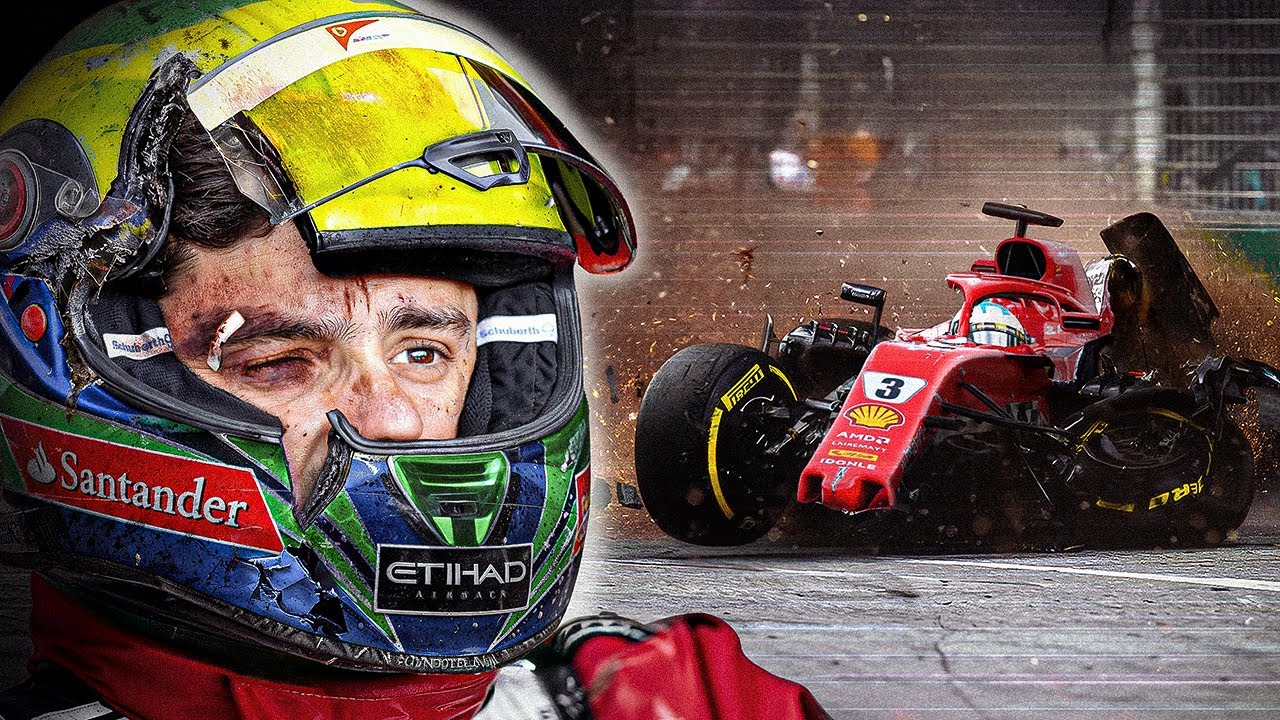
In 2009, at the Hungarian Grand Prix, Massa was pushing hard in qualifying. Suddenly, without warning, a spring that had fallen off Rubens Barrichello’s car bounced down the track and struck Massa directly on the helmet at over 160 miles per hour. He was knocked unconscious, his car careening into the tire barrier.
 He was airlifted to the hospital with a skull fracture and a severe concussion. He survived, but he missed the rest of the season, and many believe he was never the same driver again. The crash exposed a fatal flaw in helmet design: the visor gap.
It was the same vulnerability that had cost Senna his life. The FIA had been redesigning helmets since 1994, and on that day in Budapest, the progress paid off. The carbon fiber helmet absorbed the impact, saving Massa’s life.
But the sport hadn’t always been so lucky. In the early 1980s, the danger was even more visceral. In 1982, at the Belgian Grand Prix at Zolder, Gilles Villeneuve was locked in a bitter feud with his Ferrari teammate Didier Pironi.
Pironi had disobeyed team orders to steal a win at Imola, and Villeneuve was furious. He vowed to never speak to Pironi again. At Zolder, he was on a mission to outqualify his teammate.
Coming over a rise before the Terlamenbocht corner, Villeneuve closed rapidly on the slower March of Jochen Mass. Mass moved right to let him through, but at that exact moment, Villeneuve darted right too. The cars touched, and Villeneuve’s Ferrari was launched into the air, somersaulting through the sky at over 200 kilometers per hour.
The car disintegrated into a cloud of debris. Villeneuve was thrown from the cockpit, his body flying through the air, his helmet torn off by the violence of the crash. He landed more than 50 meters from the wreckage.
He was declared brain dead that evening, and life support was turned off. His death changed the sport forever, and it broke Enzo Ferrari, who had treated Villeneuve like a son. Just 31 days later, the nightmare continued.
At the Canadian Grand Prix in Montreal, Riccardo Paletti, a 23-year-old Italian making only his second start, slammed into the back of Pironi’s stalled Ferrari at the start of the race. The car burst into flames, and Paletti was pinned inside, unconscious. It took several minutes to extinguish the fire, but it was too late.
He was the last driver to die in a Formula 1 car for 12 years, until Ratzenberger and Senna.
The history of Formula 1 is a graveyard of ambition, a testament to the thin line between glory and oblivion. From the 1961 Italian Grand Prix at Monza, where Wolfgang von Trips crashed into the crowd, killing 14 spectators and himself, to the fiery death of Paletti, the sport has been forced to confront its own mortality. The introduction of the Halo, the HANS device, the reinforced cockpits, the improved fuel cells, and the stringent track safety regulations are all monuments to the fallen.
Zhou Guanyu walked away from his crash because Jules Bianchi did not. Romain Grosjean escaped the fire because Ayrton Senna did not. The phrase “he died to save others” is often used in motorsport, but the truth is more complex.
These drivers did not choose to die. They were victims of an era when speed outpaced safety. But their deaths were not in vain.
They forced a reluctant sport to evolve, to prioritize the lives of its competitors above the spectacle. The Halo is not just a piece of titanium. It is a promise.
A promise that the sacrifices of Surtees, Bianchi, Hubert, Senna, Villeneuve, and Paletti will never be forgotten. A promise that the next generation of drivers will race in a world where the unthinkable is no longer inevitable. The crashes changed Formula 1 forever, but it is the memory of the men who perished that truly guides its future.