Thelma Todd, the platinum-blonde queen of Hollywood comedy, was laughing and drinking at the Trocadero on December 14th, 1935, just hours before her body was found slumped in a garage. The hostess of that fatal party was a 17-year-old British import named Ida Lupino, a fading starlet who would soon be dragged before a grand jury. Her testimony that night would haunt her for decades, and the story she told then was not the one she told fifty years later.
The death of Thelma Todd was ruled accidental, a tragic twist of carbon monoxide fate in a garage she had no reason to enter. But the circumstances were a powder keg of 𝒔𝒄𝒂𝓃𝒹𝒶𝓁, involving an ex-husband with mob ties, extortion letters, and a married lover living just up the hill. Lupino, the young actress who watched Todd leave the party, was a key witness in the ensuing investigation, but her account of Todd’s final mood shifted dramatically over the years.
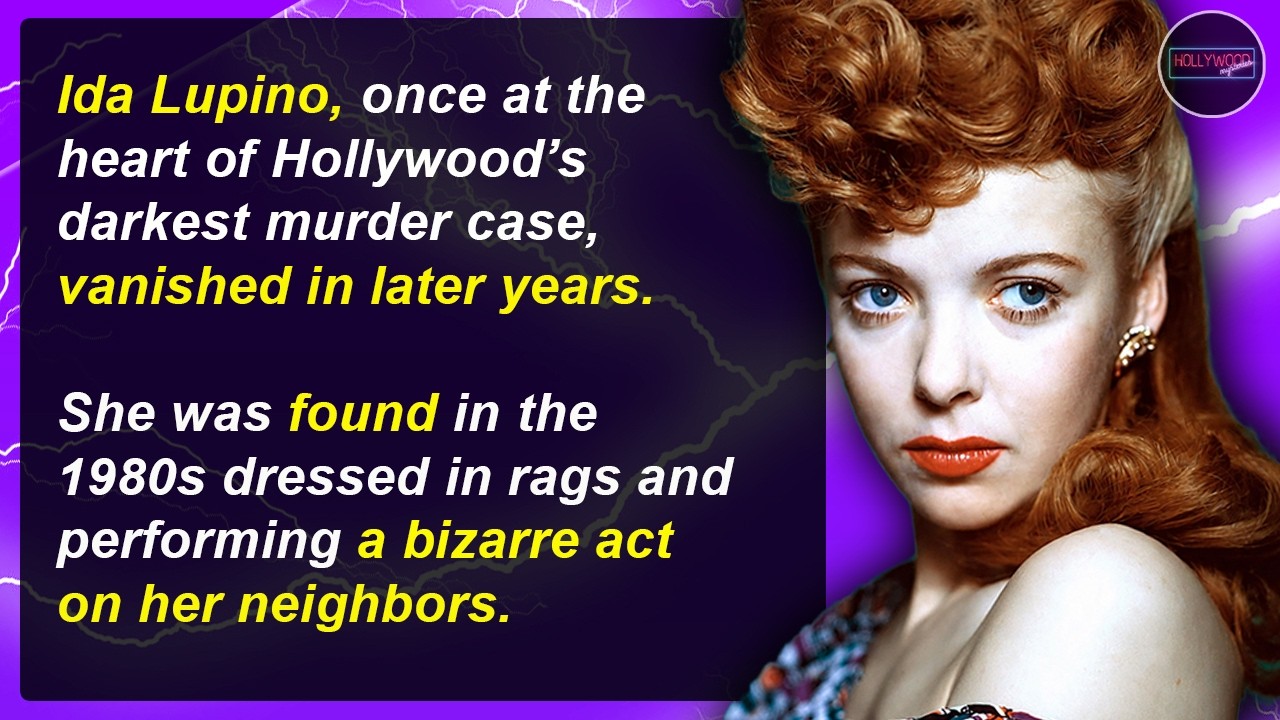 Lupino was born into a dynasty of British music hall performers, a world of puppeteers and clowns that stretched back centuries. She was a child of the stage, writing plays at seven and memorizing Shakespeare by ten, but her path was never simple. She was signed by Paramount as a fresh-faced Alice in Wonderland, yet the studio paled when they saw the worldly, smoky-eyed girl who arrived, a teenager who had already played a string of “tarts” in British films.
Her early Hollywood career was a mess of miscasting and studio confusion, but a bout with polio at sixteen redefined her. Told she might never walk again, Lupino realized her mind was her only true asset. “If that body was paralyzed, my brain could still work industriously,” she said, and she began to plot a future that would not rely on her face or her figure, a future that would eventually make her the only woman directing feature films in America.
The ’40s made her a star, but it was a reluctant stardom. She fought with Jack Warner, refused roles she found beneath her, and earned the nickname “the poor man’s Bette Davis” for taking parts the bigger star rejected. Her ferocious performances in films like The Hard Way earned critical acclaim, but she was more interested in the mechanics of filmmaking, haunting sets and cutting rooms during her many suspensions to learn the craft from the ground up.
In 1948, she formed The Film Makers, an independent production company with a mission to tackle taboo subjects on a shoestring budget. Her directorial debut came by accident when her hired director suffered a heart attack, and she took over the camera herself. She refused the credit out of “respect,” but the pattern was set: she would tell stories about rape, illegitimacy, and bigamy that no one else in Hollywood would touch.
The most chilling of her films was The Hitch-Hiker, a 1953 noir about a serial killer that she based on a real death row inmate she visited in San Quentin. She obtained the killer’s signed release, but the censors forced her to fictionalize the story, cutting the body count from six to three. The result was an airless, terrifying masterpiece, the only classic film noir directed by a woman, and it remains a testament to her unflinching vision.
Her personal life was as tangled as any of her scripts. She married actor Louis Hayward, who returned from WWII a broken man, then left him for producer Collier Young. When that marriage failed, she directed a film called The Bigamist, written by her ex-husband, starring his new wife Joan Fontaine and herself, a production so psychologically complex it remains a landmark of cinematic awkwardness.
As the studio system crumbled, Lupino found a new home in television, directing episodes of The Twilight Zone, The Fugitive, and even Gilligan’s Island. She was fast, cheap, and never went over budget, but she was also a pioneer, the only woman directing in a male-dominated arena. She played the “mother” to her crews, pretending to know less than she did to get more cooperation, a strategy that was both a survival tactic and a quiet act of rebellion.
Her final years were a retreat into a rambling, overgrown ranch house where she drank, set fire to her own mailbox, and hosed down neighbors she disliked. She was a recluse, a faded queen running her own old pictures in the dark, until a young conservator named Mary Ann Anderson came up the hill to deliver flowers and stayed for eleven years. She died in 1995, a stroke at 77, and was buried in an unmarked grave.
The gap in the stone at Forest Lawn is a fitting monument to a woman who defied easy categorization. She was a star who hated stardom, a director who played dumb, and a survivor who insisted that the truth was always more banal and more frightening than the melodrama Hollywood preferred. Her legacy is not just the films she made, but the proof that a woman could command a set, a camera, and a story without apology.