Every major predator of the ancient world hunted at night, yet early humans survived despite spending nearly a third of their lives completely unconscious and vulnerable. Lions, leopards, hyenas, wolves, and bears all prowled the darkness in search of prey, and a sleeping animal is normally the easiest meal nature offers. Sleep is one of evolution’s biggest risks. Every creature faces the same trade-off: stay awake forever or close your eyes and gamble with survival.
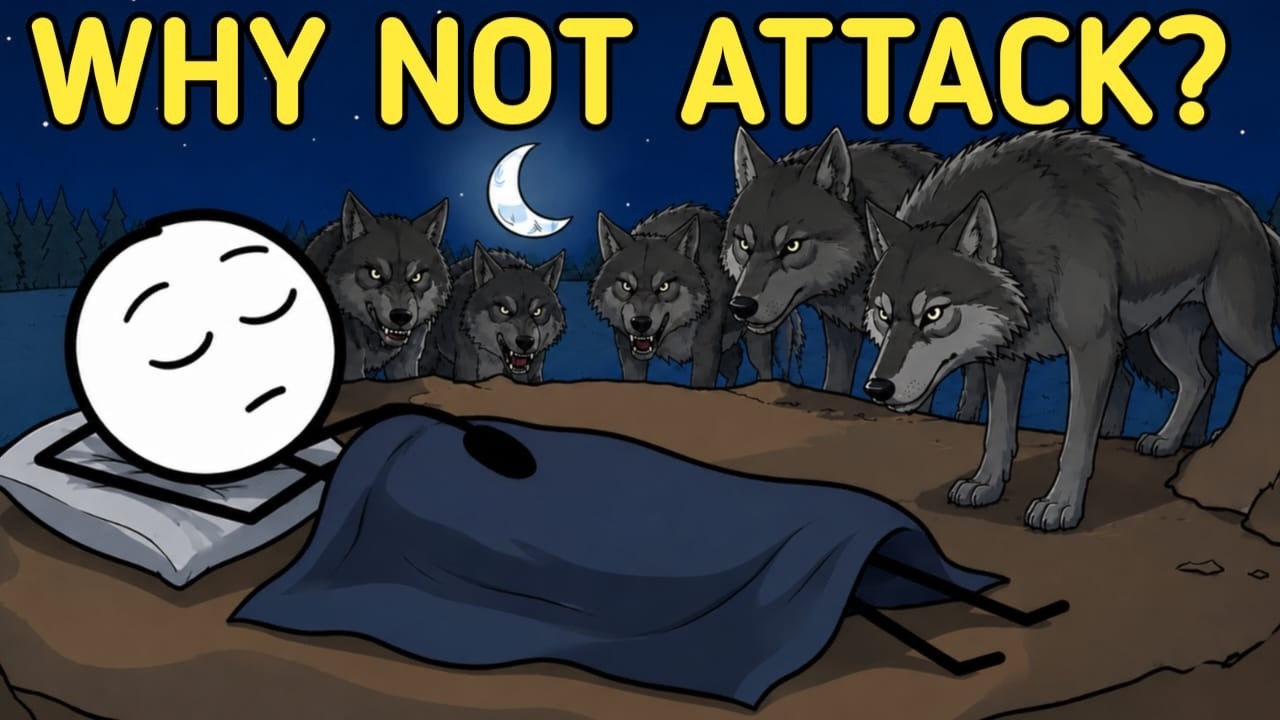
Some animals developed partial solutions, such as dolphins sleeping with only half their brain or birds napping with one eye open. Humans evolved no such defenses. When our ancestors slept, they were fully committed, with muscles relaxed and awareness gone for hours. The question then becomes why predators didn’t simply eat sleeping humans.
Part of the answer begins with the fact that a predator’s calculation is not just about whether it can kill, but whether it can afford the risk. A single injury from a hunt can mean starvation, making every attack a gamble. Humans changed the odds because they almost never slept alone. A group of sleeping people was far different from a single target.
With 20 pairs of ears instead of one, the slightest sound from a human rolling over or coughing could alert the whole camp. Predators are drawn to predictability, and a circle of sleeping humans was anything but predictable. One shout, one scream, or one thrown stick could transform an easy meal into complete chaos. Beyond simple numbers, humans had another advantage: someone was almost always awake.
People naturally fall asleep at different times, some wake in the middle of the night, and others rise before dawn. Even if 19 people in a camp were asleep, one might be awake and watching. That single person meant a predator approaching the group was not approaching sleeping prey but prey that might already be watching. The way humans responded to danger also worked against predators.
Most animals become quiet when threatened, but humans do the opposite. When a lion managed to grab a sleeping person, the rest of the group often did not simply flee. They screamed, grabbed burning branches, threw stones, and fought back, turning the hunter into the hunted. Fire played a critical role as well.
To a predator, fire is deeply unsettling because it behaves unlike anything else in nature. It produces heat from a distance, throws out unpredictable sparks, changes shape constantly, and makes noise without warning. Even today, most wild animals avoid open flames. When humans built fires and placed them at the center of their camps, they effectively created a ring of daylight in the darkness that predators refused to approach.
Groups, vigilance, and fire combined to make humans a risky meal rather than an easy one. Over thousands of generations, predators learned a simple lesson: there are easier and safer targets. Deer do not throw fire, zebras do not organize, and antelope do not chase an attacker together. Humans do.
That does not mean humans were never attacked. Killings by lions, wolves, bears, and crocodiles have occurred throughout history and still happen today. But such attacks became the exception rather than the rule. Predators do not hunt out of anger or revenge; they hunt based on probability.
Each generation of animals made the same silent calculation, and humans kept making the numbers worse. Weapons improved, groups grew larger, dogs joined camps, fences appeared, villages became towns, and towns became cities. As a result, most wild predators today do not immediately attack humans they encounter. Many watch, hesitate, and then slip away into the trees before a person even realizes they were there.
This reflects a silent conversation that has lasted tens of thousands of years, passed down through instinct and experience rather than words. The transition from relying on caves to building shelters marked another turning point. Caves offered natural protection but were often already claimed by bears, hyenas, or big cats. Humans eventually stopped searching for safety and began creating it wherever they went.
Simple wooden frames, animal hides, and windbreaks were humble by modern standards, but they represented a revolutionary idea: humans could carry protection with them across any landscape. Every glowing camp was a signal to the surrounding wilderness that humans were present. Over time, the landscape itself changed from the predator’s perspective. The safest hunting routes kept shrinking, filled with noise, fire, and organized groups that were not worth the risk.
The deepest explanation goes beyond fire or numbers. Civilization itself depends on a simple condition: people waking up in the morning. Farming, villages, trade, writing, science, and cities all rest on the foundation of a safe night’s sleep. Every peaceful night gave humans another chance to learn, invent, and raise children who would build something greater.
Humans were not the fastest, strongest, or best-equipped animals in the night. They had no claws, no fangs, and poor night vision. What they had was an invisible network of trust in which one person slept while another listened, one gathered wood while another kept the fire alive, and one spotted danger while everyone responded. That cooperation proved stronger than teeth, claws, or the darkness itself.
Predators do not attack sleeping humans because over thousands of years humans became one of the most expensive meals in nature. A sleeping person has never truly been alone. Behind every campfire stood a group, behind every group stood cooperation, and behind that cooperation stood the survival strategy that changed the course of history. Humans did not defeat the darkness by becoming stronger than the predators within it.
They defeated it by ensuring that even in their most vulnerable moment, they were never truly alone.


