For roughly 290,000 years, humans lived without nations, states, or borders. The default condition was not citizenship but kinship. Small groups of related wanderers, usually between 20 and 50 people, followed available food and belonged to people, not parcels of land. This system worked as long as everyone knew everyone else, a cognitive limit that Robin Dunbar, an evolutionary psychologist at Oxford, formalized in a 1992 paper.
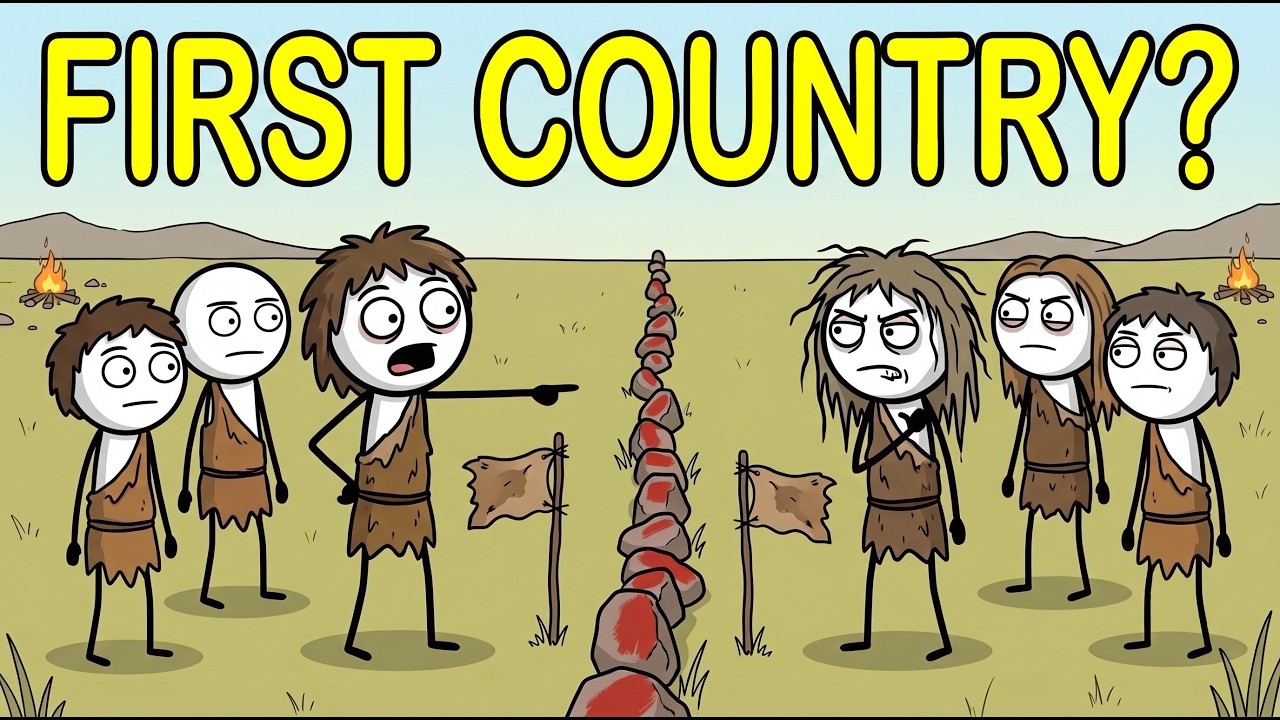
Known as Dunbar’s number, it places the maximum number of stable social relationships a human brain can maintain at around 150. Above that number, personal reputation, gossip, and hidden social pressure fail. No one can track 300 relationships intimately. When that happens, a new binding mechanism is needed, something larger than a family tree.
Every modern state, from India’s 1. 4 billion to Vatican City’s roughly 800 residents, operates far above this threshold and depends on structures the human brain was never designed for. The shift began with a decision most people do not consider political: the choice to stop moving. Around 12,500 BCE, in the Levant, the Natufian culture settled in place.
Dorothy Garrod first discovered the site at Shuqba Cave in 1928, and later excavations at Ain Mallaha from 1955 revealed circular stone houses, grinding tools, storage pits, and organized burials. These were year-round villages. Crucially, the inhabitants were still hunter-gatherers. They settled first and adopted agriculture later.
Settling changes the relationship to the land underfoot. Foragers treat land as a resource they pass through; settlers treat it as a resource they invest in. Once people clean, store food, and bury ancestors in one place, that ground becomes identity. Archaeologist Colin Renfrew argued in a 1973 paper that Neolithic tombs and monuments across western Europe functioned as boundary markers.
You bury your dead to declare that the land belongs to those who descend from those bones. The first borders were not walls or treaties but graves. Yet graves and houses were not enough to unite large numbers of strangers. A shared belief was required.
At Göbekli Tepe in southeastern Turkey, German archaeologist Klaus Schmidt began excavating in 1995 and found massive T-shaped limestone pillars, up to 5. 5 meters tall and weighing up to ten tons, carved with animal reliefs and arranged in circular enclosures. The site dates to around 9500 BCE. Its builders were not farmers but hunter-gatherers with no permanent settlement nearby, drawn from scattered groups who gathered to build a great monument together.
Schmidt’s conclusion before his death in 2014 was concise: first came the temple, then the city. Shared faith was the first technology that allowed humans to cooperate beyond personal relationships, and it preceded agriculture and borders. Shared belief alone does not create a state, however. Grain does.
Around 10,000 BCE, in the Fertile Crescent, humans began domesticating wheat and barley. Geneticist Manfred Heun and his team published a 1997 study in Science using DNA fingerprinting to trace einkorn wheat domestication to the slopes of Karacadag in southeastern Turkey, about 30 kilometers from Göbekli Tepe. Yale political scientist James C. Scott argued in his 2017 book “Against the Grain” that the first states formed specifically around grain rather than rice, yams, or cassava.
The reason is simple: grain is visible. It ripens at a set time and can be measured, divided, stored, and transported. In short, grain can be taxed. Tubers grow underground and are invisible for counting; wheat stands in the field, matures all at once, and any observer can estimate the yield.
State-making, in Scott’s formulation, is fundamentally a process of grain taxation, with borders, armies, bureaucracies, and laws existing to make those taxes possible. Before taxing grain, walls were needed. The earliest known walls belong to Jericho. Around 8000 BCE, the settlement of Tell es-Sultan, ancient Jericho, built a stone wall about 3.
6 meters high and 1. 8 meters thick, attached to a round stone tower 8. 5 meters tall with an internal staircase of 22 stone steps. Kathleen Kenyon excavated the site in the 1950s and interpreted it as the world’s first military fortification; others, including Ofer Bar-Yosef of Harvard, argued it was a flood barrier.
Scott offered a different view: ancient city walls also served to retain the workforce states needed for labor and taxes. Whether Jericho’s wall was a fortress, a dam, or a labor camp, construction required an estimated 11,000 organized days of work. A plan required a planner, overseers, and people feeding workers. That is administration, and administration forms the basis of the state.
With grain surpluses and walls came social inequality. At Dhra in the Jordan Valley, archaeologists Ian Kuijt and Bill Finlayson discovered in 2009 one of the world’s earliest known granaries, dating to about 9300 BCE, with raised floors to prevent moisture and rodent damage. Whoever controlled that storehouse controlled the food supply, and whoever controlled the food supply held power. Kent Flannery and Joyce Marcus traced this sequence in their 2012 book “The Creation of Inequality.
” Egalitarian groups used what they called the “egalitarian logic” of shaming, gossip, and social ostracism against anyone who gained excessive influence. The transition occurred when ambitious individuals found ways around those mechanisms, usually by claiming special relation to the gods or by controlling stored surplus. Once temporary influence became inherited rank, kingship was a step away, and kingship made kingdoms possible. A kingdom of two hundred village residents is not yet a state.
A city is required. Around 3500 BCE in southern Mesopotamia, a settlement called Uruk grew into something unprecedented. By roughly 3100 BCE it covered more than 250 hectares and held a population estimated at forty thousand. Uruk, by most definitions, was the first true city on Earth.
A city of forty thousand cannot be managed through personal relations or gossip. It requires record keeping, standardized measures, and knowledge of who owes what. The inhabitants invented writing, and the record of what came first is revealing: the earliest known written documents are proto-cuneiform tablets from Uruk, dating to roughly 3400–3200 BCE. More than five thousand tablets have been recovered, and over 85 percent are administrative records: grain distributions, labor ration lists, and livestock inventories.
Writing, from clay tokens used to count goods around 8000 BCE through impressions on clay envelopes to marks on flat tablets, was invented for accounting, not poetry. The state was built on paperwork. Alongside writing, Uruk mass-produced beveled rim bowls, simple undecorated clay vessels of roughly uniform size found in enormous quantities. Hans Nissen and Gregory Johnson argued these were standardized ration containers used by early state bureaucracies to distribute specific daily grain portions to workers.
The same vessel, the same amount of food, every day. This was not hospitality; it was a payroll system, and a payroll system is a government system. With writing and bureaucracy came formal borders. Around 2500 BCE, two Sumerian city-states, Lagash and Umma, went to war over a strip of fertile land called Gu-Edin.
King Mesilim of Kish arbitrated the dispute. Around 2550 BCE the boundary was surveyed and marked with an inscribed stele. When Umma later violated the agreement, King Eannatum of Lagash defeated them and erected the Stele of the Vultures around 2450 BCE, depicting soldiers marching in formation and vultures carrying the remains of the defeated. The inscription records the boundary redrawing and curses against those who cross it.
Discovered by Ernest de Sarzec in 1881 and now in the Louvre, it is one of the oldest records of a formal political boundary on Earth. Borders between two cities alone do not make a state. Robert Carneiro, an anthropologist at the American Museum of Natural History, published a paper in Science in August 1970 proposing an explanation known as “environmental circumscription. ” In regions where fertile land is surrounded by geographic barriers, such as deserts, mountains, or oceans, growing populations compete over limited arable land.
When war breaks out, the losers cannot simply move away, so they are absorbed into the winners’ territories. Villages swallow villages, chiefdoms swallow chiefdoms, and eventually a state emerges. Carneiro cited the Nile Valley, hemmed in by desert on both sides; coastal Peru, where river valleys narrow between the Andes and the Pacific; and the Tigris-Euphrates plain. The first independent states all arose in such places.
States, in this account, are partly a product of geography: humans invented them because they were trapped together and had to find a way to live at scales their brains were not designed for. Archaeological evidence shows that violence over territory predates formal borders by millennia. At Jebel Sahaba in Sudan, a cemetery excavated by Fred Wendorf in the 1960s contained 59 skeletons dated to about 13,000 years ago. At least 24 showed signs of violent death, with stone arrowheads embedded in their bones.
A reanalysis led by Isabelle Crevecoeur, published in Scientific Reports in 2021, confirmed these were not victims of a single battle but evidence of recurring, long-term intergroup violence over Nile resources during a period of severe drought. At Nataruk near Lake Turkana in Kenya, a team led by Marta Mirazón Lahr of Cambridge reported findings in Nature in 2016 describing 27 individuals dated to about 10,000 years ago, with smashed skulls, broken ribs, and obsidian arrowheads in their bones. Men, women, and at least one pregnant woman were killed at the edge of a food-rich lake. This was not a duel but a massacre.
People were fighting and killing over land thousands of years before anyone drew a line on a map. Borders came later; violence came first. In Egypt, the Narmer Palette, discovered by James Quibell and Frederick Green at Hierakonpolis in 1898, shows King Narmer wearing the crowns of both Upper and Lower Egypt. Dated to about 3100 BCE, it depicts one ruler over two lands joined into a single political entity.
That is the blueprint of a state, founded in the same way many later states were founded: by force. Not every ancient civilization built its state the same way, however. In the Indus Valley, between roughly 2600 and 1900 BCE, a civilization at sites like Harappa and Mohenjo-daro covered a larger area than ancient Egypt and Mesopotamia combined. Their cities were built on precise grids.
Their bricks were standardized across sites separated by over a thousand kilometers, all following the same dimensional ratio of 1:2:4. They had standardized weights, sophisticated drainage systems, and a writing system still undeciphered. Yet, as archaeologist Gregory Possehl argued in his 2002 book, the Indus civilization shows almost no evidence of palaces, royal tombs, or despotic rulers. There are no colossal statues of kings and no depictions of armies.
Jonathan Mark Kenoyer of the University of Wisconsin has suggested the Indus Valley may have functioned as a kind of confederation, governed not by a single king but by trade guilds and ritual elites who maintained order through shared economic standards rather than military force. If correct, and the debate remains open, the Indus Valley demonstrates that a state need not resemble Egypt and need not begin with conquest. It can begin with a system of weights and measures and a mutual agreement to use the same size brick. But even Egypt, Mesopotamia, the Indus Valley, and China, where the Shang dynasty ruled through oracle bone inscriptions and ritual bronze vessels by around 1600 BCE, were kingdoms, empires, and confederations rather than states in the modern sense.
A modern state requires a specific element that ancient empires lacked: the identification of ordinary people, not just monarchs, with a single community. Anthropologist Elman Service outlined in his 1962 book “Primitive Social Organization” a framework still taught to anthropology students: bands, tribes, chiefdoms, and states, each larger and more complex than the last. Yet legal historian Henry Maine, writing in 1861, identified the real transition more precisely. In “Ancient Law,” he described the shift from societies organized by status, meaning kinship, to societies organized by contract, meaning residence and obligation.
For most of human history, belonging to a clan was normal. Today, a state requires you to belong to a territory. Political philosopher Jean Bodin defined sovereignty in 1576 as the absolute and permanent power of the state, and Hugo Grotius laid the foundations of international law in 1625. The date most historians cite for the birth of the modern nation-state system is October 24, 1648, the Peace of Westphalia.
Two treaties, signed in Münster and Osnabrück, ended the Thirty Years’ War and the Eighty Years’ War, recognized the sovereignty of states, and established the principle that each state controls its own internal affairs. The current international system, which divides the Earth’s surface into 193 UN member states, rests on rules written 378 years ago. For a species that has existed for roughly 300,000 years, the modern state is not ancient but contemporary. Westphalia established the legal framework; the emotional framework came later.
Benedict Anderson argued in his 1983 book “Imagined Communities” that a nation is an “imagined community” because members of even the smallest state will never know most of their fellow members, yet in each mind exists an image of their communion. You will never meet 99. 99 percent of your fellow citizens, yet you feel they are part of one story. Anderson argued that print capitalism made nations possible.
When books and newspapers began circulating in local languages instead of Latin, millions of people who had never met could read the same words at the same time in the same language, creating a shared experience of belonging. Ernest Gellner made a similar argument the same year in “Nations and Nationalism,” stating plainly that nationalism does not awaken dormant nations but manufactures them. States use education systems, standardized languages, and shared cultural symbols. When Italy was unified in 1861, only 2.
5 percent of the population spoke standard Italian. Massimo d’Azeglio reportedly said: “We have made Italy. Now we must make Italians. ” The state came first, and the people who supposedly define it came after.
The French Revolution carried this idea to its logical conclusion. Article three of the Declaration of the Rights of Man and of the Citizen, adopted on August 26, 1789, states that “the principle of sovereignty resides essentially in the nation,” not in the king or in God. The levée en masse decree of August 23, 1793, turned this idea into a weapon. For the first time, every citizen owed military service not to a lord but to a nation.
France was no longer merely a place to live but something for which people were expected to sacrifice their lives. Sometimes borders were drawn by men who had never set foot on the land. On May 16, 1916, Sir Mark Sykes and François Georges-Picot drew lines on a map dividing the Arab provinces of the Ottoman Empire into British- and French-controlled zones. The lines bore little relation to the inhabitants of those regions, yet they became the borders of Iraq, Syria, Jordan, and Lebanon.
In 1884, at the Berlin Conference convened by Otto von Bismarck, representatives of fourteen European powers divided Africa among themselves without inviting a single African ruler. By 1914, roughly 90 percent of Africa was under European colonial control, divided into territories that split ethnic groups in half and forced historical adversaries into single administrative units. When these colonies gained independence in the twentieth century, most retained the colonial borders. The Organisation of African Unity voted to keep them in 1964, reasoning that any attempt to redraw them would unleash uncontrollable chaos.
The creation of states continues. In 1945, the United Nations had 51 member states; today it has 193. In 1960 alone, seventeen African countries gained independence. The newest widely recognized state is South Sudan, which gained independence on July 9, 2011, after a referendum in which 98.
83 percent voted for secession from Sudan. Human beings built states in stages. They settled in specific places, binding their identity to a piece of land marked with ancestral bones. They cultivated grain, creating a surplus that could be stored, controlled, and taxed.
They built walls to protect that surplus and the people who produced it. Their communities grew too large for personal relationships, so they invented writing, bureaucracy, and formal borders to manage populations beyond the capacity of a single mind. They fought wars that absorbed smaller groups into larger ones, especially where geography left the defeated no escape. They invented sovereignty, the legal idea that a state has absolute power within its borders.
They invented nationalism, the emotional idea that everyone within those borders belongs to the same community, even if they never meet. Then they drew lines on maps, sometimes with precision, sometimes with a ruler and a wine bottle at lunch, and called the spaces between them “states. ”
Was this inevitable? Likely.
Given agriculture, surplus, population growth, and the cognitive limits of the human brain, some form of large-scale political organization was bound to emerge. The specific shapes on the map, the names, and the flags are accidents of geography, war, and colonial ambition, but the concept itself, the idea that strangers can be bound by shared laws, shared language, and shared imagination into a single political unit, was likely to happen in any case. Ernest Renan, a French philosopher, delivered a lecture at the Sorbonne on March 11, 1882, titled “What is a Nation? ” After discarding race, language, religion, and geography as definitions, his answer was that the existence of a nation is a daily plebiscite, a choice by its people, every day, to act as though it exists.
It is held together not by soil or blood but by agreement, collective memory, and collective forgetting. “Forgetting,” Renan said, “and I would even say historical error, is a crucial factor in the creation of a nation. ” You must forget the conquests, civil wars, and injustices that built the borders you live inside, or the agreement collapses. Every state on Earth is younger than pottery, younger than agriculture, younger than the dog asleep on your couch.
States did not exist for 98 percent of human history. The only reason they exist now is that thousands of years ago, someone planted a field of wheat, someone counted the harvest, someone built a wall around it, and someone convinced the people inside that wall that they all belonged together. That is what a state is: a story believed by enough people, for long enough.