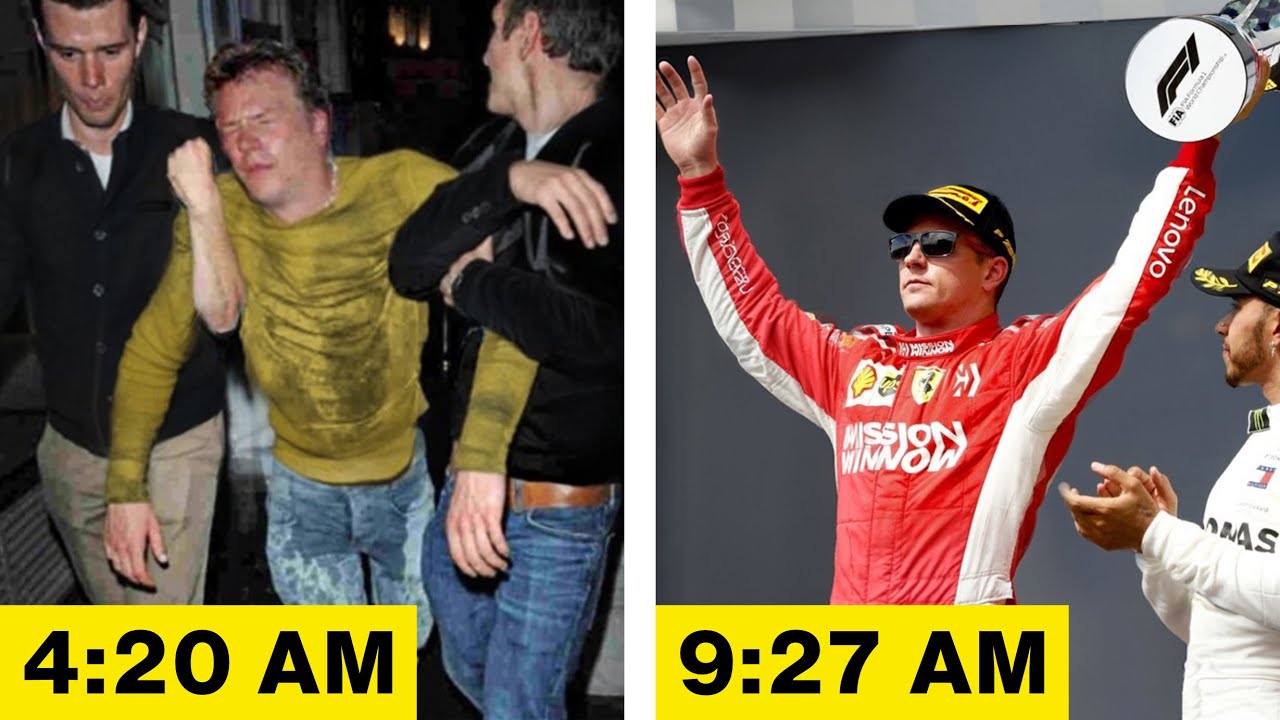
The party boat was waiting in Monaco’s harbor, the champagne already on ice, while the rest of the Formula 1 grid was buried in engineering briefings and telemetry screens. This was the paradox of Kimi Räikkönen, the man who would become Ferrari’s last World Champion by treating the pinnacle of motorsport like a casual Tuesday hobby.
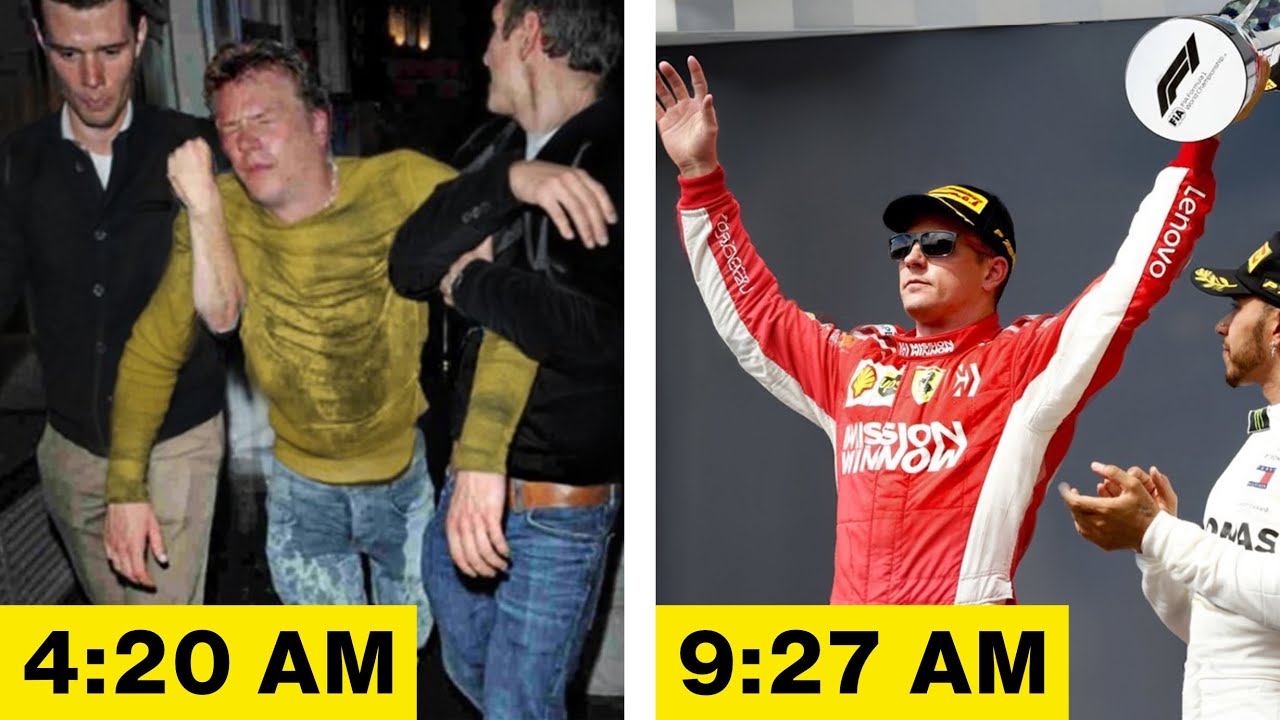
In the high-stakes, multi-billion-dollar world of Grand Prix racing, where drivers are known to sleep in hyperbaric chambers and obsess over heart-rate variability, one figure stood apart. He partied until dawn, skipped debriefs, and famously boarded a yacht while his car was still burning on the side of the track. Yet, when the lights went out on Sunday, he was untouchable.
 This is the story of how the Iceman, a quiet Finn from Espoo, rewrote the rules and smoked the establishment—armed with nothing but raw, unfiltered talent and a complete disregard for convention.
Born on October 17, 1979, in the land of Northern Lights and dangerously drinkable long drinks, Kimi Matias Räikkönen wasn’t groomed for greatness in a sterile academy. His father built roads; his mother worked an office job. But the Räikkönen household had motor oil in its veins, and young Kimi, alongside his brother Rami, was hooked on mini-motocross.
His only other passion was ice hockey, but that required waking up early—a fatal flaw for a kid who would later make “sleeping in” a global brand. Racing won, purely because it allowed him to sleep in.
His ascent was meteoric and utterly without fanfare. While other drivers learned PR-speak and corporate glad-handing, Kimi simply drove. By the age of 15, he was racing outside Finland.
In 1998, he dominated the Nordic Championship, a quiet kid who let his throttle do the talking. He famously skipped mechanic studies—deeming them pointless—to fully commit to the cockpit. His mandatory one-year military service in Finland became the stuff of legend: Kimi would stretch his leave to race, show up late to base, and occasionally still tipsy from a weekend win.
But since he kept scoring, the officers looked the other way.
When he stepped into British Formula Renault in 1999, the result was a massacre. Winning 13 of 23 races, he made the established field look like amateurs. In September 2000, Sauber’s Peter Sauber took a gamble on the unknown Finn.
Räikkönen showed up for a test, said roughly three words, and then proceeded to casually obliterate the team’s official driver, Pedro Diniz, by half a second. The decision was instant. Despite Red Bull’s Helmut Marko pushing hard for his own protégé, Sauber ignored the politics and signed the kid.
The arrival in Formula 1 was iconic. At the 2001 Australian Grand Prix, with cameras everywhere and pressure suffocating the paddock, the 21-year-old rookie was so tense he took a nap. He was asleep thirty minutes before his first ever Grand Prix.
He started 13th and finished 6th, scoring points on debut. Zero stress. Zero regard.
The Iceman persona was born.
 His entries into the top tier were merciless. McLaren came calling for 2002, and Kimi wasted no time, grabbing a podium in his first race with the team. In 2003, while the paddock was busy fawning over Michael Schumacher’s dominance, Kimi launched a title assault.
He started the season with four podiums, took his first win in Malaysia by storming from P7 and winning by an absurd 39-second margin, and pushed Schumacher to the absolute limit, losing the championship by a mere two points.
But even then, the antics were becoming legendary. His press conferences were masterclasses in deadpan minimalism. Asked by a journalist if he thought he was a better driver than his teammate, Kimi shrugged: “I don’t know.”
The parties were relentless. Wins were celebrated harder than losses. Losses were drowned in equal measure.
While McLaren mechanics worked late into the night fixing complex machinery, their driver was often out painting the town red, or living in a gorilla suit, as he famously did during the 2007 title fight.
The 2005 season saw him go toe-to-toe with Fernando Alonso. He pulled off one of the greatest comebacks in F1 history at Suzuka, charging from P17 to win on the final lap with a move that still makes pundits gasp. But the machinery was fragile.
Time and again, McLaren’s engines exploded or suspension failed, denying him crowns. In 2006, at Monaco, his car burst into flames. While the marshals extinguished the wreck, the cameras found Kimi—not on the pit wall—but on his boat, shirt off, sunbathing, sailing into the horizon.
“That’s Kimi,” the commentators laughed. “He’s got his shirt off, on his boat.”
It was this defiance that Ferrari noticed. With Michael Schumacher retiring, they needed a new heir. Enter the Iceman.
At Brazil 2006, while the entire grid attended a tribute gala for the departing Kaiser, Kimi was nowhere to be found. Tracked down by Martin Brundle, he offered the immortal response when asked if he’d missed the ceremony: “Yeah, I was having a shit.”
 Ferrari handed him the keys to the red car in 2007. The doubters questioned his work ethic. Mario Illien, the engine man at McLaren, warned Ferrari that Kimi drove flat-out with zero chill, and that he wasn’t breaking the cars—he was simply that hard on the machinery.
Ferrari decided to build a tank. It was the right call. Kimi won the season opener in Australia, immediately silencing critics.
But the season belonged to the McLaren civil war, where Hamilton and Alonso were busy ripping each other apart.
Kimi, as usual, said nothing. He drove. He lurked.
He collected points. In the penultimate race in China, the tide turned. Hamilton, cruising to the title, suffered a tire failure and beached his car in the gravel.
Kimi won. The points gap collapsed. Going to the final race at Interlagos, Hamilton was 7 points ahead, but everyone knew the weather report.
In Brazil, the rain came. Hamilton made an early error at the first corner, spinning down the field. Kimi was imperious, leading from the front.
In a move of pure calculation, Ferrari used teammate Massa as a blocker to keep Hamilton at bay while Kimi disappeared up the road.
He finished first, and with Hamilton P7, the title was his by a single point. The laughter from the paddock was deafening—the party animal had won the World Championship. His response?
A quiet “Leave me alone, I know what I’m doing,” usually saved for when the team tried to coach him. He had done it. The last real hero in red had brought the title back to Maranello.
 His subsequent Ferrari years were a mix of wonder and burnout. In 2008, he fizzled while Massa nearly stole the title before Hamilton’s last-corner miracle. Kimi’s response to poor form was to party harder.
By 2009, the Ferrari was a disaster, but Kimi refused to frown. In Malaysia, when the race was red-flagged for monsoon rain, the footage showed him standing in the garage in flip-flops, munching an ice cream, watching his rivals sit dejectedly in their cockpits. Absolute king behavior.
When Ferrari dropped him for Alonso, Kimi vanished into rally cars and NASCAR trucks, seemingly uninterested in ever returning. But in 2012, Lotus waved a magic wand and he was back. He immediately stuck the car on pole and grabbed podiums.
His radio messages became the stuff of legend. Told to attack his teammate, he replied with a dry “Let me know when the race starts.” In Abu Dhabi 2012, he won, and when his engineer frantically screamed that Alonso was catching him, Kimi snapped: “Leave me alone!
I know what I’m doing!”
The 2013 season was his last truly wild ride. He won in Australia, then hopped on a plane to Finland for a 16-day drinking binge that resulted in a total blackout. He didn’t remember a single day.
He showed up to the Spanish GP a week later, hungover or perhaps still drunk, and took second place. The man is not human.
His return to Ferrari in 2014 was a dud car-wise, but the entertainment value was elite. He bitched about the steering, demanded to be passed by his teammate, and gave sparse interviews. But then 2018 came, and the old fire returned.
At the US Grand Prix, he won after 113 races without a victory, delivering one of the most emotional podium celebrations the sport has ever seen—completely unlike his usual demeanor. He took pole in Monza with a lap record that still stands. To top it off, he arrived at the FIA Gala wearing a tuxedo with no trousers, just to prove he could.
He finished his career back at Sauber, where he started, spending his final years chilling and occasionally reminding everyone of his brilliance—like his insane 10-car overtake at the 2020 Portuguese Grand Prix. At the end of 2021, he walked away, not with a dramatic farewell, but with a simple, “I’m happy it comes to the end.”
Kimi Räikkönen retired with 353 races, 21 wins, 103 podiums, and the title of Ferrari’s last World Champion. He was the antithesis of modern sport. He raced like a beast, spoke like he didn’t want to be there, partied like there was no tomorrow, and still delivered.
He was a reminder that sometimes, talent trumps process. He was the Iceman, the last real rockstar of Formula 1. And the sport has been desperately trying to find another of his kind ever since.