The archaeological record contains a gap of roughly 250,000 years in which anatomically modern humans existed, yet left almost no trace of complex behavior, a period that runs from about 300,000 years ago to approximately 40,000 to 50,000 years ago. The earliest confirmed Homo sapiens fossils, found at Jebel Irhoud in Morocco and dated to about 300,000 years ago, had the flat faces and rounded braincases that mark fully modern humans. Their skulls would not look out of place in a modern hospital morgue. Yet the tools they made were Mousterian stone tools, a technology associated primarily with Neanderthals, and there is no evidence from their sites of the symbolic behavior that appears 250,000 years later.
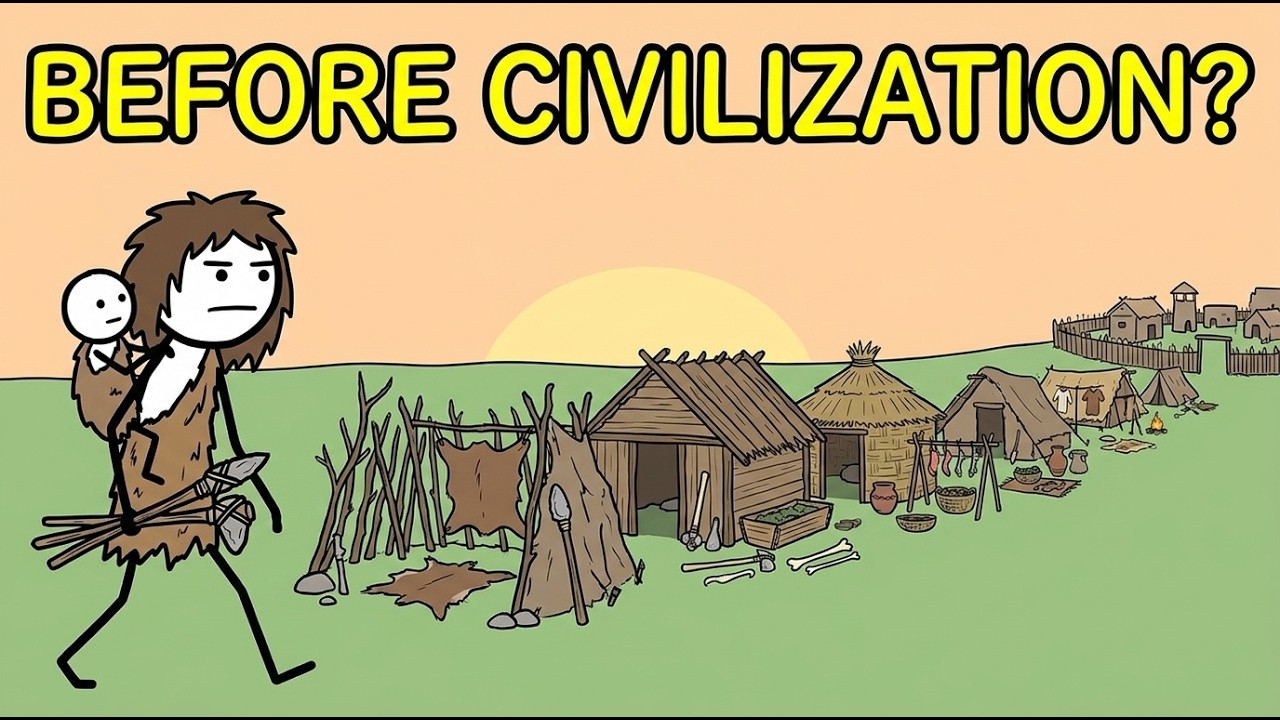
Their campsites were practical and functional. Then, at roughly 40,000 to 50,000 years ago, something changes dramatically in Europe. Cave paintings, elaborate personal ornaments, long-distance trade networks, musical instruments, and rich burials appear in what archaeologists call the Upper Paleolithic Revolution or the creative explosion. The density and complexity of the archaeological record increases by an order of magnitude in what is geologically an eye blink.
The central question is what was happening during the vast stretch of time between these two points. The first answer is preservation bias. The archaeological record is not a representative sample of ancient behavior but a collection of things that happened to survive, mostly stone and bone. Wood, fiber, leather, plant foods, and organic material generally do not survive over hundreds of thousands of years.
The things that leave no traces, songs, stories, social organization, ecological knowledge, ritual practices, and relationships between groups, are invisible not because they did not exist but because they do not preserve. The behavioral complexity of early modern humans is almost certainly being substantially underestimated. Evidence from Blombos Cave in South Africa challenges the simple picture of behavioral stagnation. Researchers have found ochre processing dating to approximately 100,000 years ago, likely used for symbolic or cosmetic purposes.
Perforated shell beads from approximately 75,000 years ago were almost certainly worn as personal ornaments, implying a social context where communicating identity through decoration was meaningful. Geometric engravings on ochre pieces and a silcrete flake dating to roughly 75,000 to 100,000 years ago represent some of the oldest abstract symbolic marks in the human record. Similar evidence has emerged elsewhere. Perforated shells used as beads have been found at sites in Morocco dating to approximately 80,000 to 90,000 years ago, and ochre use has been documented at multiple Middle Stone Age sites across Africa.
These fragments, scattered across time and geography, suggest that the behavior being preserved occasionally was much richer than what survives. The gaps in the record may reflect exceptional preservation conditions at certain sites rather than the absence of complex behavior elsewhere. Genetic evidence provides a complementary picture. The human lineage during this period was not a single expanding population but a complex, fragmented, partially isolated set of populations distributed across Africa, experiencing periods of connection and disconnection as climate and geography changed over tens of thousands of years.
When populations reconnected during periods when climate opened migration corridors, they exchanged not just genes but ideas, technologies, and cultural practices. The behavioral complexity that appears in the Upper Paleolithic record may be partly the product of this population mixing. The human population also went through at least one severe bottleneck roughly 70,000 to 100,000 years ago, with some estimates putting the global population at as few as 10,000 breeding individuals. This is associated with the Toba supervolcanic eruption approximately 74,000 years ago, though the causal relationship is still debated.
A population of 10,000 people spread across an entire continent leaves an extraordinarily low density of evidence. The apparent sparseness of the behavioral record during this period may be a straightforward consequence of how few people there were to leave evidence. Surviving such a bottleneck was not a passive achievement. It required maintaining viable breeding populations across multiple separate refugia, preserving ecological knowledge across generations, and maintaining social organization through periods of extreme resource scarcity.
Those who survived had the cognitive and behavioral sophistication to respond flexibly to deteriorating conditions, find new food sources, adjust movement patterns, and maintain social bonds and knowledge transmission systems. Their complexity is invisible because it was expressed in forms that do not preserve. Fire use provides a clear connection between the early and later record. Controlled fire use is documented at Wonderwerk Cave in South Africa at approximately 1 million years ago, and by the time Homo sapiens appears, fire is a deeply embedded part of the behavioral repertoire.
Managing fire effectively requires sustained knowledge, practice, and cultural transmission. It is learned, not innate, and it implies planning, resource management, group coordination, and the ability to pass complex practical knowledge across generations. The people who managed fire competently for hundreds of thousands of years were capable of far more than the record suggests. Language is another universal human behavior that provides a window into the missing years, even though it leaves no archaeological trace.
Every documented human group uses a complex language, and there are no simple or primitive languages. The biological structures that support language appear present in anatomically modern humans from the beginning. Language would have been the primary medium for storing, transmitting, and accumulating knowledge about the environment, water sources, prey movements, plant properties, and social history. The knowledge bases of these groups were almost certainly rich and sophisticated.
Not a single word survives because words do not last 250,000 years. The end of the gap coincides with the arrival of modern humans in Europe and the disappearance of Neanderthals. For most of the 20th century, this was taken as evidence that modern humans brought a superior cognitive toolkit that Neanderthals lacked. This narrative has been substantially complicated.
Neanderthals were also producing personal ornaments, using pigment, and making symbolic marks. The modern human genome contains Neanderthal DNA in non-African populations, confirming interbreeding. The European Revolution may not be the moment behavioral modernity was invented but the moment accumulated developments became visible in a region with exceptionally good preservation and intensive research. The deepest question raised by the gap concerns the relationship between biology and culture.
One narrative holds that behavioral modernity had to wait for the right brain or cognitive architecture. The alternative, increasingly supported by evidence, is that 300,000-year-old humans had brains capable of everything their later descendants did, and what was missing was not capacity but the cultural knowledge, social organization, and circumstances to express it in archaeologically visible ways. The missing years were not a period of stagnation waiting for cognitive upgrading. They were a period of gradual cultural accumulation, population fragmentation and reconnection, and environmental adaptation.
The explosion at the end of the gap was not the beginning of human culture but the moment it became visible. Everything before it was already there.