More than 31,000 years ago, in a rainforest on the island of Borneo, a child underwent a complete amputation of their lower left leg. The limb was not lost to a predator attack; it was deliberately removed with a sharp piece of stone. There was no sterile environment, no anesthesia, and no antibiotics. Despite the brutal conditions, the child survived the procedure and lived for nearly a decade afterward, as evidenced by the healed bone found in Liang Tebo Cave.
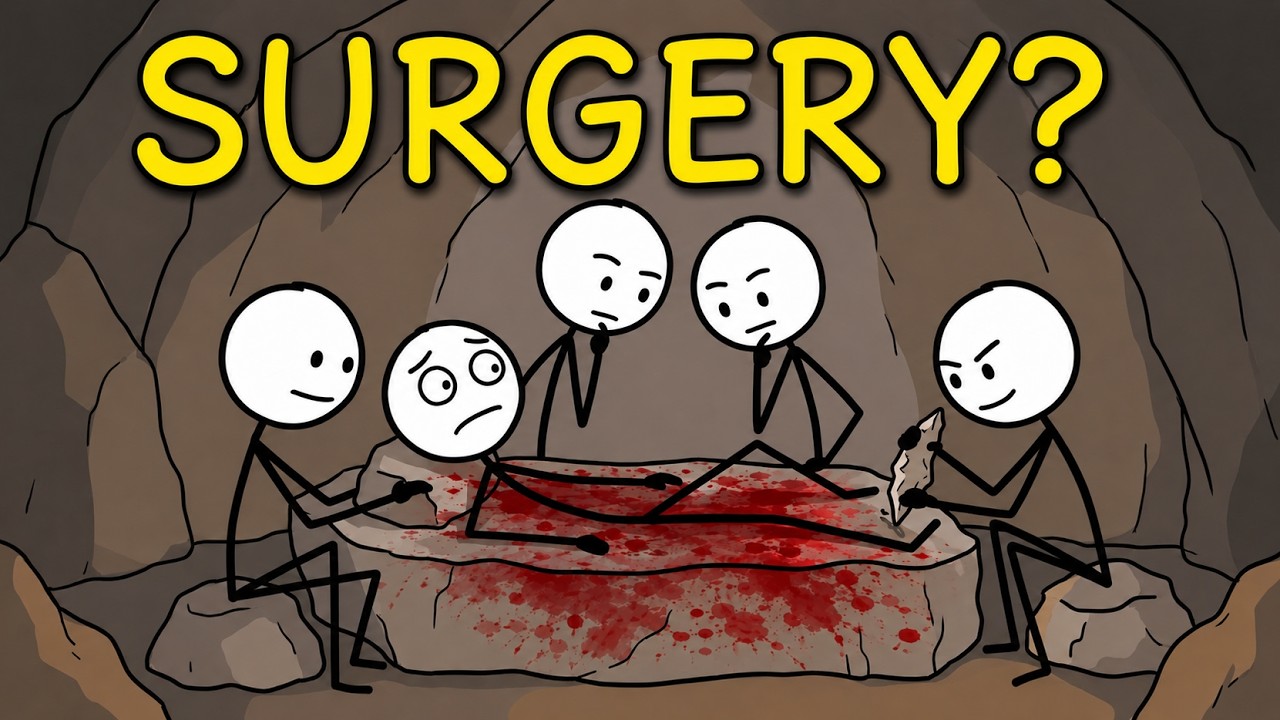
The discovery challenges long-held assumptions about prehistoric people. The bone shows clear signs of healing and remodeling that only occur over years of survival. The person who performed the surgery had to manage severe blood loss, cut through muscle and nerve tissue, saw through bone, and then prevent a fatal infection in a hot, humid jungle environment where open wounds would typically turn deadly within days. Their success suggests a deep empirical knowledge of human anatomy long before the rise of modern civilization.
This understanding of medicine was not a sudden invention. The instinct to treat wounds appears to predate the human species itself. In 2020, researchers in Gabon observed chimpanzees catching flying insects, crushing them, and applying them to open wounds on themselves and on each other. This behavior, which requires empathy and a transfer of knowledge, indicates that using external remedies for injuries is older than humanity.
Evidence of systematic care extends to the Neanderthals, who were once dismissed as brutish and unintelligent. The remains of a Neanderthal man known as Shanidar 1, found in a cave in Iraq and dating back 45,000 years, tell a different story. He suffered a crushing blow to the head that likely blinded him in one eye, had a withered right arm, and deformed legs and feet. Despite these severe disabilities, he lived to around 50 years old, an advanced age for the time.
His survival would have been impossible without his group feeding him, protecting him, and helping him move. Other Neanderthal skeletons show signs of healed fractures that were properly aligned, indicating that someone was setting broken bones. In France, archaeologists found the remains of an elderly Neanderthal who had lost all his teeth and suffered from severe arthritis. He could not have chewed his own food, meaning his community must have pre-chewed it for him.
In Siberia, a 59,000-year-old Neanderthal tooth showed signs of a cavity that had been scraped out with a small stone tool, representing an early form of invasive dentistry. One of the most common and shocking surgeries in the ancient world was trepanation, the practice of drilling a hole into the skull. Skulls with precise surgical holes have been found on every inhabited continent, with the oldest dating back around 8,000 years. In France, a man was found with two healed holes in his head, proving he survived one brain surgery and then underwent a second.
The tools used were often made of obsidian, a volcanic glass that can fracture into edges sharper than modern surgical steel. By the time of the Inca Empire in the 1400s, skull surgery had become highly refined. Analysis of hundreds of Inca skulls shows survival rates between 75 and 83 percent. This success is starkly contrasted with the American Civil War in the 1860s, when army doctors with metal tools, medical schools, and textbooks had only a 50 percent survival rate for cranial surgery.
The ancient Inca healers, using sharp rocks, outperformed 19th-century American medicine. Managing pain was a critical part of these procedures. The opium poppy was used by the Sumerians over 5,000 years ago. In South America, the Inca chewed coca leaves and spat the juice onto open wounds to numb the flesh.
Thousands of years before aspirin was invented, prehistoric people chewed willow bark, which contains salicin, a chemical that reduces inflammation and pain. For those without access to such remedies, surgery likely proceeded with patients held down by strong men, enduring the full force of the pain. The problem of closing wounds also led to innovative solutions. Before needles and thread were invented, healers used live army ants and weaver ants.
The healer would pull the edges of a wound together, force an ant to bite down, and then twist its head off. The ant’s jaws would remain locked shut, creating a biological staple. This method, recorded in ancient Indian texts 3,000 years ago, was used to close wounds and even internal organs, as the ant heads would safely dissolve over time. To prevent infection, ancient people used honey.
It draws water out of bacterial cells, releases hydrogen peroxide, and keeps tissue moist, effectively acting as an antibiotic. Modern hospitals are now returning to medical-grade honey to fight bacteria that resist contemporary antibiotics. These traditional remedies laid the groundwork for a formalized science of surgery. The Edwin Smith papyrus, a document from ancient Egypt written about 3,600 years ago, is the oldest known surgical manual.
It is a copy of an even older text, and unlike other ancient writings, it contains almost no spells or prayers. It lists 48 cases of trauma with a logical structure, categorizing them as treatable, possibly treatable, or not treatable. This indicates that the surgeons understood their limits. The text describes the brain for the first time in recorded history and details a systematic protocol for managing severe cranial wounds.
In ancient India, around 2,600 years ago, the physician Sushruta pioneered a different branch of medicine: plastic surgery. At the time, having one’s nose cut off was a common punishment for crimes. Sushruta developed a technique for skin grafting, taking a flap of skin from the forehead, twisting it down over the missing nose, and sewing it into place while keeping it attached to its original blood supply. He also used leeches to inject hirudin, an anticoagulant, into the surgical site to keep the graft alive.
Modern surgeons still use medical leeches for this exact purpose. The history of medicine is written in the healed bones of our ancestors. A healed femur, the massive bone in the thigh, requires months of immobility and care. Finding healed femurs in prehistoric skeletons proves that communities stopped and cared for the injured, bringing them food and water while they recovered.
Nature dictated that the weak would die, but early human medicine defied that rule. Even minor ailments received attention. In Slovenia, a 6,500-year-old jawbone was found with a cracked tooth that had been filled with beeswax, padding the exposed nerve. Between the Neanderthals drilling out cavities 59,000 years ago and this Neolithic filling, ancient people were actively fighting dental pain.
Every modern surgical technique, from closing wounds to removing infection, was developed through the trial and error of past generations. The underlying mechanics of surgery remain the same today as they were when a child’s leg was amputated in a Borneo cave 31,000 years ago. Humans have not become smarter since then; they simply acquired better tools.