LONDON — The most written-about woman of the 1920s died alone in a public hospital ward, her once-legendary frame reduced to 26 kilograms, her mind fractured beyond reason, a pen still clutched in her hand as she scrawled disconnected poetry against the oxygen tent that failed to save her.
Nancy Cunard, heir to the Cunard shipping fortune, patron of Samuel Beckett, and a firebrand whose defiance of racial convention cost her family, fortune, and ultimately her sanity, passed away on March 17 at a Paris hospital. She was 69 years old. Her ashes were placed in a columbarium niche, and when the municipal concession lapsed in 1973, they were dispersed without ceremony.
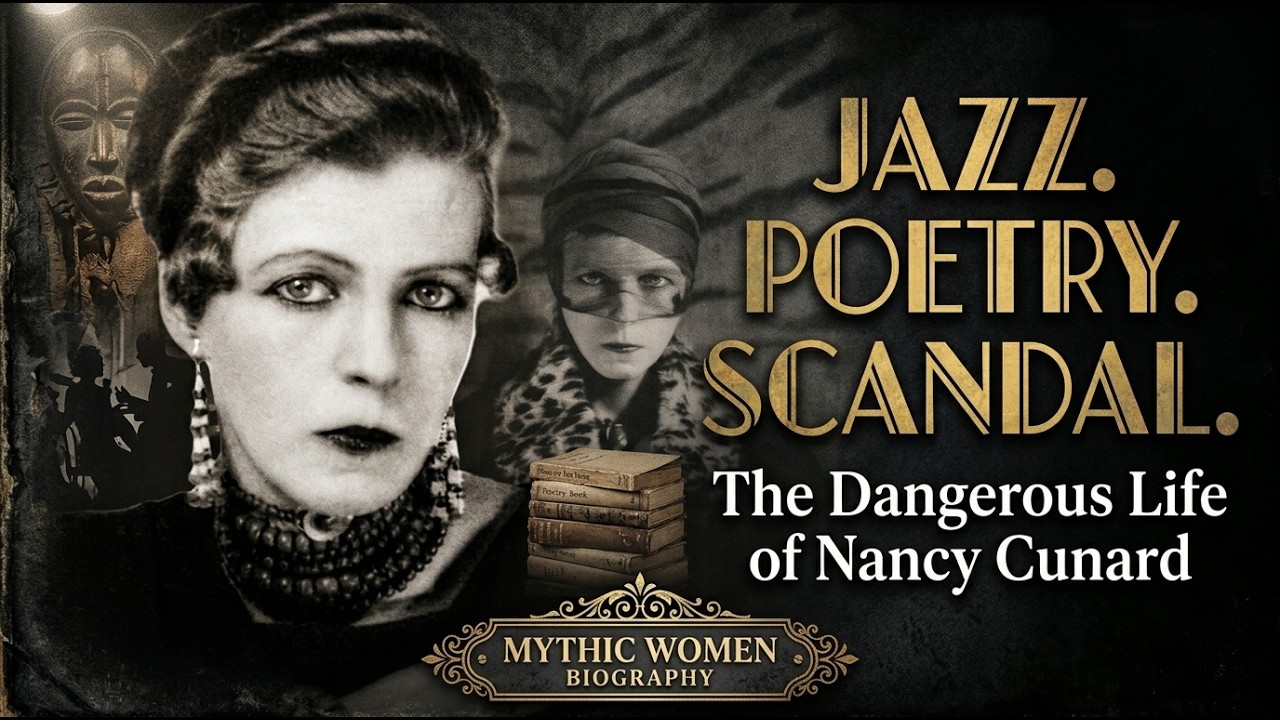 The woman who had inspired more poems, novels, and plays than any of her generation had become a footnote—but what a scandalous, magnificent footnote it was.
Born in 1896 at the height of Edwardian splendor, Cunard was raised in the great halls of Nevill Holt, where her mother, Maud, pronounced motherhood “a low thing” before ceding the child to nannies and governesses. She grew up in silence, reading voraciously, constructing an interior world to survive the emotional vacuum of her parents’ disastrous marriage. Her only confidant was George Moore, her mother’s former lover, who walked with her through the Leicestershire lanes and treated her as a real person.
By 20, Cunard had married Sydney Fairbairn for the freedom he promised, not for love. The wedding was an omen. When a guest made an ill-advised quip, the bride ripped the orange blossoms from her hair and hurled them to the floor.
The marriage collapsed within two years.
The war broke her first. Her beloved Peter Broughton-Adderley, the only man she would ever say she “loved entirely,” was shot in the stomach and died in October 1918. Cunard could not celebrate the armistice.
She caught the Spanish flu and later admitted she did not care whether she lived or died.
She chose to live—extravagantly, recklessly, publicly. In Paris, she became the tawny-haired muse of the avant-garde. Aldous Huxley, obsessed with her, wrote her into his novels with increasing cruelty.
Michael Arlen stole her life for his bestseller The Green Hat. Wyndham Lewis put her in his fiction and gossiped about her behind her back. She inspired more verse and prose than any woman of her generation, and never once gave her permission.
Her body betrayed her early. In 1921, at age 24, a botched procedure at a Paris clinic led to a hysterectomy, followed by peritonitis and gangrene. Doctors gave her a 2 percent chance of survival.
She survived, but the damage was permanent—physically and psychologically. She would spend decades navigating pain that some men found perverse to accommodate. “She was making herself as light and steely as possible,” observed poet Brian Howard.
“A thin blade of a woman cutting away her past.”
But the defining act of her life came in Venice in 1928, when she met Henry Crowder, a Black American jazz pianist. Their relationship was a grenade thrown into the drawing rooms of the English aristocracy. Children shrieked insults in Venice.
Fascists watched them pass. In London, her mother—now calling herself Emerald—hired private detectives to trail them, hoping to get Crowder arrested and deported.
Cunard responded by publishing an 11-page pamphlet titled Black Man and White Lady. It was an attack on institutional racism, yes, but also a scalding public evisceration of her mother. The pamphlet was sent to the Prince of Wales, to the newspapers, to every friend her mother had.
Emerald Cunard said only: “One can always forgive anyone who is ill.” Nancy never saw her mother again.
She spent her fortune on what mattered. She printed Samuel Beckett’s first work at her Hours Press before the world knew his name. She assembled Negro, an 850-page anthology of Black history and culture that remains a landmark of scholarship.
Hate mail arrived, some signed by the Ku Klux Klan: “I hope that when you try to free the lousy down in Alabama, the white people will lynch you.”
When the Spanish Civil War erupted, she went to the front lines. She filed dispatches for the Associated Negro Press, distributing questionnaires to writers demanding they state their position on the Republic. Almost 150 responded.
George Orwell refused, citing the bullet hole in him. She stayed through the rout, through the refugee camps where half a million fled to France, and her reporting helped spark a relief campaign that fed some of the dispossessed.
Franco’s victory broke her. She fled to South America. The Second World War found her in London, where, for the first time in her life, she was in step with the city.
She translated for the Free French and edited a volume celebrating the occupied France she loved. It was the closest she would come to peace.
After the war, she returned to her beloved house at Réanville to find it looted—not by German soldiers, but by her own French neighbors. Books torn from bindings, canvases slashed, the stone walls she had stripped bare scrawled with filth. She never returned.
The final decades were a slow-motion fall. Alcohol, paranoia, sanatoriums, arrests. In 1960, she was expelled from Spain for loudly demanding the release of political prisoners.
The expulsion cracked something vital. Friends found her wild-eyed, convinced that those closest to her were fascist agents. She spent that summer in Holloway sanatorium, sedated, force-fed.
Released, she never recovered. By early 1965, emphysema had stolen her breath. She broke her thigh.
She weighed too little to survive it. In her final hours, she demanded wine, pen, and paper. She asked for her name.
She could not remember it.
Iris Tree, her oldest friend from the Fitzrovia days when they were barely more than girls, heard the news and remembered not the ruin, but the apparition. “I still see Nancy,” she said, “crowned with feathers, streaming with ribbons, and simmering expectations.”
The Daily Express once tracked her arrival in Monte Carlo with breathless attention to her outfits. The papers documented every 𝒶𝒻𝒻𝒶𝒾𝓇, every breakdown, every 𝒔𝒄𝒂𝓃𝒹𝒶𝓁. They wanted the spectacle.
But the woman behind it—the poet who worked at her lines with the discipline of a monk, the publisher who shaped type by hand until ink stained her skin, the war correspondent who wrote from the shelling while buildings burned around her—disappeared into the drink and the depression and the pages of other people’s books.
She once wrote, in a poem called Remorse: “Wasteful, wanting, foolish, bold. Loved with grasping hands and lustful eyes. I sit ashamed and silent in this room while the wet streets go gathering in their gloom.”
She was 20 years old when she wrote that. She knew the account she was keeping. She kept it until the last page filled, the pen still moving when the writing stopped.