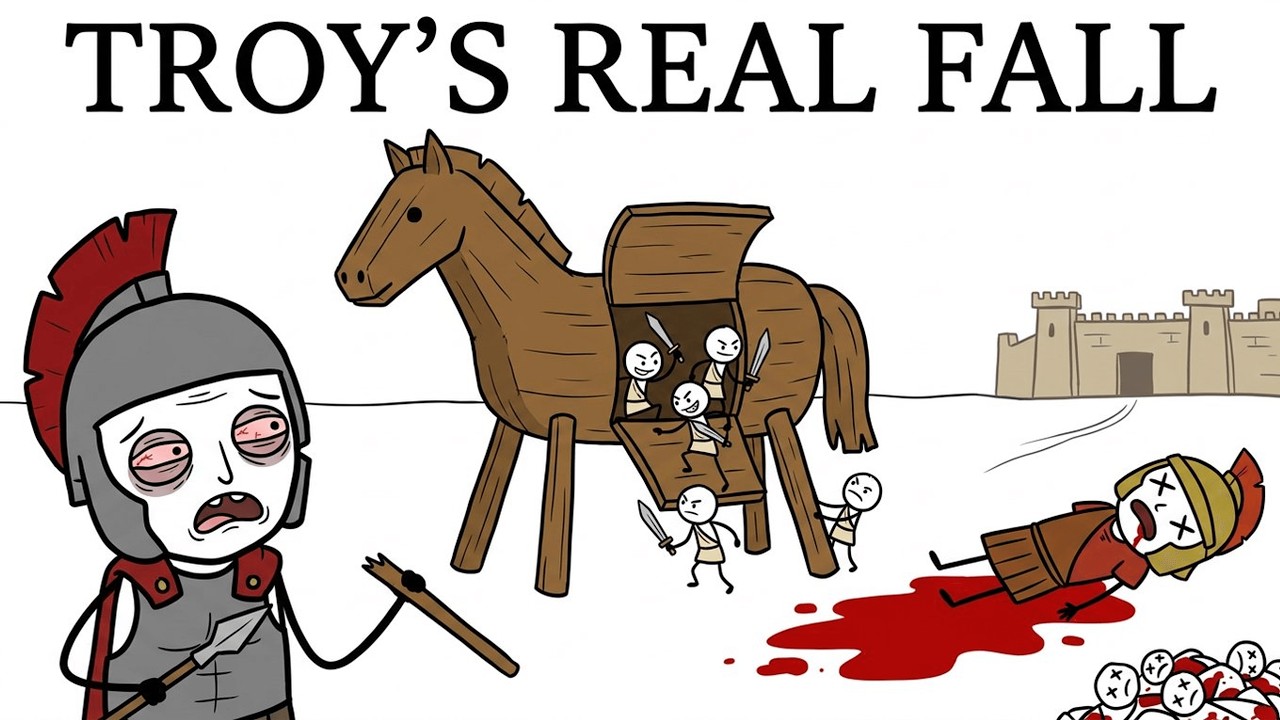
The most famous image of the Trojan War, the giant wooden horse rolled through the gates of Troy, is also the part of the story that historians trust the least. What remains after sifting through the poem, the ruins, and the records of a forgotten empire is a messier, more compelling truth about a real city that was destroyed by a combination of earthquake, siege, and the collapse of an entire ancient world. The epic poems attributed to Homer do not actually contain the Trojan Horse in the way most people remember. The Iliad ends before the city falls, and the tale of the wooden horse appears only later in the Odyssey and was fleshed out by Roman writers like Virgil centuries afterward.
Homer composed his works around the 8th century BC, which places him roughly 400 to 500 years after the events he described, a gap that was bridged only by generations of oral tradition. In the 1930s, scholar Milman Parry demonstrated how this tradition worked by studying illiterate bards in Yugoslavia who could recite enormous poems by using stock phrases and rhythmic building blocks. Homer’s repeated tags, such as “rosy-fingered dawn,” are the fingerprints of this system, a memory machine that was excellent at preserving emotion but terrible at recording dates. The hunt for the physical city began with Heinrich Schliemann, a German businessman and relentless self-promoter who was convinced the poems were true.
In the late 19th century, he dug at a mound called Hisarlik near the Dardanelles, the strategic strait connecting the Aegean to the Black Sea. He was right about the location, but catastrophically wrong about the method, blasting a massive trench straight through the middle of the mound and destroying vast amounts of evidence in the process. Hisarlik is not one city but at least nine, built on the rubble of their predecessors over more than 3,000 years. Schliemann tore through most of them to reach the bottom and announced he had found “Priam’s Treasure,” a hoard of gold he attributed to the Trojan king.
The find was likely staged from objects found at different times and places, and worse, the layer it came from dates to around 2400 BC, roughly a thousand years too early to be the Troy of the war. Later archaeologists cleaned up the mess. Wilhelm Dörpfeld argued that a grander, later city labeled Troy VI was the best contender for a Homeric stronghold, with massive walls and real ambition. In the 1930s, Carl Blegen conducted a meticulous dig that distinguished between Troy VI and the layer squeezed on top of it, Troy VII, setting the stage for the debate that continues today.
The location itself explains why the city mattered. Hisarlik guards the entrance to the Dardanelles, a choke point for any ship sailing between the Mediterranean and the Black Sea. The winds and currents there are brutal, often forcing vessels to wait for days. A city at that pause point could grow rich on tolls, trade, and harbor fees, making it a prime strategic prize that had nothing to do with a runaway queen.
Evidence shows the city was larger than once thought. Excavations in the 1980s and 1990s by Manfred Korfmann revealed the outlines of a sprawling lower town beyond the citadel, ringed by a defensive ditch cut into bedrock. If correct, Troy was not a lonely fortress but a settlement of possibly 5,000 to 10,000 people, a serious center of power. The claim was fiercely disputed by other scholars, and the debate remains genuinely unresolved.
Geography also backs up the poem’s setting. Homer describes a Greek camp on a beach with a plain between the sea and the city. Today, the sea is several kilometers away, but geologists have determined that in the Late Bronze Age, a wide bay reached far inland near the foot of the citadel. The coastline was pushed out over millennia by silt, meaning the poem’s stage directions preserve a landscape that no longer exists.
The fall of the city itself appears to have happened in two stages. Troy VI likely came to an end around 1300 BC, and the evidence shows signs of an earthquake, with walls shifted off their foundations. Scholars have even suggested that the wooden horse could be a distorted memory of this event, since the earthquake god Poseidon was also the god of horses and was said to have built Troy’s walls. The survivors rebuilt a poorer, more crowded city now called Troy VII.
There, they sank large storage jars into the floors of their homes to hide grain and water, a clear sign of a population bracing for a siege. This city did not die quietly. Excavators found a destruction layer with fire, unburied human remains in the streets, arrowheads embedded in walls, and piles of slingstones stacked like ammunition that was never used. These are the marks of a violent human attack, not a natural disaster.
The Hittite archives provide the geopolitical context. These ancient records from Anatolia mention a place called Wilusa, which scholars link to Homer’s Ilios, in the exact region where Hisarlik sits. They also record a king of Wilusa named Alaksandu, which matches Alexandros, the alternative name for the Trojan prince Paris. The documents repeatedly reference a seafaring Greek power called Ahhiyawa, the Achaeans of Homer, clashing with the Hittites over this contested coastline for generations.
The fall of Troy happened as the entire Late Bronze Age collapsed. Around 1200 BC, the great civilizations of the Eastern Mediterranean fell almost simultaneously. The Hittite Empire vanished, and Mycenaean Greece was destroyed so completely that the Greeks lost the ability to write. Historians argue over the causes, but the leading view describes a systems collapse, a chain reaction brought on by raids, drought, earthquakes, and broken trade networks.
The honest reconstruction is that Troy was a real place that fell through a messy pileup of trade rivalry, regional politics, earthquake damage, and siege, all during the implosion of an entire world. The wooden horse is likely a memory compression, a symbol that preserved the drama of the city’s destruction while forgetting the paperwork.