Five major civilizations independently embraced sibling marriage as official state policy, building religions and ruling classes around the practice—and all five eventually faced strikingly similar biological consequences. The reasons behind this pattern were remarkably consistent across cultures that had no contact with one another. The logic rested on three reinforcing pillars. Religious origin stories often featured divine sibling couples, making royal sibling marriage a reenactment of cosmic order.
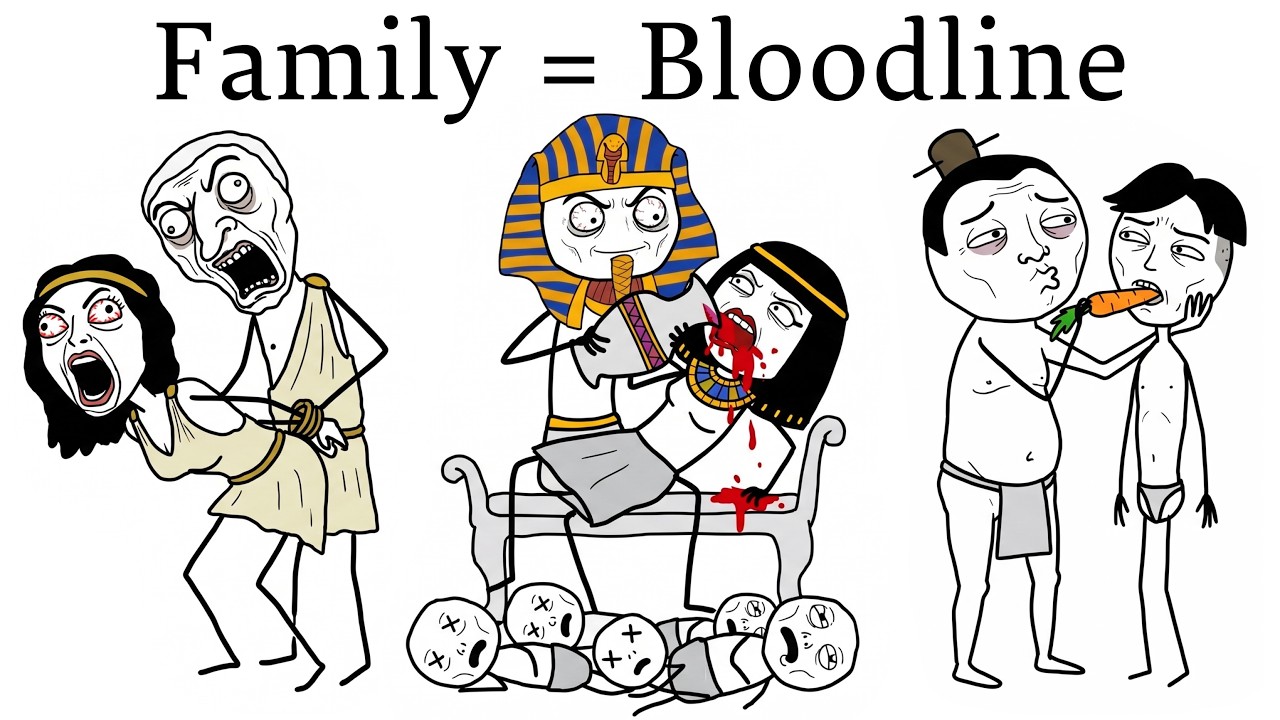
Politically, keeping marriage inside the family prevented wealth from splitting through dowries and stopped rival in-law clans from rising. And for rulers claiming descent from gods, marrying a sibling preserved divine blood purity that a foreign spouse would dilute. The most famous example was Egypt’s Ptolemaic dynasty, which ruled from 323 BC to 30 BC. Ethnically Macedonian Greeks who inherited Egypt after Alexander the Great’s death, the Ptolemies legitimized their rule by embracing the local myth of the sibling-spouse gods Osiris and Isis.
Brother married sister for eleven generations. Cleopatra VII, the dynasty’s last ruler, was herself the product of sibling parents and married two of her younger brothers in succession. The genetic damage was already documented a thousand years earlier. A 2010 DNA study published in the Journal of the American Medical Association confirmed that Tutankhamun’s parents were full siblings.
The young pharaoh inherited a cleft palate, clubfoot, a rare bone disease, and died around age 18. The dynasty became so complicated that contemporary Greek historians openly complained about the difficulty of writing accurate genealogies. Ptolemy VIII married his sister Cleopatra II, then also married his niece Cleopatra III while remaining married to the niece’s mother. The Ptolemies ultimately collapsed when Rome conquered Egypt, but by then the family tree had become a closed genetic experiment.
The Sasanian Empire of Persia practiced something even more overtly religious. From 224 to 651, Zoroastrian texts formally endorsed marriages between parents and children, full siblings, and uncles and nieces. The custom, called Xwedodah, was framed as strengthening bloodlines against evil spirits. Royal marriages between siblings were performed publicly as signs of religious devotion.
The practice predated the Sasanians. Cambyses II, son of Cyrus the Great, married two of his sisters, and Artaxerxes II married two of his own daughters. Greek historians were scandalized, but Persian sources treated it as standard policy. The Islamic conquest completed in 651 banned the practice abruptly, and within a generation what had been considered holy became heretical.
The strangest case comes from Korea. The kingdom of Silla operated a rigid hereditary class system called golpum, or bone rank. At the top sat seonggol, sacred bone, a rank requiring both parents to hold the same status. Only sacred bone individuals could become monarch.
To produce sacred bone children, you needed two sacred bone parents, which meant the marriage pool was mathematically tiny. The royal Kim and Pak clans intermarried for generations. Uncle-niece marriages were standard, half-sibling marriages occurred, and first-cousin marriages were considered the minimum acceptable distance. For centuries, barely enough qualified candidates existed to pair off.
Then the math cracked. Queen Seondeok took the throne in 632 only because no qualified male remained. Her cousin Queen Jindeok succeeded her, and when Jindeok died in 654, the genealogists concluded that no sacred bone candidates of any gender existed anywhere. The rank effectively went extinct.
The throne passed to a lower-ranked king, and Silla adjusted its own rules to admit the sacred bone was over. An entire social class had inbred itself out of existence through arithmetic rather than conquest. Hawaii developed a similar system around the concept of mana, sacred power concentrated through genealogy. The highest rank, called Pi’o, was reserved for children of two full siblings from the top ali’i noble lineage.
Pi’o children outranked even their parents, and commoners were required to fall face down when one passed, with direct eye contact forbidden. Casting a shadow on a Pi’o chief could carry the death penalty. King Kamehameha I, who unified the islands in the late 1700s, married Keōpūolani, a close relative from Pi’o-rank parents. Their son, who became King Kamehameha III, had a documented relationship with his sister Nahi’ena’ena, which senior chiefs politically encouraged because a Pi’o child from their union would have been the most sacred ruler imaginable.
Christian missionaries campaigned against the relationship and eventually separated them. Nahi’ena’ena married another chief in 1836, gave birth to a child widely understood to have been her brother’s, and died at age 21. The system collapsed within a generation of Western contact, not because Hawaiians stopped believing in mana, but because colonial pressure dissolved the infrastructure that maintained the ranks. The Inca Empire operated on the same logic.
From roughly 1438 to 1533, the Sapa Inca was required to marry his full sister, who held the title Coya. Together they mirrored the divine pair Inti, the sun god, and Mama Quilla, the moon goddess, who were themselves siblings. Only children born from this union were legitimate heirs, because only they carried the doubled divine pedigree. The most famous Sapa Inca, Huayna Capac, died around 1525 from smallpox that arrived before any European physically had.
The disease killed him, his designated heir, and much of the elite. His sons Huascar and Atahualpa fought a civil war over succession while Francisco Pizarro arrived in 1532 with 168 men. Atahualpa won the war but was captured and executed within a year. The empire fell.
The deeper political problem was structural. The succession system depended on a very small pool of sibling-produced heirs, and when the top died simultaneously from disease, no backup existed. Keeping the bloodline pure had kept it brittle. Inca theology framed the royal marriage as holding the cosmos in place, meaning a ruler who married outside his sister would break the cosmic mirror and invalidate the empire’s divine right to rule.
The science behind these patterns is straightforward. Most harmful mutations are recessive, meaning a person can carry one broken gene copy without knowing. When unrelated people reproduce, the odds both carry the same broken gene are low. When relatives reproduce, those odds dramatically increase because both inherited from the same grandparents.
The result is called inbreeding depression: higher rates of stillbirth, infant mortality, infertility, jaw deformities, cleft palate, skeletal disorders, and rare diseases appearing every generation. Modern breeders see the same arithmetic. Pugs, bulldogs, and Persian cats carry inbreeding coefficients matching the Ptolemies, producing their characteristic breathing problems and hip dysplasia. Certain modern populations with high cousin-marriage rates show measurably higher rates of recessive disorders, which is why genetic counseling is now standard premarital care in those regions.
The five civilizations had different gods, different languages, and different architectural styles. They followed the same logic to the same biological dead end. If the right to rule is divine, dilution feels threatening, so the bloodline gets concentrated again and again, until it narrows to a king who cannot produce an heir, or produces one who cannot survive adolescence.
Concentrate a bloodline enough times, and eventually you concentrate it down to nothing.