Politics is far older than civilization, older than farming, and arguably older than language itself. At its core, politics is simply the process groups use to make collective decisions when individuals don’t automatically agree. By that definition, the moment two or more people face a decision affecting them all, the raw ingredients of politics are already present. The roots of this behavior extend beyond the human species.
Primatologists have documented intricate social maneuvering among chimpanzees, including alliance-building, coalition formation, and strategic loyalty shifts. Frans de Waal’s influential book *Chimpanzee Politics* drew direct parallels between chimp behavior and human political scheming, noting displays of dominance timed to impress onlookers rather than intimidate rivals. This suggests the common ancestor humans share with chimpanzees likely engaged in similar political dynamics millions of years ago. For most of human existence, people lived in small, mobile hunter-gatherer bands of roughly 20 to 80 individuals.
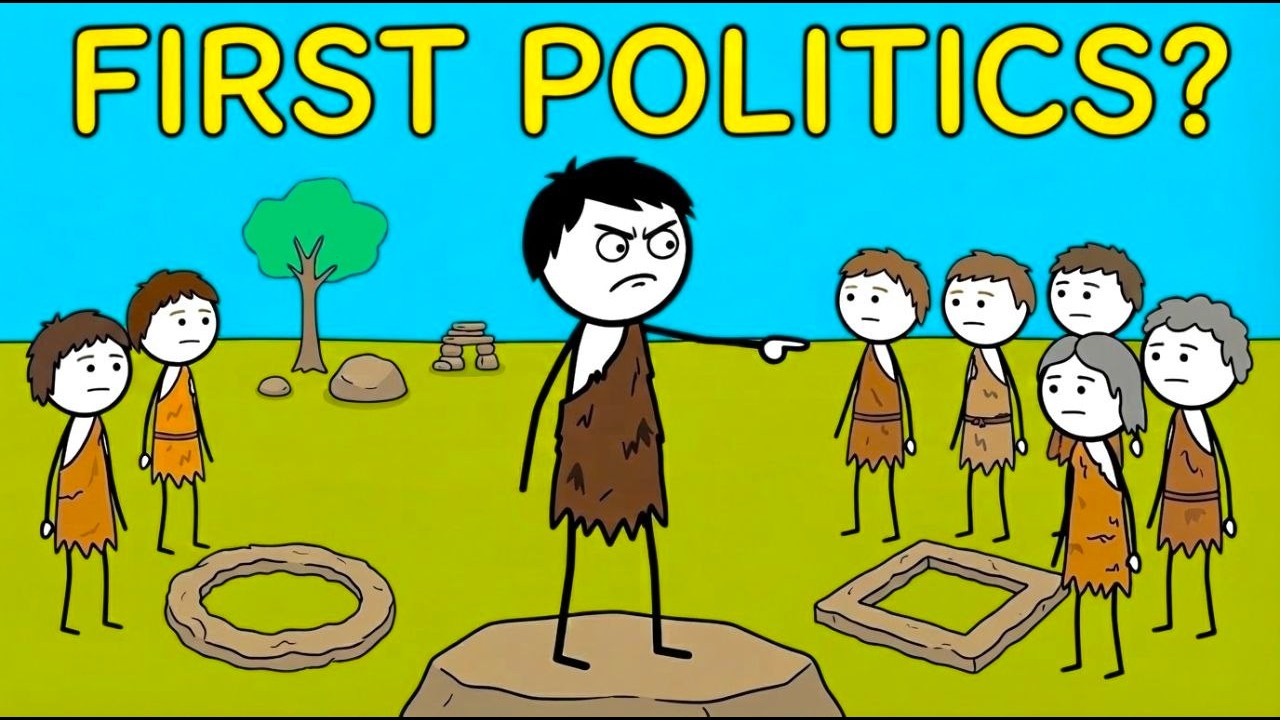
These groups typically had no chiefs or kings and were remarkably egalitarian. Decisions emerged through discussion, consensus, and the constant social pressure of reputation. Anthropologist Christopher Boehm described this as a reverse dominance hierarchy, in which the group actively works to prevent any single individual from accumulating too much power. Enforcement of this system relied on graduated social tools.
Public ridicule was a primary method of deflating overbearing behavior. If mockery failed, the group could withdraw cooperation, refusing to share food or assist with tasks. In extreme, repeated cases, banishment or even execution by group consensus occurred. Anthropologists studying groups like the Hadza in Tanzania and San communities in Southern Africa have documented these patterns repeatedly, describing them as a cultural immune system against arrogance.
The shift away from egalitarian band politics began with agriculture. Farming created surplus, which introduced a new political problem: who controls the stored grain and decides how it is distributed. As settlements grew denser and resource management became more complex, centralized coordination became increasingly useful. Managing irrigation, organizing defense, and mediating land disputes all benefited from someone keeping track of labor and schedules.
Early leadership in these transitional societies appears to have emerged through competence and trust rather than brute conquest. Individuals skilled at organizing and mediating gradually accumulated influence. Once concentrated, that influence tended to snowball. Prestige attracted followers, and followers provided labor and loyalty that reinforced the leader’s position.
Over generations, informal influence solidified into inherited authority, turning chiefs into hereditary rulers and eventually into kings. This pattern repeated independently across the globe. Mesopotamia developed early city-states with kings, Egypt developed pharaonic rule, early Chinese dynasties built hereditary imperial systems, and Mesoamerican civilizations like the Maya established hereditary rulers. None of these societies copied one another, yet they arrived at strikingly similar hierarchical structures once they reached certain population sizes and economic complexity.
Some early urban societies resisted this drift toward kingship for surprisingly long stretches. Çatalhöyük in modern-day Turkey, one of the earliest known large permanent settlements, shows houses of remarkably similar size and layout with no obvious palace or elite quarter. Cities of the Indus Valley Civilization, such as Mohenjo-Daro, display orderly planning and sophisticated infrastructure but little archaeological evidence of grand monuments glorifying individual rulers, unlike contemporary Mesopotamian or Egyptian sites. The appearance of written law marked a major political development.
The Code of Hammurabi from ancient Babylon, roughly 3,700 years old, is often remembered for its harsh punishments, but its structural significance lies in what it represented. Carved into stone and displayed publicly, it declared that even the king’s authority operated within a defined, consistent set of rules that ordinary people could reference. Similar legal codification appears in ancient Egypt, early Chinese codes from the Zhou Dynasty, and early Indian traditions found in texts like the Manusmriti. Ancient Greece holds a special place in this history because Athens developed a system in the 5th century BCE where a large portion of male citizens directly participated in political decision-making through assembly voting.
This was not democracy in the modern inclusive sense, as it excluded women, enslaved people, and non-citizens, but it represented a deliberate attempt to structure collective decision-making explicitly. Notably, it echoed the consensus-driven bands of tens of thousands of years earlier, both systems attempting to solve the same puzzle: how to make binding group decisions without concentrating unchecked power in one person. The Roman Republic offered another solution through checks, elected offices, term limits, and competing bodies like the Senate and popular assemblies. This system distributed power among competing elite factions for centuries, complete with political rivalries and shifting alliances.
However, it eventually collapsed under growing wealth inequality, an overextended military, and ambitious generals with loyal armies. The Republic gave way to the very kind of concentrated one-man rule it had been designed to prevent, demonstrating that political systems distributing power require ongoing maintenance. Before all these structures existed, the first political arena was the household and extended family. Humans negotiated power dynamics within family units long before city-states or chiefdoms, deciding who eats first, who influences decisions about children, and which relatives receive shared resources.
Anthropological and primate studies suggest that kin-based political maneuvering may be the evolutionary foundation beneath every larger political structure that followed. This means the negotiating instincts used in everyday family disagreements run on the same ancient cognitive machinery that once helped establish hunting territory boundaries and eventually built empires. Workplace dynamics operate on this same evolved social machinery. Office politics, with its alliance-building, reputation management, and careful navigation of influence, is not a modern corporate invention but a continuation of behavioral patterns humans have practiced for the entire existence of the species.
Human political behavior has shown remarkable flexibility across history. Depending on circumstances, environment, population density, and resource availability, humans have organized themselves into radically different structures, from egalitarian consensus-based bands to hereditary god-king monarchies, citizen assemblies, and the representative systems common today. This flexibility itself may be one of humanity’s most underrated evolutionary advantages, allowing dramatic restructuring of political arrangements according to situational demands. Some linguists and evolutionary anthropologists propose that complex language may have evolved partly because early humans needed sophisticated tools for political negotiation, including coalition-building, tracking favors owed, warning about untrustworthy individuals, and persuading others.
If accurate, politics and language co-evolved, each pushing the other toward greater complexity across hundreds of thousands of years. Politics may be one of the forces that made complex human communication necessary in the first place. Warfare and outside threats also accelerated political centralization. Societies under constant threat from hostile neighbors benefited from leaders capable of coordinating defense quickly.
Purely consensus-based decision-making, with its deliberation and debate, cannot match the speed of decisive centralized leadership when danger approaches. Much of humanity’s drift toward centralized political power may therefore have been driven less by pure ambition than by circumstance, as communities traded some egalitarian flexibility for the security that strong leadership could provide during unstable periods. The honest answer to when humans invented politics is that no single moment exists. It emerged gradually, stretching back before our species existed in its current form, visible in the coalition-building of primate ancestors, refined through hundreds of thousands of years of hunter-gatherer consensus-building, then transformed by agriculture, surplus, and the coordination problems that pushed societies toward hierarchy, kingship, written law, and eventually modern governments.
What has remained constant throughout is the core challenge: how groups with different interests and opinions make decisions together without falling apart in the process.