The earliest politics were not conducted in parliaments or courtrooms, but around campfires. For most of human history, small bands of roughly 20 to 80 people made collective decisions through discussion, consensus, and social pressure, without any formal leader or written rules. This system, described by anthropologists as a reverse dominance hierarchy, was designed to prevent any single individual from accumulating too much power. If someone became overly assertive or hoarded resources, the group responded with ridicule, gossip, withdrawal of cooperation, or in extreme cases, banishment.
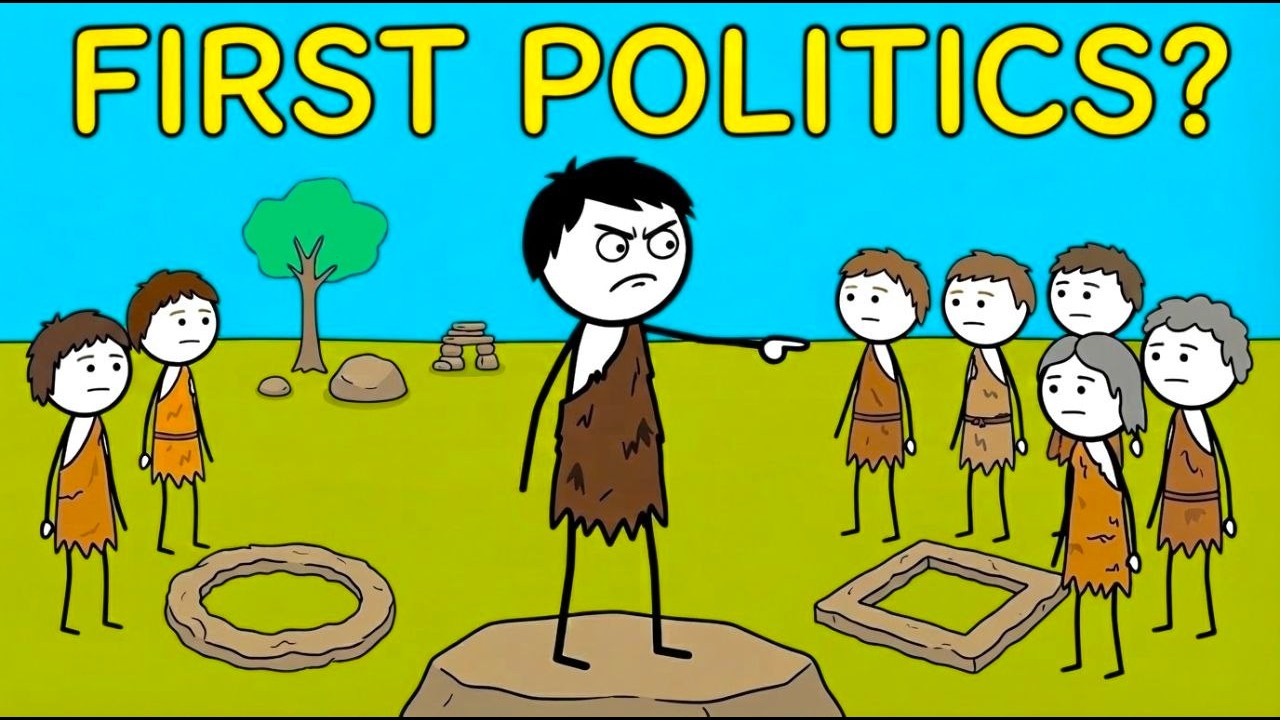
Primatologists have observed sophisticated political maneuvering in chimpanzee troops, including alliance formation, strategic betrayal, and displays timed to impress onlookers. This suggests that the common ancestor shared with chimpanzees likely engaged in similar behavior, meaning politics may predate the human species entirely. The major shift away from egalitarian structures came with the development of agriculture. Farming created surplus, which introduced a new problem: who controls the stored grain.
As settlements grew larger and resource management became more complex, informal influence gradually solidified into permanent, inherited authority. Archaeological evidence from early farming settlements like Çatalhöyük in modern-day Turkey shows these communities remained relatively equal at first, with no obvious palaces or elite quarters. However, over generations, this pattern repeated across Mesopotamia, Egypt, China, and Mesoamerica, with leadership emerging through competence and trust before crystallizing into hereditary kingship. Anthropologists note that this drift toward hierarchy appears to have been an emergent property of large-scale cooperation rather than a deliberate invention.
Yet, exceptions existed. Some early cities, including those of the Indus Valley Civilization, showed sophisticated urban planning and infrastructure with strikingly little evidence of rulers glorifying themselves. The emergence of written law marked a significant political development. The Code of Hammurabi, carved into stone around 3,700 years ago, publicly declared that even royal authority operated within a defined set of rules.
This represented a shift from raw power to power that claimed to operate according to principle. Ancient Athens introduced a different approach in the 5th century BCE, allowing a large portion of male citizens to vote directly in an assembly. While this system excluded women, enslaved people, and non-citizens, it was a deliberate attempt to structure collective decision-making without concentrating unchecked power in a single person. Family dynamics likely formed the first political arena, with negotiations over resources and decision-making within households providing the evolutionary basis for larger political structures.
The same instincts used in family disagreements remain the cognitive machinery behind coalition building and reputation management in modern workplaces and social groups. Some linguists and evolutionary anthropologists have proposed that complex language may have evolved partly to support political negotiation, including coalition building and tracking social obligations. Politics and language may have co-evolved over hundreds of thousands of years. Warfare and outside threats also accelerated political centralization.
Societies under constant danger from raiders benefited from decisive leadership that could coordinate defense quickly, trading some egalitarian flexibility for security during unstable periods. The Roman Republic offered another experiment in distributing power through checks, elected offices, and term limits. For centuries, it successfully balanced competing elite factions, but growing inequality and ambitious generals with loyal armies gradually eroded these safeguards, culminating in the one-man rule the system was designed to prevent. Ultimately, politics was never invented in a single moment.
It emerged continuously, extending back beyond our species, refined through hunter-gatherer consensus-building, and transformed by agriculture. The core challenge remains unchanged: how groups with different interests and opinions make decisions together without falling apart. This question was alive around Stone Age campfires, in Sumerian court intrigue, in Athenian assemblies, and in Roman political maneuvering.
It remains present in every family debate, office disagreement, and group decision made today.