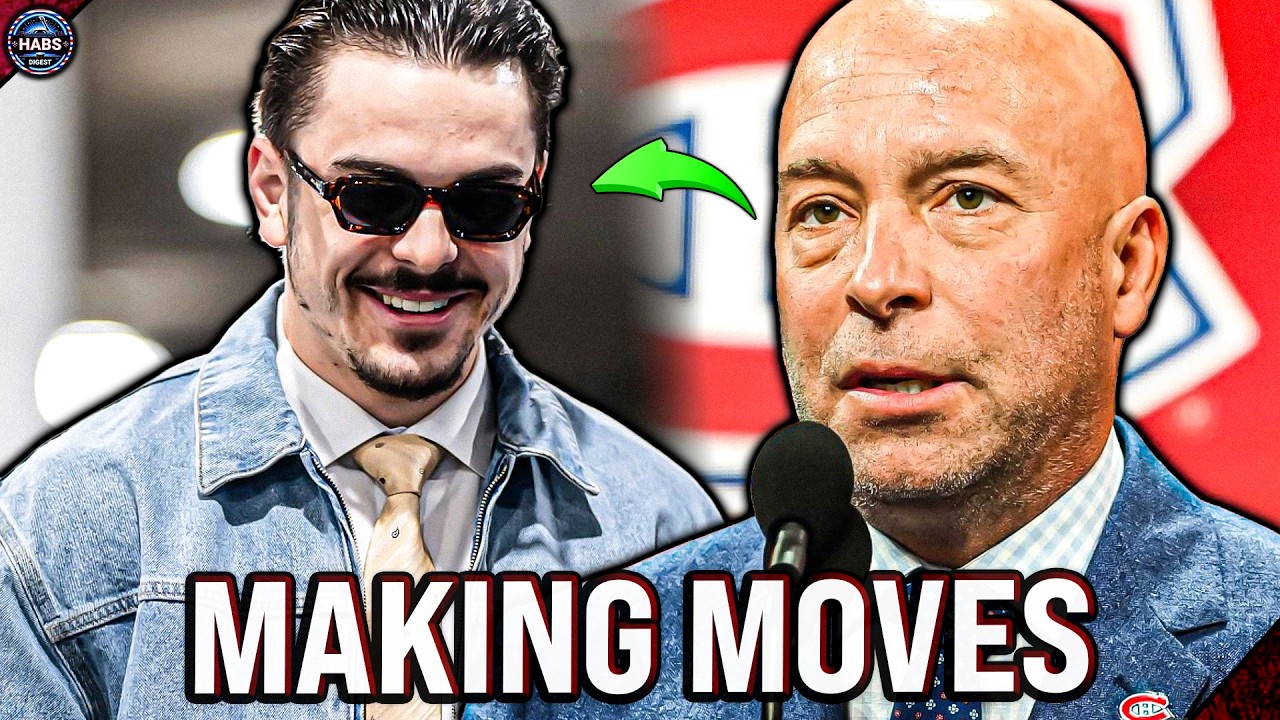
MONTREAL — The Montreal Canadiens have secured restricted free agent defenseman Arber Xhekaj on a one-year, $1.5 million contract, a move that carries far more weight than its modest financial figure suggests. The deal, finalized just days before the opening of training camp, ends weeks of speculation about the bruising blueliner’s future with the organization while simultaneously setting the stage for what promises to be one of the most fiercely contested roster battles in recent franchise history.
The timing is deliberate. General Manager Kent Hughes and his front office have been signaling for weeks that significant personnel decisions were imminent, with hints dropped during the team’s annual golf tournament that a resolution was near. Now that the ink has dried, the message is clear: Xhekaj has one year to prove he belongs in the Canadiens’ long-term plans, and the pressure could not be higher.
 Xhekaj, 24, has carved out a unique niche in Montreal since bursting onto the scene as an undrafted free agent out of the OHL’s Kitchener Rangers. His path to the NHL was never conventional, marked by relentless determination and a physical playing style that has made him a fan favorite at the Bell Centre. But the advanced analytics have never fully embraced his game, and the organization’s growing depth on the blue line means his roster spot is no longer guaranteed.
The contract structure is telling. By opting for a one-year bridge deal rather than a multi-year extension, the Canadiens are sending a direct challenge to Xhekaj. He will enter training camp not as an established veteran but as a player fighting for his professional life, competing against a wave of highly touted prospects including David Reinbacher and Adam Engstrom, both of whom are knocking loudly on the NHL door.
Head coach Martin St. Louis has historically been cautious with Xhekaj’s deployment, often sheltering him in limited minutes rather than trusting him in high-leverage situations. That hesitancy has fueled speculation about the defenseman’s long-term fit, and this season represents a critical juncture.
If Xhekaj cannot demonstrate consistent reliability in his own zone and show he can be trusted in late-game scenarios, his future in Montreal becomes increasingly uncertain.
The stakes are magnified by the current state of the Canadiens’ defense corps. Kaiden Guhle, expected to be a cornerstone of the unit, is currently sidelined with an injury that, while reportedly not long-term, will likely cause him to miss the start of the regular season. That opens a window of opportunity for Xhekaj to step into a more prominent role immediately, potentially logging between 12 and 18 minutes per night while Guhle recovers.
Xhekaj’s playoff performance last spring offers a compelling counterargument to his regular-season struggles. While his regular season was statistically modest, with four points and a minus-eight rating across 65 games, he transformed in the postseason. In the playoffs, Xhekaj recorded two points, a plus-five rating, 45 hits, and six blocked shots despite being deployed in limited minutes.
That dramatic swing in performance, a plus-13 differential in on-ice impact, has not been lost on the front office.
 The physical dimension of Xhekaj’s game remains his most valuable asset. In a league increasingly defined by speed and skill, his ability to punish opponents and change the tenor of a game through sheer force is a rare commodity. Teammates and coaches alike have noted that even among a roster that includes other physical presences like Josh Anderson and Samuel Bolduc, Xhekaj stands apart as the most intimidating hitter on the team.
But the underlying numbers tell a more complicated story. Xhekaj’s on-ice metrics, particularly his shot attempt share and expected goals, have lagged behind those of his defensive counterparts. Critics point to his defensive zone coverage and decision-making with the puck as areas that require significant improvement.
The Canadiens have responded by bringing in new coaching voices, including Derek Lalonde, to work with the defense corps and address these systemic issues.
The one-year term also provides Montreal with flexibility. If Xhekaj fails to seize the opportunity, his contract becomes a tradeable asset, potentially packaged in a deal to address other roster needs. If he excels, the Canadiens retain the right to negotiate an extension with a player who has repeatedly expressed his desire to remain in Montreal.
Xhekaj’s brother, Florian, is also in the organization, adding a personal dimension to his commitment to the franchise.
The roster picture is further complicated by the sheer number of expiring contracts on the team’s books. Players like Alex Carrier, Alex Newhook, Artturi Lehkonen, and Josh Anderson are all entering the final year of their deals, creating a logjam of players competing for long-term security. Xhekaj now joins that crowded field, knowing that his performance this season will directly determine whether he secures a future with the only NHL organization he has ever known.
 Training camp, which opens in just days, is expected to be an absolute bloodbath. The competition for defensive spots will be intense, with Xhekaj, Struble, Engstrom, and Reinbacher all vying for limited positions. The Canadiens’ depth, once a weakness, has become a strength, and that depth creates difficult decisions for the coaching staff.
Xhekaj’s path to this point has been defined by overcoming obstacles. He was never drafted, forced to earn his way through the minors, and had to fight for every opportunity at the NHL level. That resilience has become his calling card, and those who know him best believe he thrives when his back is against the wall.
This season represents the ultimate test of that character.
The Canadiens have made clear they believe in the culture they have built. They have the skill, the young talent, and the organizational vision to compete. What they need, according to the front office, is the physical edge that players like Xhekaj provide.
The question now is whether Xhekaj can round out his game enough to become a reliable everyday defenseman rather than a situational enforcer.
There is also the matter of the salary cap. The one-year, $1. 5 million deal leaves Montreal with significant flexibility, but that flexibility comes with expectations.
 The Canadiens are not simply treading water; they are positioning themselves for sustained contention. Every contract decision, including this one, is made with an eye toward the future.
For Xhekaj, the message from management is unmistakable. They believe in his potential, but they need to see tangible progress. They need to see him become a player who can be trusted in all situations, not just when the game gets physical.
They need to see him elevate his regular-season performance to match his playoff intensity.
The coming weeks will provide the first answers. Xhekaj will have every opportunity to prove himself during training camp and the early part of the season, particularly with Guhle sidelined. The competition will be fierce, and nothing will be handed to him.
But that is exactly how he has always wanted it.
The Canadiens have made their move. Now the ball is in Xhekaj’s court. One year to prove his worth, one year to secure his future, one year to show that he is not just a fan favorite but a foundational piece of a team with championship aspirations.
The stakes could not be higher, and the hockey world will be watching closely.